Top Digital Marketing and SEO Services in Kansas City: Your Go-To Agency for Web Design, WordPress, and Custom Solutions
An easier lead source can mean less control. When comparing Angi Ads with running your own Google Ads for home services, consider whether marketplace leads or campaign control better fits your business. Angi Ads can connect you with homeowners through a marketplace, while your own Google Ads campaign gives you more control over targeting and budget.
It’s reasonable to want more than a low cost per lead. An inquiry matters when it matches your services, becomes a booked job, and fits your team’s capacity. This comparison looks at lead sharing, job tracking, visibility, and the work each option requires.
Compare Angi Ads with managing your own Google Ads for home services by looking beyond inquiry counts. We’ll show you how to weigh each channel against your workload and decide where to focus.
Key Takeaways
- Compare lead sources by the jobs you book and their revenue, not just by the number of inquiries.
- Factor in lead sharing: a marketplace lead may reach other businesses, while your own Google Ads campaign gives you more control over targeting.
- Consider where each option can make your business visible and how customers find your services.
- Choose a channel that fits your team’s capacity to respond to leads and manage campaigns.
- Understand which factors shape advertising costs before deciding which approach fits your goals.
Booked jobs, close rates, and revenue tracking
Calls and Booked Job Tracking
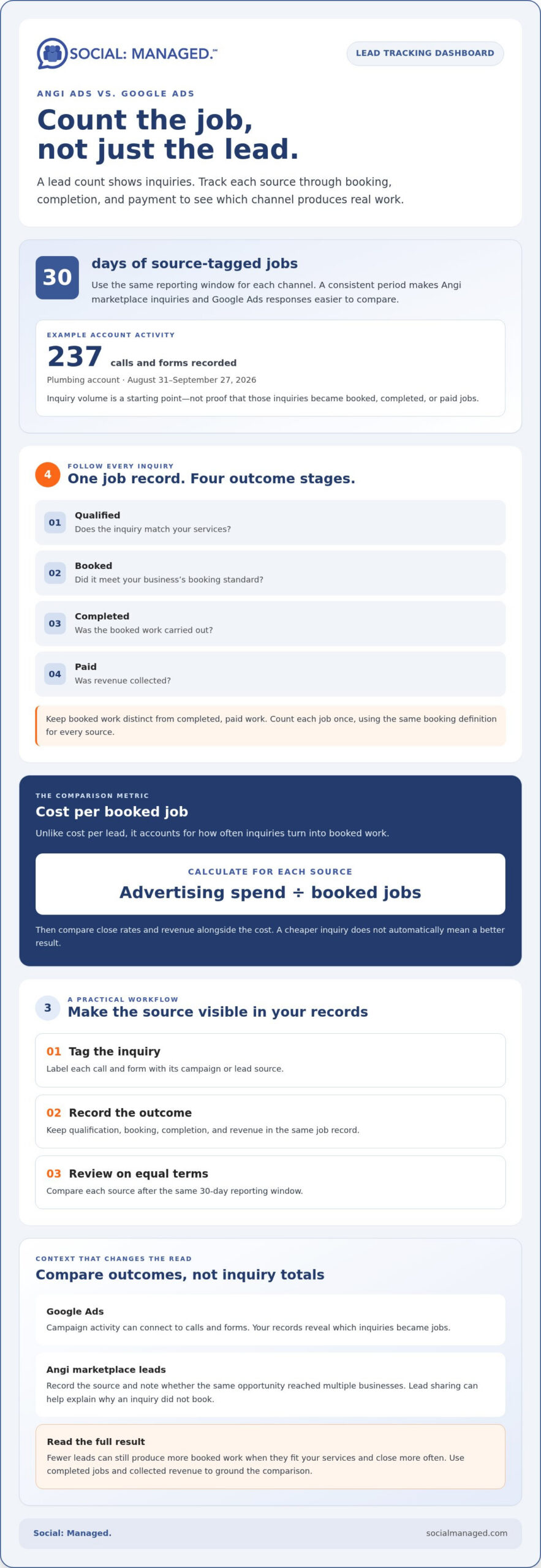
A lead count shows inquiries, not which campaign produced paying work. Track each call and form by source, then record whether it was qualified, booked, completed, and paid. For a practical comparison, use 30 days of source-tagged jobs. This makes Angi marketplace inquiries and Google Ads responses easier to assess using the same stages.
For example, a plumbing account recorded 237 calls and forms from August 31 to September 27, 2026. Those figures show why tracking should connect ad activity to job outcomes, rather than stopping at the first call or form.
Cost per Booked Job
Cost per booked job compares advertising spend with the number of jobs won. Unlike cost per lead, it accounts for close rate. The price of a lead alone hides this conversion gap.
Divide each source’s spend by its booked jobs over the same period. Keep the definition consistent: count a job once it meets your booking standard, and distinguish booked work from completed, paid work. Then compare close rates and revenue alongside cost per booked job, so a cheaper inquiry source doesn’t automatically appear more effective.
A useful tracking workflow is straightforward:
- Tag calls and forms with their campaign or lead source.
- Record qualification, booking, completion, and revenue in the same job record.
- Review each source after 30 days, using the same reporting window.
Google Ads can connect campaign activity to calls and forms, while your records show which inquiries became jobs. For marketplace leads, record the source and note whether the same opportunity reached multiple businesses. That context can explain why a lead did not book, without counting every unconverted inquiry as a successful result.
Use both conversion rate and revenue to interpret the comparison. A campaign with fewer leads can still produce more booked work if those leads fit your services and close more often. Likewise, a high inquiry count doesn’t prove stronger returns unless tracking connects it to completed jobs and collected revenue.
When comparing lead sources, home-service businesses should focus on cost per booked job, not cost per lead. That keeps the comparison centered on jobs won rather than inquiries generated. Apply the same booking definition and reporting period to each source, and distinguish conversions from booked jobs when reviewing results.
Treat that figure as a reference point for reported conversions, not proof that each conversion became a booked, completed, or paid job. Compare conversion costs with booked-job counts and resulting revenue before deciding which source performs better. This keeps lead-source decisions grounded in outcomes your business can verify in its own records.
Discuss a Tracking Plan for Your Home-Service Ads
Ad placement and platform visibility
Google Ads and Angi Ads put your business in different discovery settings. Google can reach people across several Google surfaces, while Angi centers visibility within its home-services marketplace.
Google Ads can appear on Google Search, Display, YouTube, Gmail, and Maps. Search campaigns can target keywords, so a plumbing business could focus on searches for a service in its area. An ad can send a potential customer to a website or landing page, where the business controls the information and next step.
That reach comes with more campaign choices. Google Ads supports multiple ad formats and keyword targeting, while placement depends on campaign setup and the search or audience context. A landing page gives the business room to explain its services, provide relevant details, and invite a call or form submission. The advertiser shapes the path from ad to inquiry.
Local Services Ads work differently from standard Google Ads. They can appear near the top of Google Search results and Google Maps for local service queries, even if a business has no website. The text-first format can make campaign setup simpler and reduce the need to build keyword lists. This can reduce the need to build keyword lists, but offers less control over ad format.
Visibility within Local Services Ads can be position-sensitive. These ads capture an average of 13.8% of all clicks, and the first-position ad receives more than twice the clicks of ads in positions two or three. Those figures describe Local Services Ads, not Angi Ads or every Google campaign. They illustrate why placement and competition matter alongside the platform itself.
Angi Ads uses a marketplace model, unlike Google’s multi-surface ad network. Homeowners using Angi are already exploring home-service options there, but a marketplace inquiry may be shared with other businesses. By contrast, Google Search targeting lets advertisers shape which queries and locations should trigger an ad. The channels therefore differ in both discovery context and control.
To decide which visibility fits, map the customer’s path:
- Choose Google Search when keyword and geographic targeting matter.
- Consider a landing page when customers need service details before contacting you.
- Compare marketplace inquiries with search-driven calls and forms by their source.
Google discussed bringing ads into AI Overviews at Google Marketing Live in May 2024. That announcement shows how Google placements can evolve, but it doesn’t change the core decision: choose the platform based on where your customers search and how much control you need over targeting and the next step.
The page says many home service contractors with $1M-$3M in revenue hit a ceiling in Local Service Ads visibility when they lack substantial Google review volume.
Google Ads supports keyword targeting and multiple ad formats, while Local Services Ads uses a simplified, text-first format and automatically determines relevant keywords. Local Services Ads can appear without a business website, while Google Ads is generally used to drive traffic to a website or landing page. Local Services Ads target local customers searching for specific services in a defined area. Google Ads and Local Services Ads can work together to reach customers at different stages, from research to immediate service needs.
Choosing a channel by business size and capacity
The right channel depends on more than company size. Match lead volume and campaign control to the people, schedule, and service area your business can support. Choosing between Angi Ads and managing Google Ads yourself also depends on who can handle inquiries and campaign tasks.
A solo contractor with limited office support may prefer a simpler source of inquiries. A marketplace can put the business in front of homeowners already looking for services, but shared leads may require prompt follow-up and clear availability. If calls come in while you’re on a job, extra inquiries can become missed opportunities rather than booked work.
Running Google Ads yourself gives you more control over targeting, campaign settings, and lead volume, but it requires regular attention. Home-service campaigns need weekly review, especially during their first months. Without time to assess search terms, locations, and lead quality, a business may struggle to manage the campaign alongside field operations.
Response capacity matters as much as campaign management. A Harvard Business Review study found that companies contacting a lead within an hour were roughly seven times more likely to have a meaningful conversation than companies that waited longer. Set a process before increasing lead volume: assign who answers calls, returns missed inquiries, and records outcomes. If one person handles all three, growth needs to fit that person’s schedule.
Use these signals to assess fit:
- Choose a simpler lead flow if your team can handle inquiries but has limited time for weekly campaign work.
- Favor self-managed Google Ads if someone can regularly adjust targeting and review campaign performance.
- Limit added demand if your schedule is full or service coverage is narrow.
- Reassess account strategy when monthly advertising spend reaches $25,000 or more.
Treat that threshold as a prompt to review strategy, not a universal recommendation to spend more. A business at that level should examine how campaigns divide budget, locations, and service categories. Smaller businesses can apply the same logic by checking whether current leads fit available crews and profitable services.
Google’s marketing-plan example sets a goal of 30 new customer leads per month. Treat that as an example, not a forecast for every contractor. A roofing company with several crews may welcome that volume, while a solo plumber might need fewer inquiries. Capacity changes what a useful target looks like.
Before choosing between Angi Ads and running your own Google Ads for home services, note your service area, open appointment capacity, and who owns lead response. Then choose an approach your team can sustain, with enough time to handle inquiries and campaign decisions.
Benefits and risks of running Google or Meta Ads
Contractors weighing Angi leads against self-managed Google Ads should consider lead sharing, campaign oversight, and follow-up capacity. Marketplace inquiries may reach other businesses, while managing Google Ads yourself means taking responsibility for targeting decisions and ongoing campaign work.
Google Ads can put a plumbing company in front of homeowners searching for a specific repair. Location targeting can narrow campaigns to ZIP codes, and bids can be adjusted for towns producing the strongest jobs. This control helps align visibility with service areas, but broad targeting or weak campaign settings can attract inquiries from outside the company’s useful territory.
That control also brings a management burden. Google Ads campaigns need weekly attention, especially during their first months. Review search terms, locations, and incoming lead quality, then refine settings when the data shows wasted reach. Without this routine, a campaign can keep generating clicks without clearly showing which searches lead to real work.
Meta Ads play a different role. A plumbing contractor can use Facebook or Instagram to introduce a service to homeowners who may not be searching for it at that moment. This can support awareness, but the ad and creative must earn attention before a homeowner expresses immediate intent. For businesses seeking inspiration on producing compelling visual assets for their campaigns, agencies like frameworkcreative.co.uk illustrate how professional media can help capture interest. Don’t treat views or clicks as proof of demand: track inquiries and booked work.
Remarketing also needs service-specific judgment. For emergency services, avoid remarketing because customers typically hire someone within 24 hours. A homeowner with a burst pipe is unlikely to wait for repeated reminders. For non-emergency projects, such as a planned bathroom renovation, follow-up advertising may have a different purpose, but the campaign still needs a clear audience and useful message.
Angi’s marketplace model reduces the need to build a full advertising campaign, but shared leads can mean competing for the same opportunity. Contractors should account for the possibility that another business will contact the homeowner too. The practical risk is poor fit: if service coverage, availability, or response routines don’t match incoming inquiries, lead volume alone won’t solve the problem.
Before committing, make a short operating plan:
- Set the towns or ZIP codes your crews can serve.
- Assign who answers new calls and follows up on missed inquiries.
- Track lead source, qualified inquiries, booked jobs, and revenue separately.
- Review campaign settings weekly and pause targeting that brings unsuitable requests.
The central tradeoff is control versus simplicity. Angi can provide marketplace exposure, while self-managed Google Ads offers more direct control over targeting and campaign decisions. Meta can broaden awareness, but it requires a message that earns attention. For companies exploring paid social campaigns, specialists such as Web Bridge can help craft the digital content and messaging needed to engage audiences effectively. Choose a channel your team can manage and measure, then use job outcomes to guide what you change.
Contact Social: Managed to Discuss Your Ad Strategy
How does Angi Ads pricing work for home service businesses?
Angi Ads is part of a home-services marketplace where businesses compete for homeowner inquiries. The available facts establish that leads may be shared, but not Angi’s exact billing formula. Don’t assume its charges follow Google Ads or Local Services Ads: Google Ads uses pay-per-click, while Local Services Ads uses pay-per-lead.
That distinction affects what to measure. With Google Ads, clicks can incur costs before a homeowner calls or submits a form. For any marketplace lead source, evaluate the inquiries you receive and how many become booked jobs. Shared leads can affect close rates because other businesses may contact the same homeowner. The meaningful comparison is cost per booked job, not just the initial lead count.
Build a comparison from your own records rather than an assumed industry rate. For each source, track:
- Advertising spend over the same reporting period.
- Inquiries received and which ones fit your services.
- Booked jobs, completed work, and revenue tied to each source.
- Whether an inquiry was shared or reached your business directly.
For example, if a plumbing company records marketplace inquiries separately from Google campaign calls, it can see how each source performs through booking and payment. Divide each source’s spend by its booked jobs to calculate cost per booked job, then compare revenue and close rate. A lower cost per lead may still result in a higher cost per booked job if fewer inquiries convert.
Before setting a marketplace budget, decide how many additional inquiries your team can answer and serve. A contractor with limited appointment capacity should weigh the risk of paying for leads that cannot be handled promptly. A business with available crews may value added opportunities, if its records show those inquiries turn into worthwhile work. The right budget depends on lead quality, service area, available capacity, and conversion performance.
With Google Ads, control also means managing click costs and campaign settings. The business can shape targeting and review which searches generate inquiries, but it must track spending against booked outcomes. Local Services Ads follow a separate pay-per-lead model, which doesn’t establish Angi’s pricing. Keep each channel’s charges and job results distinct.
Use a consistent review period, such as 30 days, and compare source-tagged jobs. This gives you a practical basis for adjusting spend, rather than reacting to one expensive or unproductive lead. If Angi inquiries produce booked work at a sustainable rate, the channel may suit your capacity. If not, shift attention toward sources with stronger job-level results.
Social: Managed: Search Engine Optimization
Social: Managed. helps home-service businesses improve organic visibility through Search Engine Optimization. It can be a natural next step when paid campaigns generate leads but you also want homeowners to find useful service pages through search. SEO focuses on your website’s relevance and visibility, while Google Ads puts paid campaigns in front of selected audiences.
For example, a plumber can build service pages around the repairs and locations the business actually serves, then give each page a clear call to action. Social: Managed. also offers Digital Marketing and Google Ads, which can complement an SEO strategy when your goals include both organic and paid visibility. We can help create a coordinated plan to improve how customers discover your business and assess which channels bring relevant inquiries.
Contact Social: Managed. to discuss your home-service marketing goals.
Make Your Next Marketing Move With Purpose
Choosing between Angi Ads and running your own Google Ads for home services is an operating decision, not a permanent commitment. As your crews, service area, and booking capacity change, review whether your lead strategy still fits the work you want. Keep a clear record of what your team can handle and use it to guide future campaign decisions.
Social: Managed can bring your next steps together through Digital Marketing, Search Engine Optimization, and Social Media Management. This support can help when you’re ready to build visibility beyond a single lead channel and take a more coordinated approach to customer discovery. A clear plan keeps marketing activity aligned with the services and jobs your business wants to grow. Keep your goals practical, your tracking consistent, and your next step focused on the work your team is ready to take on.

Ready to get started? Reach out to Social: Managed. online, or call us at 866-324-9700. We manage your company’s social life so you can have one! You don’t need complicated packages. We listen to your goals.
Then we design and manage SEO, social media, ads, websites, and email campaigns built to deliver results. No jargon. No guesswork. Just real growth from a team that cares. Ready to get rolling? Follow Social: Managed. on Facebook for a peek into our social life.