Top Digital Marketing and SEO Services in Kansas City: Your Go-To Agency for Web Design, WordPress, and Custom Solutions
What if the biggest cost of an email marketing platform isn’t the subscription, but the time your team spends running campaigns? The decision in Constant Contact vs managed email marketing agency services is about more than choosing a tool. Constant Contact gives your team a platform, but your team still needs to plan campaigns, prepare content, manage the list, and review results. A managed service adds people and campaign support, helping bring strategy and execution together.
Software can be a practical option when your team wants direct control and has time to manage email in-house. But if campaigns are inconsistent or keep slipping behind other priorities, access to a platform may not be enough.
This comparison weighs control, workload, expertise, and the support your campaigns need. You’ll see what a software-led approach involves, what managed email marketing can include, and how to choose a model that suits your team. Social: Managed. provides email marketing and campaign management that can coordinate with your wider digital marketing.
Key Takeaways
- Constant Contact provides email campaign tools, while a managed service can take on agreed campaign responsibilities.
- Compare Constant Contact vs managed email marketing agency services by looking beyond platform access to the time, skills, and strategic support your team needs.
- Use your campaign schedule, staff capacity, and approval process to decide whether you need software, execution support, or both.
- A self-managed approach can work well when your team has time to plan, create, send, and review campaigns.
- Social: Managed. offers email marketing and campaign management, with services tailored to the needs you select.
Constant Contact vs. managed email marketing: what are you actually choosing?
The main difference is who handles the campaign work. Constant Contact is a software platform businesses can use to create and send email campaigns. Managed email marketing is a service model in which a team takes on agreed campaign responsibilities, using email technology as part of the work. The Constant Contact Wikipedia page offers background on the company, but your practical decision is about how your own campaigns will get done.
With software, your business remains responsible for deciding what to send, preparing each campaign, and following through. With an agency, you can delegate selected tasks while keeping others in-house. Neither model is automatically the right one. The fit depends on your campaign needs, internal skills, and the time your team can consistently commit.
What does email marketing software help a business do?
Email software gives a business a place to build and send campaigns. Before choosing a platform or plan, investigate the features that matter to your process: How easy is it to edit an email? Do the templates suit your brand? What list-management and reporting tools are provided? Can automation support the follow-up your campaigns require?
Tools can support the work, but they don’t decide who to contact, write the message, or determine what to do with the results. For example, a team might use a template for a monthly update, but someone still needs to choose the content, check its accuracy, manage the send, and review whether the message served its purpose. Software can organize the process; your business still has to operate it.
What does a managed email marketing service change?
A managed service adds people and campaign support to the technology. The agreed scope can cover strategy, content, campaign coordination, or performance review. Define the responsibilities around what your team wants to retain and where outside support would be useful.
That scope can be set for a project or ongoing work. A business might delegate a specific campaign task or coordinate recurring email activity with its wider digital marketing. Hiring support doesn’t mean handing over every decision. Your team can set priorities and approve the work while a partner takes responsibility for selected execution.
So, Constant Contact vs managed email marketing agency services is ultimately a decision about ownership, not just access to tools. If your team has the time and skills to manage each campaign step, software may be enough. If planning and execution keep slipping behind other priorities, delegating defined work can add capacity without requiring your business to manage every detail itself.
Schedule a Free Consultation with Social: Managed.
How software-led and agency-managed email campaigns get done
A campaign takes more than a send button. Someone needs to set the goal, gather accurate information, prepare the content, and review what happened after the email goes out. Software gives your team a way to carry out these steps, but it doesn’t make the decisions or complete the work automatically. That distinction is central to understanding Constant Contact vs managed email marketing agency services.
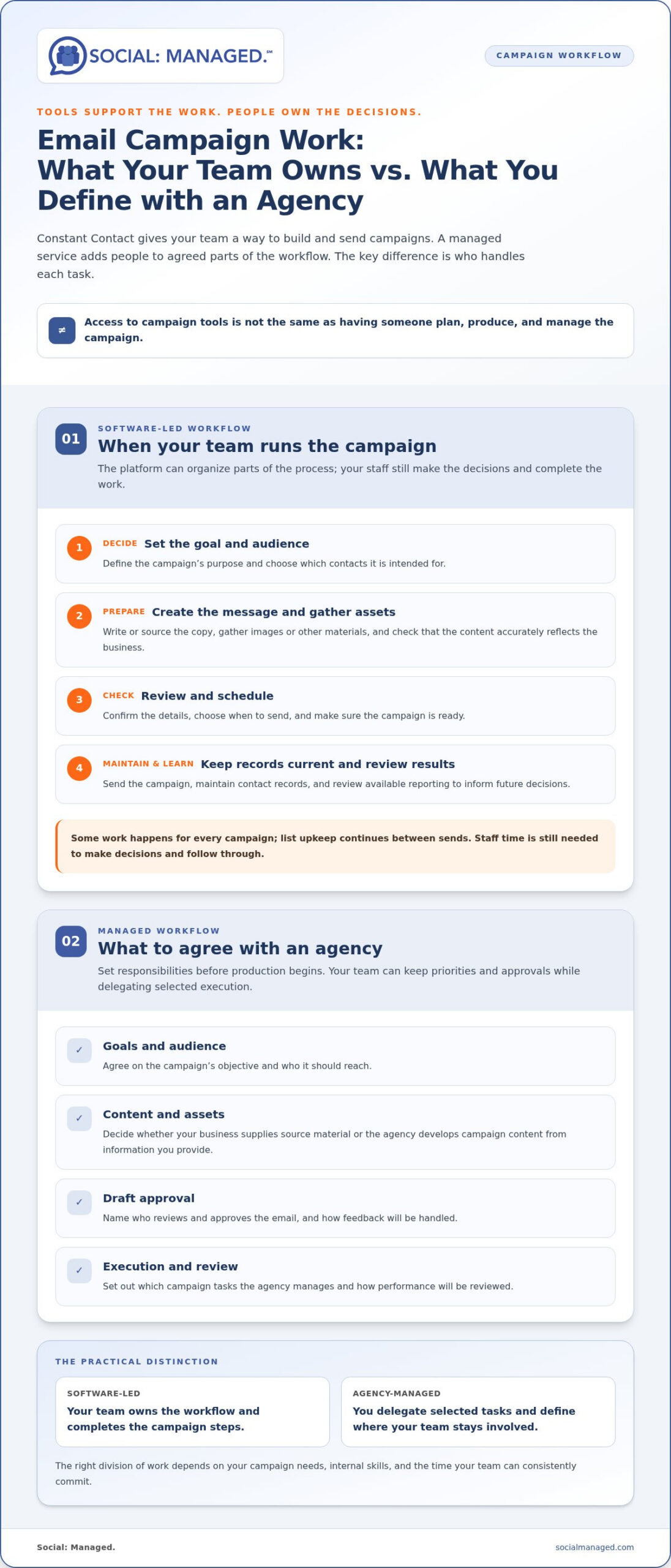
Access to campaign tools is not the same as having someone plan, produce, and manage the campaign. In a self-managed setup, your team owns the workflow. With an agency, you agree on which steps the agency handles and where your team stays involved.
The work a business owns when it uses software
For an in-house campaign, start by choosing an audience and a clear purpose. A product update, event invitation, and customer newsletter each need different information and messaging. Your team must decide what readers need to know and gather accurate details before drafting the email.
- Set the goal and audience. Define the campaign’s purpose and choose which contacts it’s intended for.
- Prepare the message and assets. Write or source the copy, gather images or other materials, and check that the content accurately reflects the business.
- Review and schedule. Confirm the details, choose when to send, and make sure the campaign is ready.
- Maintain and learn. Keep contact records current, send the campaign, then review the available reporting to inform future decisions.
Some steps happen for every campaign; others, such as list upkeep, continue between sends. A platform can help organize parts of the process, but staff still need time to make decisions and complete the work. If one person handles email alongside several other responsibilities, even a straightforward campaign can compete with those priorities.
The work to define when an agency manages email
An agency relationship begins with alignment, not simply handing over a login. Your business and the agency need a shared understanding of the campaign’s purpose, intended audience, division of work, and approval process. Clear responsibilities help both sides know what’s expected before production begins.
- Goals and audience: Agree on the campaign’s objective and who it should reach.
- Content and assets: Decide whether your business supplies source material or the agency develops campaign content from information you provide.
- Draft approval: Name who reviews and approves the email, and how feedback will be handled.
- Execution and review: Set out which campaign tasks the agency manages and how performance will be reviewed against agreed objectives.
The scope can cover a defined project or ongoing campaign work. It should make ownership clear without implying that every decision moves outside your business. Your team can retain control of key messages and approvals while delegating selected planning or execution tasks. To discuss your email campaign needs, get in touch with Social: Managed.
Constant Contact vs. an agency: compare control, workload, and support
Choosing between Constant Contact and an agency means weighing who owns the campaign work, not simply comparing a platform with a service. Software may be enough if your team can plan, create, send, and review campaigns consistently. If that work strains your capacity, an agency can take on agreed tasks while your business retains its voice, priorities, and approval authority.
The trade-off is internal control and hands-on workload versus delegated campaign work and added guidance. The approaches can also work together: a business can keep using its email platform while bringing in support for strategy or execution. The right arrangement depends on what your team needs to retain and what it has capacity to manage.
Ownership
With software, your team owns the campaign process. With an agency, responsibilities are shared according to the agreed scope.
Team time
In-house work requires staff time for planning, writing, production, sending, and review. Managed support can shift selected tasks to the agency, while your team still provides input and approvals.
Strategic input
Your internal team leads strategy when managing campaigns itself. Agency support can add outside planning and coordination shaped around your business goals.
Control
Self-management keeps day-to-day decisions close to your team. A managed relationship delegates execution without requiring you to give up business decisions or final approval.
Support
A platform provides software tools, while your team supplies the labor and judgment to use them. An agency adds people to the process, with support defined by the work you agree to delegate.
When an email platform may fit an in-house team
A platform-led approach can suit a team with the time and skills to own its email workflow. If staff can set campaign priorities, write or source content, prepare sends, and review results as part of their regular responsibilities, managing campaigns directly may be a practical fit. It also suits businesses that prefer straightforward workflows and want day-to-day decisions to stay inside the team.
Be realistic about capacity, not just capability. Your team may know how to create a campaign but lack consistent time to do it. Consider whether email work gets completed on schedule without displacing other priorities. That practical answer matters more than assuming software alone will remove the workload.
When managed support may fit better
Managed support can help when campaign tasks repeatedly compete with other work or when email needs to align with broader marketing activity. An agency can take responsibility for agreed planning, production, or coordination while your team provides business context and approves the work. This keeps your expertise in the process without requiring staff to handle every execution detail.
Scope matters. A software subscription and an agency service cover different things, so compare what each includes rather than treating them as like-for-like costs. In Constant Contact vs managed email marketing agency services, the practical question is whether your team needs access to tools, help carrying out campaigns, or a combination that fits its capacity. Managed support can add structure and expertise, but it doesn’t guarantee a particular campaign result.
Choose an email marketing approach using your team’s real constraints
The best-fit model depends less on your business size than on the work your team can reliably handle. A platform may be enough if campaign planning, production, and review already fit into people’s roles. If those tasks keep getting delayed, outside support may address the workload gap. Choose a setup that matches your actual process, not an ideal version of it.
Questions to answer before choosing
Map the current workflow from planning to reporting. Name who sets campaign priorities, writes or supplies the content, approves drafts, schedules sends, and reviews results. Then consider how often campaigns go out and whether the people responsible have the time and skills to maintain that schedule.
- Time: Does email work consistently get space on the team’s schedule, or does it get pushed aside?
- Frequency: How often do you need to communicate, and can your current process support that pace?
- Skills: Does the team feel equipped to plan campaigns, prepare content, and interpret performance reports?
- Approvals: Can the right people review drafts promptly, or do sign-offs routinely slow progress?
- Ownership: Which decisions and tasks should remain in-house, and which would you prefer to delegate?
Your answers help clarify whether you need software access, hands-on execution help, or both. Your team can continue using its existing platform while bringing in support for selected work. That preserves internal control over business decisions while adding capacity where it’s needed.
Match the support model to your business stage
A small team might value relief from recurring campaign tasks, while a staffed marketing department may prefer to manage execution itself. Neither situation dictates the choice. A lean team with strong email skills and enough dedicated time may be comfortable working in-house; a larger team can still need outside coordination if responsibilities are spread across departments.
For a growing business, consider how email connects with the rest of your marketing. A campaign might reinforce a website update or align with social media messaging. If keeping those touchpoints consistent is becoming difficult, coordinated digital marketing planning in Kansas City can help bring channel activity into a shared approach. The right support should reflect the coordination your team needs, not simply add more activity.
As you weigh Constant Contact vs managed email marketing agency services, write down what you want to own, what you want help with, and how approvals will work. That gives you a practical basis for comparing a self-managed setup with a tailored service arrangement. Revisit the plan when campaign needs or team capacity change. Click here to discuss email marketing support for your team.
How Social: Managed. supports businesses that want managed email marketing
For businesses that want help putting email campaigns into motion, Social: Managed. provides email marketing and email campaign management as part of coordinated digital marketing support. The scope is shaped around your needs rather than a one-size-fits-all package. With a transparent build-your-own fee structure, you select the services relevant to your priorities.
Email can also support a business’s other marketing activity. A campaign might reinforce a website message or support a social media initiative. Social: Managed. serves Kansas City businesses and surrounding communities, including Overland Park, Olathe, and Leawood, and can coordinate email planning with a broader digital approach.
What working with Social: Managed. can look like
First, the team aligns campaign support with your objectives and selected scope. Experienced Brand Managers provide a point of connection, and direct communication helps keep responsibilities clear. The collaboration can focus on the email work you want handled and the business decisions or approvals you want to retain.
Services are available on a monthly retainer or project basis. A project can address a defined need, while ongoing support can provide a structure for continued campaign work. Monthly performance reviews create a regular opportunity to discuss campaign activity and consider next steps in light of your objectives. They support informed review, not a promise of a particular result.
Discuss the right email marketing support for your business
A useful conversation starts with a clear picture of your current process. Bring the goals you’re working toward, the campaigns you expect to run, and a sense of where your team spends time. It also helps to identify who currently supplies content, approves drafts, and handles reporting. These details make it easier to explore a scope that fits how your business operates.
You don’t need to arrive with every task already mapped. Explain what’s working, where email work gets stuck, and what you’d prefer to keep in-house. Social: Managed. can use that context to discuss relevant campaign support and how it may coordinate with your wider digital marketing. The conversation is about defining an appropriate scope, not promising specific performance outcomes.
In the Constant Contact vs managed email marketing agency services decision, managed support is worth considering if you want experienced help with selected campaign work while keeping your business involved in priorities and approvals. Start with your real needs, then explore an arrangement that reflects them.
Choose a model that can grow with your next priorities
Your email setup doesn’t have to be permanent. As campaign needs shift or team responsibilities change, the right balance of in-house ownership and outside support may change too. Treat Constant Contact vs managed email marketing agency services as a decision to revisit when your workload, priorities, or internal capacity changes, rather than a choice you must get right forever.
A useful next step is to note which campaign tasks take the most effort and where delays tend to happen. That gives you a practical starting point for deciding whether to keep the current process, delegate selected work, or adjust how your team and agency share responsibilities. You’ll have a clearer basis for a conversation focused on your actual needs, not a one-size-fits-all package. Choose the support that makes email manageable for your team today, and give yourself room to adapt as your business evolves.
Let’s Discuss Your Email Marketing Goals
Frequently Asked Questions
Is Constant Contact enough for a small business’s email marketing?
It can be, if the business’s campaign needs are manageable with its current setup. Choose one recurring email, such as a monthly customer update, and map the steps from draft to send. Notice whether the process is repeatable and whether the team can keep contact information accurate. If the workload or campaign requirements change, reassess the setup rather than assuming it must stay the same.
Can an email marketing agency work with Constant Contact?
An agency can work within an existing Constant Contact account when that fits the agreed workflow. Before work begins, clarify account ownership, user access, and who handles the platform subscription or contact-data changes. Also agree on how drafts and final versions will be shared, so your team can find the approved campaign record later. These details help keep the process organized without making a platform change the starting point.
What does a managed email marketing agency do?
A managed email agency takes on defined campaign tasks, with the exact work shaped by the agreement. Scope details might include a campaign calendar, copy drafts, template preparation, audience recommendations, or post-send review. Assign each responsibility clearly rather than assuming every service includes the same work. That clarity helps you understand what your team will receive and what it must provide.
How do I decide between email marketing software and an agency?
Review a recent campaign as a practical test. Note which steps took the most effort, where work paused, and which tasks required specialist input. Then separate needs that call for software access from those that call for added labor or expertise. This audit can reveal whether the main gap is a tool, a process, or available capacity, giving you a more grounded basis for choosing support.
Does hiring an email marketing agency mean giving up control?
No. You can set clear brand guidelines, specify who has final approval, and decide who can access campaign materials. For example, document preferred language, claims that need review, and the person authorized to approve a send. These working rules help protect your brand and reduce confusion as tasks move between your team and an agency. Delegating execution doesn’t require delegating decisions about your business.
Can an agency manage email campaigns alongside other marketing services?
Yes. Social: Managed. offers email marketing alongside services such as social media management and search engine optimization. To coordinate the work, define the role each channel should play in a campaign. An email may carry more detail about an offer, while a social post introduces it. Agreeing on the core message and timing helps keep activity connected without making every channel identical.
How is managed email marketing scoped and billed?
Social: Managed. offers services on a monthly retainer or project basis, using a build-your-own fee structure based on selected services. Before work starts, make the scope specific: identify deliverables, review responsibilities, and any content or materials your team will supply. This gives both sides a clear reference for what the arrangement covers and helps avoid treating platform fees and agency work as the same expense.

Ready to get started? Reach out to Social: Managed. online, or call us at 866-324-9700. We manage your company’s social life so you can have one! You don’t need complicated packages. We listen to your goals.
Then we design and manage SEO, social media, ads, websites, and email campaigns built to deliver results. No jargon. No guesswork. Just real growth from a team that cares. Ready to get rolling? Follow Social: Managed. on Facebook for a peek into our social life.