
Top Digital Marketing and SEO Services in Kansas City: Your Go-To Agency for Web Design, WordPress, and Custom Solutions
A strong e-commerce email program is measured by more than how often a store sends messages. For online stores in Olathe, email marketing services for e-commerce in Olathe should connect campaigns to sales reporting and make messages more relevant through audience segmentation. This gives business owners a clearer way to assess email’s contribution and understand how different customer groups respond.
Email should do more than fill an inbox. Revenue attribution depends on tracking how campaigns and automated messages relate to orders, while personalization starts with useful distinctions among customers, such as their interests and buying behavior. Without these foundations, a busy sending calendar can be difficult to evaluate and may produce generic messages.
This guide explains how an e-commerce email marketing agency can measure campaign-related revenue, build audience segments, and tailor messages across the customer journey. It also covers what to look for in an agency and how email can work alongside other digital marketing, so you can understand the strategy and decide where to begin.
Key Takeaways
- Assess email performance by tracing how campaigns and automated messages contribute to orders, not just by counting sends.
- Build audience segments around customer interests and behavior to make campaign messages more relevant.
- Evaluate platform support based on how your store, email data, and reporting needs fit together.
- Use automated abandoned-cart and post-purchase messages to support shoppers at key points in their buying journey.
- Consider how email marketing and search engine optimization can work together to support broader e-commerce growth.
Revenue attribution and ROI
Email revenue attribution connects campaign activity with customer orders. For an Olathe e-commerce store, that means tracking which messages a shopper received, what they clicked, and whether they later purchased. A clear process distinguishes email’s contribution from other influences, such as a paid ad or a returning customer’s direct visit. Attribution is a decision-making tool, not proof that one message caused every sale.
Start by defining what counts as email-attributed revenue. One report might credit an order when a customer clicks a campaign link before purchasing; another model may also count a later purchase after an email view. The attribution window and rules can change the result. Keep settings consistent across reports and document them so campaign comparisons remain meaningful.
Then connect sales data with campaign performance. Review attributed orders alongside revenue, conversion rate, average order value, and unsubscribes. Compare a promotional send with an automated welcome message, or examine whether a custom offer performs differently for first-time and repeat buyers. Mature email programs are benchmarked at 20 to 40 percent of total e-commerce revenue, but that range is a reference point, not a target for every store. Product mix, list quality, purchase frequency, and other sales channels affect the result.
For a practical review, set a baseline before changing campaign strategy. Track the same metrics before and after a test, and record the audience, message, offer, and timing. Evaluate whether an agency can show measurable ROI within 30 to 90 days, while recognizing that useful measurement depends on clean tracking and enough purchase activity. If revenue rises but discounts deepen, compare order value and margin before deciding the campaign improved performance.
For commercial email in the United States, CAN-SPAM provides the relevant framework. Include truthful sender and subject information, a working unsubscribe option, and a process for suppressing opted-out addresses in campaign reviews. These steps help keep compliance and list hygiene visible.
Deliverability, analytics, and list growth are connected, but each needs its own measure. A service plan may review sending reputation and bounce patterns, configure campaign tracking, and assess signup forms or consent-based list growth. These tasks relate to inbox placement, attributed sales, and the quality of new subscribers. Ask how reports connect these measures to store orders instead of relying on opens alone.
Olathe and Kansas businesses can explore small-business advising or grant programs as potential sources of digital marketing support. Eligibility and allowable expenses vary. First define the work, such as analytics setup or email campaign planning, then compare it with the program’s stated purpose.
Contact Social: Managed. for E-Mail Campaign Assistance
Segmentation and personalization
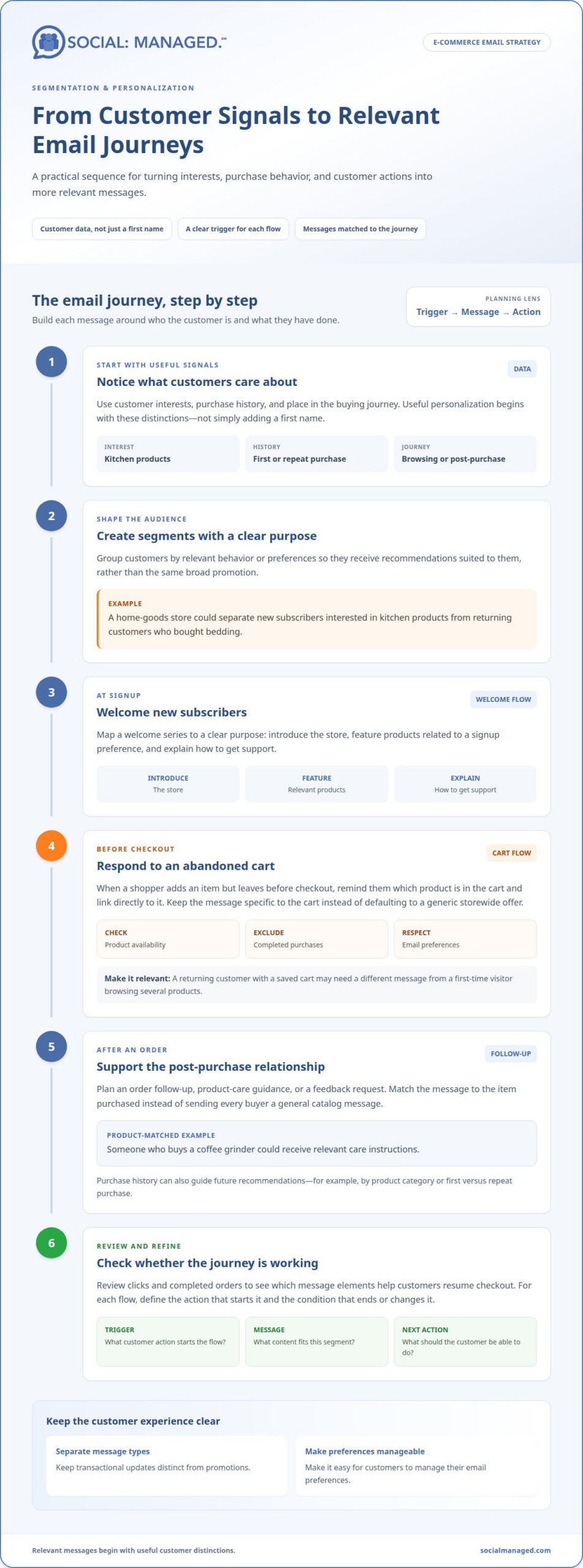
Useful personalization starts with customer data, not just a first name. For an Olathe store, segments might reflect product interests, purchase history, or a shopper’s place in the buying journey.
Email Automation
Email automation uses customer actions or profile details to trigger relevant messages. A welcome series, for example, can introduce the store, feature products related to a signup preference, and explain how to get support. An agency can map each message to a clear purpose, then review its timing, content, and audience rules. Look for workflows that adapt when a customer purchases or changes preferences.
Segmentation makes those workflows more specific. A home-goods store might separate new subscribers interested in kitchen products from returning customers who bought bedding. Each group can receive different recommendations instead of the same broad promotion. Before building a flow, define the customer action that starts it and the condition that ends or changes it.
Abandoned-Cart Campaigns
An abandoned-cart campaign responds when a shopper adds an item but leaves before completing checkout. A message can remind them which product is in the cart and link directly to it. The content should reflect the cart rather than default to a generic storewide offer. Product availability, completed purchases, and the shopper’s email preferences should guide who receives each message.
Segmentation can make the reminder more relevant. A returning customer with a saved cart may need a different message from a first-time visitor browsing several products. An apparel store, for example, could feature the selected item and relevant sizing information without recommending unrelated products. Review clicks and completed orders to see which message elements help customers resume checkout.
Post-Purchase Campaigns
Post-purchase messages begin after an order and can support the next stage of the customer relationship. An agency might plan an order follow-up, product-care guidance, or a request for feedback. Match the content to the item purchased. Someone who buys a coffee grinder, for example, could receive relevant care instructions instead of a general catalog message.
Purchase history can also guide future recommendations. Segment customers by product category or first versus repeat purchase, then send messages suited to each group. Keep transactional updates distinct from promotions, and make preferences easy to manage. This helps keep follow-ups relevant instead of treating every buyer as though they made the same purchase.
For a focused plan, map each segment to its trigger, message, and intended customer action. A review of email campaign planning can help clarify which flows suit your store and its customer journey.
Which email marketing agencies serve e-commerce businesses in Olathe, Kansas?
Olathe businesses can consider e-commerce agencies across the Kansas City market, then assess their email-specific work. A Kansas City directory lists 89 e-commerce digital marketing agencies based in the area. That figure covers the broader e-commerce agency pool, not email-only specialists. A business comparing email marketing services for e-commerce in Olathe should focus on relevant store experience, campaign capabilities, and the support its team needs.
Agency size offers context, but it doesn’t establish fit. The median employee size of Kansas City e-commerce digital marketing agencies is 1-10 employees as of Nov 6, 2026. The Kansas City directory lists 71 agencies with 1-10 employees, 15 with 11-50 employees, and 3 with 51-200 employees. These categories give a sense of the teams businesses may encounter.
To assess an agency’s fit, examine what it handles from planning through reporting. Find out whether the team develops campaign calendars, writes email content, manages automations, and tracks outcomes related to store sales. An Olathe retailer with a growing catalog, for example, may need ongoing campaign support. A smaller shop may prioritize foundational setup and a few customer journeys.
Look for e-commerce context in an agency’s examples. A useful case study explains the store’s challenge, the changes made, and how performance was assessed. Consider whether the work involved a similar sales model, such as seasonal products or repeat purchases. A broad digital marketing portfolio can show creative range, while email-specific examples reveal how an agency approaches audience strategy and execution.
Clarify the working relationship before selecting a partner. Establish who plans campaigns, approves messaging, manages audience data, and shares reporting. Kansas City agencies average 4.7 contacts per company as of Nov 6, 2026, but that market figure doesn’t identify your day-to-day contact. A defined point of contact and review process can make responsibilities clearer from the start.
Choosing email marketing services for e-commerce in Olathe should start with your store’s priorities. If campaign performance is difficult to interpret, look for clear reporting methods. If messages feel generic, consider how the agency builds segments from customer interests and behavior. The right fit aligns campaign support with your sales model, customer journey, and internal capacity, rather than adding sends without a clear purpose.
One agency a store might compare is ICS Creative Agency. Its background alone does not show whether its email work fits an Olathe store’s needs. Review relevant e-commerce examples and clarify which campaign tasks the agency would handle.
Compare that range with the proposed scope, including planning, content, automation, and reporting, before deciding whether it fits your store. Clarify what the work includes and how ongoing support would align with your team’s priorities.
Supported Platforms: Shopify, Klaviyo, and Mailchimp
Shopify, Klaviyo, and Mailchimp serve different roles in an e-commerce email setup. Shopify is the store platform, while Klaviyo and Mailchimp are commonly used for email marketing. For an Olathe business, the practical question is whether the selected tools can work together with customer, product, and order data. Platform names alone don’t show how well an agency will manage that connection.
Start by mapping the information each campaign needs. A message recommending a related product depends on usable product and customer details. A post-purchase follow-up needs the order event to reach the email platform. Whether the setup uses Shopify, Klaviyo, or Mailchimp, clarify which system holds each piece of information and how it moves between systems.
Integration quality affects segmentation and automation. An apparel store, for example, may want separate messages for shoppers interested in different product categories. The email platform needs reliable category or purchase data to build those audiences. Review how the integration handles missing, duplicated, or outdated records. A clear process for resolving data issues helps prevent irrelevant messages and inconsistent campaign reporting.
Address account access and data ownership before any transition. Document who controls the Shopify store, email platform, subscriber records, templates, and tracking settings. If an agency changes, those details can help preserve campaign history and ongoing workflows. Clarify how campaign approvals work and where performance reports are stored, so operational knowledge isn’t held by only one person.
Platform support should include testing, not just an initial connection. A practical launch check follows a test subscriber from signup through the intended welcome message. A separate test order can show whether purchase information reaches the right workflow. Confirm that links open the intended store pages and that the campaign displays correctly on common screen sizes. These checks can catch handoff problems before a wider send.
For a store choosing between Klaviyo and Mailchimp, start with actual campaign needs rather than assumed feature lists. Write down the audience segments, automations, and reporting questions the business relies on. Then compare how each proposed setup supports those tasks alongside Shopify. An agency’s explanation should connect each tool to a specific workflow, such as signup, purchase follow-up, or campaign measurement.
Useful platform support means the systems work together across one coherent customer journey. A signup can lead to an introductory series, while a later order informs relevant follow-up. Keep the setup understandable, assign ownership for data and approvals, and document key workflows. Those steps make Shopify, Klaviyo, and Mailchimp easier to assess as parts of an e-commerce operation, rather than isolated software choices.
Do Olathe agencies provide email automation, abandoned-cart, and post-purchase campaigns?
These are established campaign types in e-commerce email marketing, and businesses in Olathe can include them in an agency’s project scope. What matters is how each flow fits the store’s customer journey. A campaign plan should identify the event that starts a message, the audience that qualifies, and the action that ends or changes the sequence.
Automation planning starts with a trigger and a clear purpose. A new subscriber might receive a welcome message, while a product-view event could inform a later recommendation. An agency can map each workflow, write its messages, and configure audience rules. Ask how the plan handles customers who qualify for multiple flows, such as a new subscriber who also places an order.
Abandoned-cart campaigns need accurate cart status. A reminder should reflect the items a shopper left behind, then stop if checkout is completed. If a customer buys the product after the first reminder, for example, later messages should not keep urging them to purchase it. The campaign plan should also define the message sequence, offer rules, and how performance will be assessed.
Post-purchase campaigns focus on the experience after an order. An agency might coordinate an order follow-up, product guidance, or a review request. A skincare store, for example, could send care instructions relevant to the product purchased. The workflow should distinguish product education from promotions and account for repeat purchases before recommending another item.
Before launch, test each campaign with realistic customer scenarios. Place a test order, complete checkout, and confirm that the abandoned-cart flow stops. Then check whether the post-purchase message uses the correct product details. Review links, audience exclusions, and unsubscribe handling too. These steps can catch practical errors, such as a buyer receiving a reminder for an order already completed.
After launch, review each flow separately instead of judging all automated email together. Compare delivered messages, clicks, orders, and unsubscribes across the welcome, cart, and post-purchase journeys. If a cart reminder gets clicks but few orders, review the landing page and checkout experience. If a post-purchase message gets engagement, assess whether its content serves buyers without overwhelming them.
A useful agency scope names the trigger, audience, message sequence, exclusions, testing process, and reporting for every flow. That structure makes responsibilities clear and gives the store a practical way to refine campaigns. For support planning automated e-commerce email campaigns, discuss your campaign needs.
Social: Managed. and Search Engine Optimization
Social: Managed. can connect email marketing with Search Engine Optimization when your store needs to attract shoppers before they join your mailing list. Search visibility can bring potential customers to relevant product and category pages, while email supports follow-up with subscribers. The channels serve different stages of the customer journey, so they work best when their roles and messaging are clear.
Consider this approach if your store wants to strengthen discovery and customer communication. Social: Managed. also offers Digital Marketing and Social Media Management to support a coordinated online presence. A conversation can focus on your priorities, such as improving product-page visibility or aligning search content with email campaigns.
Build a More Connected Growth Plan
Decide how email should support your store’s broader growth priorities. The right email marketing services for e-commerce in Olathe can fit into a plan that also considers how shoppers discover your products and stay connected with your brand. Social: Managed. offers Search Engine Optimization, Social Media Management, and Digital Marketing to help businesses coordinate these efforts. This can be useful when you want email campaigns to complement search visibility and social content rather than operate as a separate channel.
Start with a priority, such as improving product discovery or communicating more effectively with existing customers. A focused discussion can help shape an approach around your goals and current marketing efforts.
Your next step can be clear and manageable: build from the priority that matters most to your store.
Get Your E-Mail Campaing Rolling With Social: Managed.
Frequently Asked Questions
What Makes a Top eCommerce Email Marketing Agency?
A strong agency ties its recommendations to the store’s business model and marketing priorities. For example, a store with seasonal inventory needs campaign planning that accounts for product availability and changing promotions. Look for clear ownership of strategy, creative, implementation, and reporting. Communication matters too: your team should understand what is changing, why it matters, and how the work supports your e-commerce goals.
What email marketing services do Olathe agencies offer for online stores?
Services can include campaign planning, email content, audience targeting, automation, and performance reporting. The right scope depends on whether an Olathe store needs help with one campaign or ongoing email work. Social: Managed. offers Email Marketing alongside Search Engine Optimization, Social Media Management, and Digital Marketing. This lets businesses consider email as part of a broader plan for reaching and engaging online shoppers.
How do Olathe email marketing agencies compare in e-commerce expertise, reviews, and results?
Compare agencies by the relevance and clarity of their evidence, not ratings alone. A useful case study explains the store’s situation, the work performed, and the outcomes measured. Reviews can add context about communication and project management, while campaign examples show an agency’s approach to e-commerce. In Olathe, consider how that experience applies to your product range, sales cycle, and team’s approval process.
How can an e-commerce business choose and hire an email marketing agency in Olathe?
Start by writing down the business need, such as improving communication with repeat customers or organizing campaign work. Then discuss your store platform, current email process, approval workflow, and reporting expectations with the agency. Ask for a proposed scope that names responsibilities and deliverables. Before work begins, agree on who supplies product details, who approves messages, and how results will be reviewed. This creates a practical starting point for a partnership in Olathe.

Ready to get started? Reach out to Social: Managed. online, or call us at 866-324-9700. We manage your company’s social life so you can have one! You don’t need complicated packages. We listen to your goals.
Then we design and manage SEO, social media, ads, websites, and email campaigns built to deliver results. No jargon. No guesswork. Just real growth from a team that cares. Ready to get rolling? Follow Social: Managed. on Facebook for a peek into our social life.