Top Digital Marketing and SEO Services in Kansas City: Your Go-To Agency for Web Design, WordPress, and Custom Solutions
What if a therapy website could help someone feel more confident about reaching out before they ever speak with you? For practices considering website design for therapists and counselors in Leawood, trust starts with clear information, a welcoming tone, and an easy next step.
A professional site should explain your services and who you work with without promising outcomes your practice can’t guarantee. It should also work smoothly on a phone and make essential details easy to find. This guide explains what to assess before choosing a design approach, from page structure and mobile usability to local search and the inquiry process.
We’ll cover practical ways to communicate your specialties, create a more accessible browsing experience, and help visitors decide whether to get in touch. We’ll also explain how design can work alongside useful content, photography, and search optimization. The goal is a clear, reassuring website that reflects your practice and gives visitors a practical next step.
Key Takeaways
- Use clear service and therapist pages to help visitors understand whom the practice serves and what to explore next.
- Compare website options by considering the control, effort, and flexibility each approach offers your practice.
- Plan a redesign in stages, from setting goals and organizing content to reviewing the finished site before launch.
- Strong website design for therapists and counselors in Leawood can reflect local search intent through useful location and contact details.
- Consider how design, SEO, content, photography, and video can work together to create a cohesive online presence.
What Should a Leawood Therapist Website Help Clients Do?
For a practice owner, the challenge is personal: explain the care you offer in a way that feels clear and welcoming, not impersonal or overly polished. Your website should introduce your services, help visitors decide whether the practice may suit their needs, and make it easy to choose a next step. For people comparing options in Leawood and across Johnson County, clear information can shape their first impression before they contact you.
A therapy practice website is more than a digital brochure. It’s an introduction that helps visitors understand the practice and decide what to do next. Prioritize useful information over broad claims. A strong site doesn’t promise a particular outcome. It gives prospective clients a grounded sense of the practice’s focus, people, and process.
How can a website make a counseling practice feel approachable?
Start with plain language. Describe services and areas of focus in terms prospective clients can understand, and explain whom the practice works with. Clear descriptions help visitors find relevant pages without having to interpret clinical jargon. For example, a service page can explain the concerns it addresses and what an initial conversation involves, without making claims about results.
Visual choices also set the tone. A warm, consistent identity, from colors and typography to photography, can reflect the practice’s character without feeling generic. Therapist biographies add context: include relevant credentials, describe each therapist’s approach in accessible terms, and use a professional, natural voice. These details introduce the people behind the practice without making clinical promises.
Good web design brings visual choices together with usability and accessibility. We consider how layout and content help people find information, rather than treating appearance as the only measure of quality. A thoughtfully structured website design project can build those priorities into the experience from the start.
What should a prospective client find first?
Make the essentials easy to spot: services, intended audiences, therapist information, practice location, and contact options. Visitors shouldn’t have to search several pages to learn whether the practice serves people like them or where it’s based. Describe the Leawood location accurately and include practical details that help someone understand where the practice is and how to reach it.
Keep the next step visible and low-pressure. A clear contact or scheduling option can invite action without demanding it. Use straightforward labels and explain what happens after someone submits an inquiry, based on the practice’s actual process.
Mobile-friendly navigation matters because prospective clients may be researching from a phone. Menus should be easy to use on a small screen, text should be comfortable to read, and contact options should be simple to access. Test the main pages on a phone, including the service information, biographies, and inquiry form, so visitors can focus on whether they’d like to learn more.
Schedule a Free Consultation with Social: Managed.
Which Website Design Features Matter for Leawood Therapists and Counselors?
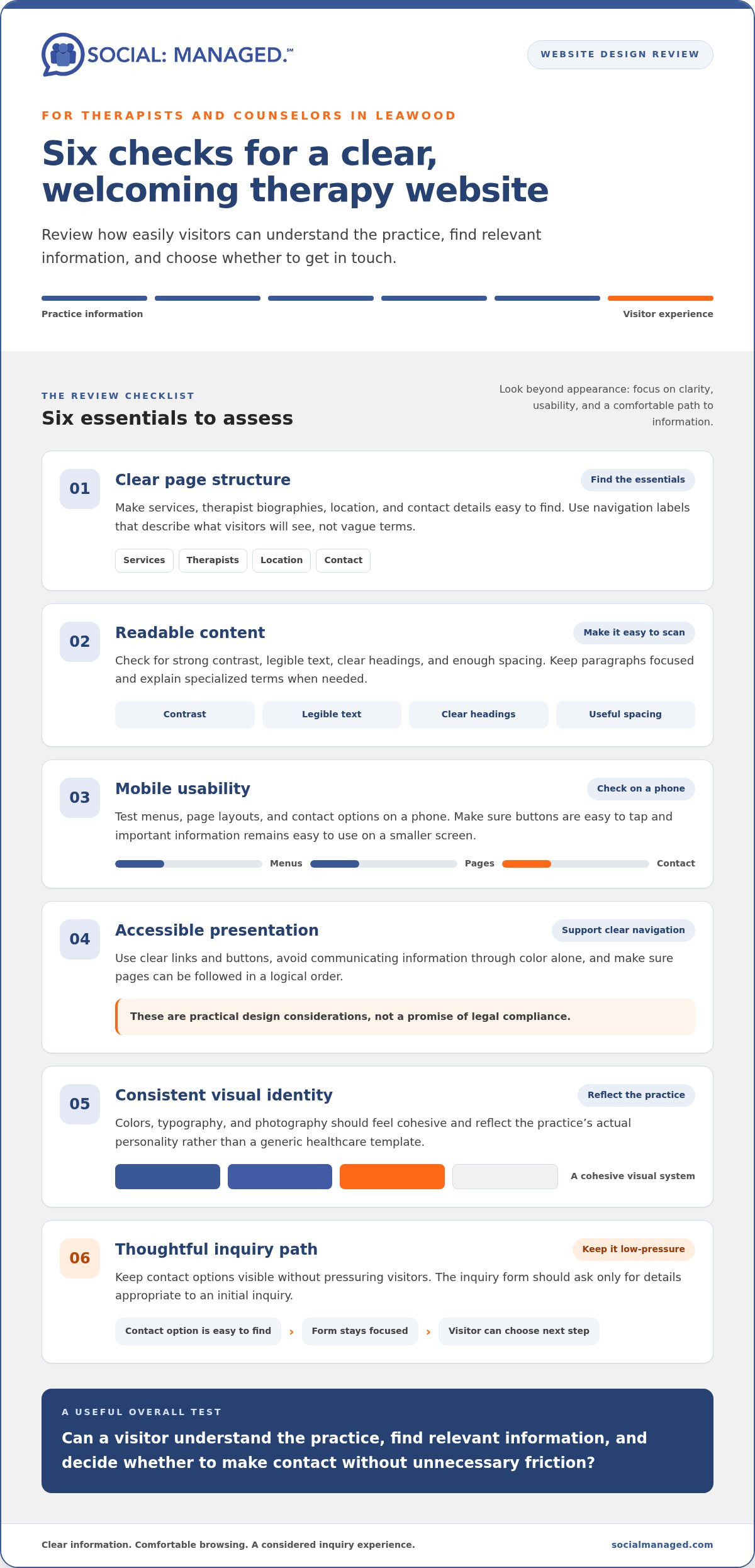
A useful design review goes beyond color and layout. Check whether the site helps a prospective client understand the practice, move between relevant pages, and make an informed choice about contacting you. For website design for therapists and counselors in Leawood, use this checklist to assess how well the site serves both visitors and the practice.
- Clear page structure: Services, therapist biographies, location, and contact details should each be easy to find. Navigation labels should describe what visitors will see, rather than use vague terms.
- Readable content: Look for strong contrast, legible text, clear headings, and enough spacing to make pages comfortable to scan. Keep paragraphs focused and explain specialized terms when needed.
- Mobile usability: Test menus, page layouts, and contact options on a phone. Buttons should be easy to tap, and important information shouldn’t disappear or become difficult to use on a smaller screen.
- Accessible presentation: Check that links and buttons are clear, information isn’t communicated through color alone, and pages can be followed in a logical order. These are practical design considerations, not a promise of legal compliance.
- Consistent visual identity: Colors, typography, and photography should feel cohesive and reflect the practice’s actual personality rather than a generic healthcare template.
- Thoughtful inquiry path: Contact options should be visible without pressuring visitors. The form should ask only for details appropriate to an initial inquiry.
How should therapy services and therapist biographies be presented?
Give each service its own page when visitors need more than a brief overview to understand it. Use plain-language headings and explain the service, its intended client population, and the therapist’s approach. Separate therapist biographies also help visitors compare relevant backgrounds without searching through one long page.
Keep each biography accurate and grounded in information the practice can support. Include relevant qualifications and a clear description of the clinician’s approach, but avoid guarantees about treatment outcomes or claims beyond the practice’s experience. Custom design can give these pages a clear structure while keeping the experience consistent across the site. Our Kansas City website design work is tailored to each project’s needs and goals, including projects for businesses in Leawood, Overland Park, and Olathe.
What makes an inquiry path clear and privacy-conscious?
Make contact details and inquiry options easy to locate on both desktop and mobile pages. Keep forms focused: an initial message may need a way to respond and a simple prompt, rather than a detailed account of someone’s personal circumstances. Clear instructions can explain what information to share and what to expect next.
Privacy and compliance decisions deserve careful review. Website design alone can’t establish that forms, tools, or information practices meet the requirements relevant to a practice. Review those choices with appropriate qualified advisors before launch. If you’re planning a redesign, talk with our team about your project and the design priorities you’d like to address.
How to Compare Website Design Options for a Leawood Counseling Practice
The right approach depends on what the practice needs to explain, how much time you can invest, and how much flexibility you want later. A site can look polished and still leave visitors unsure which service fits or how to take the next step. Compare options by how well they support the visitor’s journey, not by appearance alone.
Use this framework to connect common practice needs with the capabilities each approach may offer:
| Practice need | DIY builder | Customized template | Custom design |
|---|---|---|---|
| Simple set of pages | Can be a practical starting point if you’re comfortable building and maintaining the site. | Offers a prepared structure with room for selected adjustments. | Can be tailored, though a simple site may not need extensive customization. |
| Distinct services or audiences | Depends on the builder’s available layouts and your time to organize them. | Can work if its page structure accommodates the practice’s content. | Allows page structure and navigation to be shaped around the practice’s needs. |
| Mobile experience | Requires careful setup and testing across screen sizes. | Uses a starting design that still needs review on phones and tablets. | Can prioritize mobile layouts as part of the design process. |
| Future editing and growth | You manage updates within the platform’s tools. | Editing is shaped by the template and its available options. | Can be planned around the practice’s likely content and editing needs. |
When might a template be enough, and when is custom design useful?
A template may suit a practice with a small, straightforward site and limited customization needs. It provides a framework, but the practice still needs to make its services clear and test how pages work on mobile. Custom design may be useful when services need distinct page journeys, the brand needs a more specific expression, or the site should coordinate with broader marketing.
There’s no single right platform or scope for every practice. Consider who will update the site, how much content needs to be organized, and whether the structure can adapt as the practice changes. Compare how a proposed design handles an actual service page, therapist biography, and inquiry path. Those examples reveal more than a homepage preview alone.
What should you evaluate in a website design partnership?
Look for a clear project scope, direct communication, and a shared process for reviewing content and design. Ask how the site structure will support visitor needs and future editing. At Social: Managed., we coordinate custom website design with content, SEO, photography, and video capabilities, so these elements can support a consistent experience rather than feel like separate pieces.
Experience is another useful point of comparison. Founder David Alexander’s previous firm built more than 1,000 websites. That describes the firm’s past work, not a promise about results for a new project. For website design for therapists and counselors in Leawood, weigh that background alongside the proposed scope, communication approach, and how progress will be reviewed and reported. If you’re weighing options for your practice, share your website goals with our team to discuss a project scope tailored to your needs.
How to Plan a Therapist Website Redesign in Leawood
A focused redesign starts with decisions, not colors. Before reviewing layouts, decide what the site should communicate and what visitors should be able to do. For website design for therapists and counselors in Leawood, a clear plan also connects practice information with the questions people may have as they look for care nearby.
What should a practice prepare before design begins?
Take inventory of the current site and gather source material in one place. Note which pages are useful, which are outdated, and what visitors still need to know. Assemble current service descriptions, clinician biographies, approved brand assets, and frequently asked questions. Existing website analytics, if available, can help show which pages people visit and where they may leave.
Choose the primary inquiry action, such as submitting a contact form, and identify any secondary actions the site should support. Then plan photography and other creative needs. Current, approved images can help the site feel specific to the practice. If new visual assets are needed, include that work in the project plan.
How can a redesign move from goals to launch?
Use a sequence that keeps decisions manageable and gives the practice opportunities to review the work:
- Clarify goals: Decide what the site needs to explain and which visitor actions matter most.
- Gather content: Assemble accurate service details, clinician information, brand materials, and relevant analytics.
- Map pages: Group information into a straightforward structure, such as service pages, clinician profiles, location details, and contact information.
- Design: Develop the visual system and page layouts around the content and the experience visitors need.
- Review: Check page accuracy, navigation, mobile layouts, links, and inquiry paths with the practice team.
- Launch and monitor: Publish the approved site, then review available performance data to guide future updates.
Assign clear owners for content approval and design feedback. A shared review process helps prevent late-stage surprises, such as a service page without approved copy or contact details that don’t match across pages.
How can local search fit into website planning?
Use accurate, consistent practice location and service-area details wherever they help visitors understand where care is offered. A Leawood practice should make its location and contact information easy to find. Page titles and content should describe the practice’s actual services in natural language. Organizing pages around real services helps visitors and search engines interpret the site, but no structure can guarantee rankings.
Local visibility also needs attention after launch. We coordinate website structure with search optimization and review measurable reporting over time. Our Kansas City SEO work can support practices serving Leawood, Overland Park, Olathe, and the wider Kansas City area as their content and priorities evolve. Click here to plan your therapist website redesign with our team.
How Social: Managed. Can Build a Website for a Leawood Therapy Practice
A therapy practice website should reflect the care and professionalism of the people behind it while making key information easy to understand. At Social: Managed., we build custom websites around each project’s goals, audience, content, and visitor actions. For website design for therapists and counselors in Leawood, that means shaping the site to the practice rather than squeezing it into a one-size-fits-all structure.
What does a coordinated website project involve?
We begin by aligning the site structure with the practice’s services and the information prospective clients need. Visual identity, page content, and inquiry paths should work together. For example, a service page can explain the practice’s focus, introduce relevant clinicians, and give visitors a clear way to learn more or get in touch.
Our custom website design and development can include WordPress when it fits the project’s requirements. The platform is one part of the decision. Content, editing needs, and planned features also help shape the approach. We work with the practice to identify priorities and define what the site needs to accomplish.
Design can also coordinate with content, SEO, photography, and video. Consistent language and creative assets help the website feel unified, while search-focused structure makes its information easier to interpret. Our Kansas City website design work brings these considerations into project planning for businesses in Leawood, Overland Park, Olathe, and the wider Kansas City area.
Experience informs the work, but it isn’t a guarantee of results. Founder David Alexander’s digital and web experience dates to 2001. His previous firm was named a Top 25 Website Designer in Kansas City by Ingram Magazine. We pair that background with direct communication and a tailored scope, keeping decisions and priorities clear throughout the project.
What happens after the website launches?
Launch is a milestone, not the end of a website’s usefulness. As the practice evolves, its services, team information, or priorities may change, and the site may need updates to stay accurate. Ongoing SEO and coordinated marketing can support continued local visibility. Reporting can help the practice review performance without treating rankings, inquiries, or revenue as guaranteed outcomes.
We provide real-time reporting and monthly performance reviews. These touchpoints give us and the client a regular opportunity to review available results, discuss priorities, and identify possible adjustments. Clear communication keeps ongoing work connected to the practice’s goals. For Leawood practices considering a new site, we can discuss goals, priorities, and a project scope tailored to the work ahead.
Take the Next Step Toward a Website That Fits Your Practice
A useful time to improve your website is when you can identify what visitors need to understand or do more easily. Start with one practical priority, such as clarifying a service, updating clinician information, or simplifying the inquiry process. That focus can shape a useful project scope without requiring every part of the site to change at once.
For website design for therapists and counselors in Leawood, a thoughtful partnership can turn those priorities into a clear plan. We tailor each project to the practice’s goals and connect design decisions with the content and marketing support that make sense for its next stage. Social: Managed. received the 2019 UpCity National Excellence Award, recognition of our commitment to serving clients with care and professionalism. Your practice has its own voice and priorities. With a focused plan, your website can express them clearly and welcome prospective clients to take the next step.
Schedule a Free Consultation About Your Practice’s Website
Frequently Asked Questions
What should a therapist website include?
A therapist website should give visitors the information they need to decide whether to learn more about the practice. Include service and clinician details, along with practical answers about how appointments work, accepted payment methods, and what happens after someone submits an inquiry, where the practice can provide those details. Keep the information current. A short, useful answer can prevent confusion before someone makes contact.
How much does website design for a therapy practice cost?
Cost depends on the project’s scope, including the number of pages, the level of design customization, and whether content or creative assets are part of the work. A focused site with a simple structure differs from a project with multiple service pages and tailored features. We offer website design on a project basis or monthly retainer, with the fee shaped around the practice’s goals and the work involved.
How long does it take to design a therapist website?
There isn’t one timeline that fits every practice. The amount of content, number of pages, design decisions, and pace of feedback can all affect the schedule. To prepare, assign someone to approve copy and design, collect current materials early, and consolidate feedback before sending it. These steps can help the project move steadily, while timing depends on its scope.
Can a therapist website help attract clients in Leawood?
A well-organized site can help people evaluating local options understand a practice’s focus and find a useful next step. That’s the role of website design for therapists and counselors in Leawood: support clear communication and make relevant practice information easier to discover. Local SEO can complement the site for practices serving Leawood and nearby Kansas City communities, including Overland Park and Olathe. No website can guarantee inquiries or rankings.
Should a therapist use WordPress for their website?
WordPress can be a suitable choice if its flexibility aligns with the practice’s content and editing needs. A practice that expects to update clinician profiles or publish educational pages, for example, may value a platform that supports ongoing content changes. Also consider who will maintain the site and handle updates. Choose based on the project’s requirements, not platform popularity alone.
How can a therapy website protect prospective clients’ privacy?
Start by limiting inquiry forms to information needed to respond, and make it clear what visitors should avoid sharing through a general contact form. Review how form submissions are stored, who can access them, and which third-party tools handle the information. Privacy and compliance depend on the practice’s specific tools and processes, so have qualified advisors review those decisions. Design choices alone can’t establish compliance.
Should therapists combine website design and SEO?
Combining them can align the site’s structure and content with the questions prospective clients use to find and evaluate services. SEO planning can inform page organization and descriptive titles, while design keeps those pages easy to use. Practices in Leawood, Overland Park, Olathe, and the wider Kansas City area can also review local details for accuracy. SEO supports visibility over time, but it doesn’t guarantee search placement or new clients.

Ready to get started? Reach out to Social: Managed. online, or call us at 866-324-9700. We manage your company’s social life so you can have one! You don’t need complicated packages. We listen to your goals.
Then we design and manage SEO, social media, ads, websites, and email campaigns built to deliver results. No jargon. No guesswork. Just real growth from a team that cares. Ready to get rolling? Follow Social: Managed. on Facebook for a peek into our social life.