Top Digital Marketing and SEO Services in Kansas City: Your Go-To Agency for Web Design, WordPress, and Custom Solutions
What if your nonprofit’s marketing could make every message, channel, and campaign work toward the same mission? A marketing plan for non-profit organizations in Overland Park starts with that alignment, not a longer list of tasks.
When time is limited, social posts, emails, and fundraising appeals can feel disconnected. Without clear goals, it can also be hard to tell whether those efforts are reaching donors, volunteers, or the people your organization serves. A focused plan helps your team choose what matters most and make progress easier to evaluate.
This guide will help you set mission-aligned objectives, identify distinct local audiences, and choose realistic channels for each. You’ll also learn how to define useful measures and revisit your approach as you see what’s working. From search and email to social media and paid advertising, the goal isn’t to do everything. It’s to connect your mission with the right people through a coordinated, manageable plan.
Key Takeaways
- Build a marketing plan for non-profit organizations in Overland Park around mission priorities, specific audiences, and the actions you want people to take.
- Audit your current communications, digital assets, audience feedback, and team capacity before setting objectives.
- Choose website, SEO, social media, email, and paid advertising based on audience needs and campaign goals, not trends.
- Use a practical planning process to set focused priorities that fit your team’s time and resources.
- Decide what your team can manage internally and where coordinated digital support and performance reviews could help you evaluate progress.
What a nonprofit marketing plan in Overland Park should accomplish
A marketing plan for non-profit organizations in Overland Park is a mission-led roadmap for deciding whom to reach, what to communicate, which channels to use, who is responsible, and how to evaluate progress. It gives day-to-day communications a clear purpose, so each effort supports an organizational priority rather than adding activity for its own sake. A plan can guide awareness, program participation, donations, volunteer engagement, or community education.
Marketing and fundraising plans are related, but they aren’t interchangeable. A fundraising plan focuses on securing financial support, while a marketing plan covers how the organization communicates across its broader goals and audiences. Their aims overlap when a campaign explains a program’s impact and invites supporters to donate. The marketing plan can clarify the audience, message, and channel; the fundraising plan can shape the giving goal and donor approach.
A formal plan also connects research, objectives, and implementation. Reviewing the components of a marketing plan can help your team organize these elements into a coherent process, then adapt them to your organization’s mission and capacity.
Start with mission and the change your organization wants to create
Use your mission and strategic priorities to set boundaries. Decide which needs and outcomes your communications should support, then name the audience actions that could move them forward: applying for a program, referring a family, volunteering, donating, or learning about a community issue. Keep organization-wide goals broad enough to guide ongoing work, and make individual campaign objectives specific to a defined audience and action.
For instance, increasing awareness of a service is an organization-wide priority; helping eligible residents understand how to apply is a campaign objective. That distinction keeps messages focused and makes evaluation more meaningful.
Map the Overland Park audiences your nonprofit needs to reach
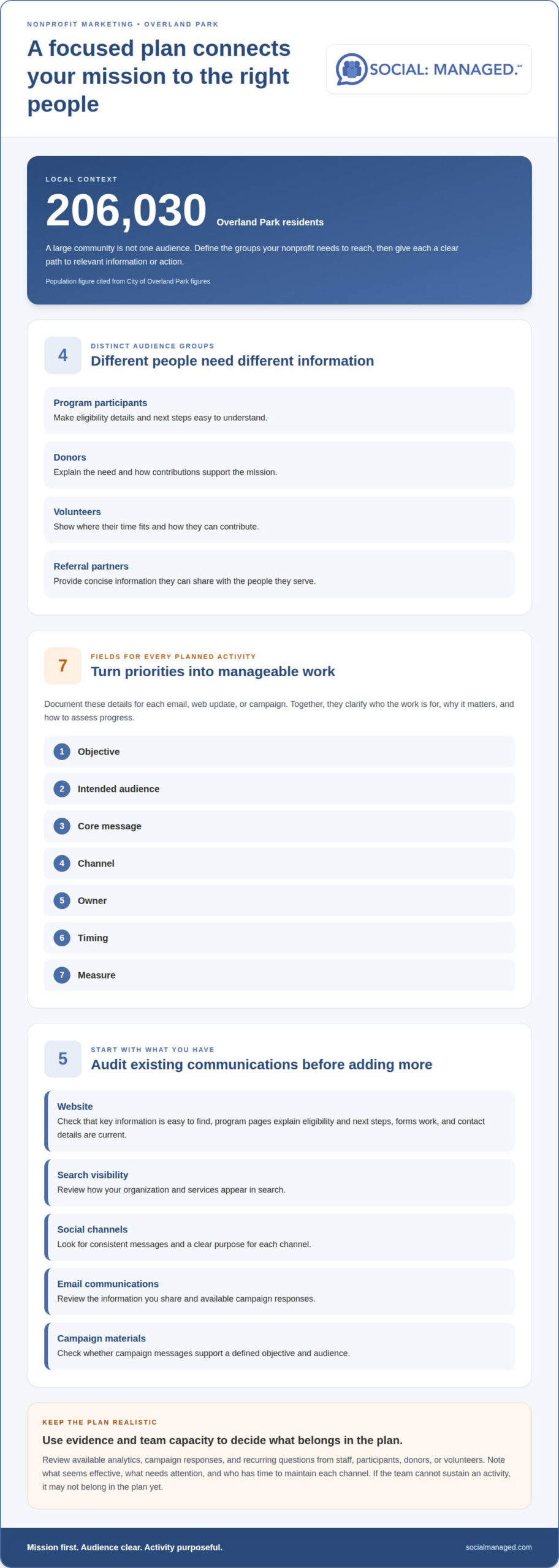
Different audiences need different information before they act. Program participants may need clear eligibility details and next steps. Donors may want to understand the need and how contributions support the mission. Volunteers need to see where their time fits, while referral partners need concise information they can share with the people they serve.
Overland Park had 206,030 residents, according to the City of Overland Park’s 2025 and 2026 figures. That local context is a reminder to define relevant groups rather than treat residents as one audience. Consider where people encounter your services, what questions they raise, and which community relationships can help your message reach them. For organizations serving the wider Kansas City area, including Olathe and Leawood, audience needs may differ by program and location. A single campaign can still serve multiple groups, but give each a clear path to the information or action that matters to them.
Once audiences and priorities are clear, channel choices become easier to assess. Organizations seeking coordinated digital execution can explore digital marketing services in Overland Park as one way to put a defined plan into practice.
Schedule a Free Consultation With Social: Managed.
The essential parts of an Overland Park nonprofit marketing plan
A useful plan turns priorities into work your team can actually manage. For a marketing plan for non-profit organizations in Overland Park, document the objective, intended audience, core message, channel, owner, timing, and measure for each planned activity. This simple structure makes it easier to spot gaps, prevent duplicate work, and explain why a particular email, web update, or campaign deserves time.
Keep the plan focused. A long list of tactics can look productive, but without a clear connection to an objective, it’s difficult to know what to prioritize or learn from the results. Treat every activity as a choice: which audience should it reach, what should they do next, and how will the team recognize progress?
Audit existing communications before adding new activity
Start with what you already have. Review your website, search visibility, social channels, email communications, and campaign materials. Note whether key information is easy to find, whether messages are consistent, and whether each channel has a clear purpose. Check practical details too, such as whether program pages explain eligibility and next steps, forms work, and contact information is current.
Then add evidence and capacity. Look at available analytics, campaign responses, and recurring questions from staff, participants, donors, or volunteers. Record what seems effective, what needs attention, and who has time to maintain each channel. If the team can’t sustain an activity, it may not belong in the plan yet.
Set objectives, messages, and measures that belong together
Write objectives around an audience action. “Raise awareness” needs more definition: who should learn what, and what useful next step can they take? An objective might focus on helping prospective participants understand how to access a service, encouraging supporters to subscribe to updates, or guiding community members to an event.
Pair each objective with one clear message and a relevant way to assess progress. For example, if the aim is to increase event interest, the message should explain why the event matters to that audience. A suitable measure might be event-page visits or registrations, depending on the intended action and the data your organization can access. Record a starting point when available, so later reviews have context.
- Objective: The audience action you want to support.
- Message: The key information or reason to act.
- Channel and timing: Where and when you’ll communicate.
- Owner and measure: Who will carry out the work and what signal you’ll review.
Assigning an owner doesn’t mean one person must do everything. Clarify who approves the message, who prepares it, and who checks the results. Set timing that reflects the team’s actual workload, then review planned activities against available capacity before adding more.
A coordinated digital approach can help connect website, search, email, and social activity to the same objectives. We provide real-time reporting and monthly performance reviews to support ongoing evaluation. If your team wants help aligning digital execution with its plan, talk with us about coordinated marketing support.
How Overland Park nonprofits can choose the right marketing channels
The right channel is the one that helps a specific audience take a useful next step and that your team can maintain. For a marketing plan for non-profit organizations in Overland Park, channel decisions should follow the objective and audience behavior, not a passing trend or a competitor’s activity. A program sign-up goal may call for a clear website page and local search visibility; an update for existing supporters may be better suited to email.
Use this comparison to weigh each channel’s role, workload, and signals of progress. The measures are examples, not a requirement to track everything. Choose indicators that reflect your objective and that your team can review consistently.
Website: A central destination for mission, programs, event details, and next steps. It can help visitors learn, apply, register, or give. Review relevant page visits and completed actions, such as form submissions.
Search engine optimization (SEO): Helps people discover useful information when they search for a cause, service, or local resource. It can support awareness and program access over time. Review relevant search visibility, page visits, and actions on key pages.
Social media: Supports timely updates, community engagement, and sharing campaign stories. Choose platforms your intended audience uses and your team can manage. Review meaningful interactions, link visits, or event responses rather than relying on follower totals alone.
Email: Gives your organization a direct way to share updates with subscribers, donors, volunteers, or participants. It can support repeat engagement and campaign follow-through. Review delivery, clicks, and the action taken after a message.
Paid advertising: Can put a specific message in front of a defined audience or direct people to a campaign page. It requires budget oversight and clear conversion tracking. Assess visits and completed actions against the campaign objective, not impressions alone.
Match each channel to an audience action
Start with the destination and the decision. A website should make program, mission, and action information easy to find. SEO is worth considering when people are likely to search for relevant services or local information. Email may suit audiences who have opted to receive updates, while social media can help distribute timely content. Choose a manageable mix, then make the next step clear on every channel.
Coordinate digital channels instead of treating them as separate campaigns
Keep the central message consistent across search results, social posts, email, and the page where people act. If a campaign invites residents to an event, align the event details and call to action everywhere, then direct each channel to the same useful destination. A broader Overland Park digital marketing approach can help organizations coordinate that work across channels.
Paid advertising can complement that mix, but it isn’t a guaranteed source of donations or participation. Use it when it supports a defined objective, fits available capacity, and can be evaluated with meaningful measures.
A practical process for building and maintaining the plan
A plan becomes useful when it guides real work, not just an annual planning meeting. Build it in manageable stages, choose a small set of priorities your staff can support, and give each activity a clear owner and review point. The process below can help turn a marketing plan for non-profit organizations in Overland Park into a flexible working tool.
- Choose the priorities. Select a small number of organizational goals that need communication support. Weigh their importance against staff time, available resources, and existing commitments. A narrower plan is easier to carry out and evaluate than a long list of initiatives.
- Define the action and audience. For each priority, name who you need to reach and what you want them to do. An objective might help prospective participants find a service, encourage volunteers to register, or guide supporters to learn more about a campaign.
- Assign the work. Record an owner, channel, timing, and measurement approach for every activity. Clarify who drafts content, who approves it, and who checks the results. Shared responsibility works best when handoffs are explicit.
- Schedule and prepare. Place activities on a calendar around program dates, community needs, and organizational milestones. Include time for content preparation, approvals, publishing, and follow-up, not only the launch date.
- Review and adjust. Compare results with the objective, note what the team learned, and decide whether to continue, revise, or pause the activity. Update the plan when evidence or organizational priorities change.
Turn priorities into a workable calendar
A calendar should show the work behind each public-facing date. If a program announcement is scheduled for a particular week, plan backward from publication to allow time for drafting, review, and updates to relevant pages. Add follow-up tasks too, such as answering inquiries or sharing a reminder. Keep some flexibility for timely community needs, but use the organization’s priorities to decide which changes warrant a shift.
Make the calendar practical to maintain. If several activities compete for the same staff member’s attention, adjust timing or reduce the workload before commitments are missed. A visible owner and next step help the team spot conflicts early.
Measure progress and learn from campaign results
Separate activity signals from outcomes. Page visits, email clicks, and social engagement show that people interacted with communications; they don’t always show whether the intended action followed. Pair those signals with an outcome tied to the objective, such as completed registrations or inquiries, when that information is available. Review website, search, social, email, and advertising data together to understand how channels contribute.
For local search visibility, organizations can include measures such as relevant search impressions, visits to service pages, and completed actions. Our Overland Park SEO services support search-focused work as one part of a broader plan. Use recurring reviews to identify what to retain, refine, or stop, then carry those lessons into the next planning cycle.
Getting support to execute a nonprofit marketing plan in Overland Park
A clear plan still needs time, skills, and follow-through. For a marketing plan for non-profit organizations in Overland Park, decide which work your team can own consistently and where added support could help keep execution coordinated. The right arrangement may be entirely internal, supported by an outside partner, or shared between the two.
Decide which work your team can own and where support helps
Keep mission decisions, audience knowledge, and organizational approvals close to your leadership and program teams. They understand the work and should guide how it’s represented. Then assess recurring digital tasks: Are website updates delayed? Is search visibility a priority but no one has time to manage it? Do social media, email, or campaign reporting need more consistent coordination?
Outside support can help with defined execution needs such as SEO, paid advertising, social media, website design, content, or email marketing. A shared model can work well too: your staff sets priorities and approves messaging, while we handle agreed-upon digital work. At Social: Managed., we coordinate digital marketing services around the work an organization selects, using a transparent build-your-own fee structure.
Be specific about the gap you want to address before assigning work. A request such as “help us improve our marketing” is hard to scope. “Maintain the program pages and report on search activity” gives your organization and its marketing team a clearer responsibility to discuss.
Build an accountable working relationship around the plan
Start with shared objectives and a written understanding of who owns each step. Agree on who supplies program information, who drafts or manages digital content, who approves it, and how questions will be handled. Set a review rhythm that fits the plan, so reporting leads to decisions rather than becoming a collection of numbers with no next step.
Our experienced Brand Managers bring web-marketing backgrounds to client work. We provide a live portal for real-time tracking of ad performance and conversions, along with monthly performance reviews. These touchpoints help teams examine available data, raise questions, and decide whether an activity still fits the plan. They support evaluation, not a promise of a particular result.
Make the first step manageable. Identify one priority that needs execution support, define what your organization will own, and outline the information and approvals we’ll need. That creates a practical starting point without asking your team to hand over mission decisions or commit to more activity than it can sustain.
Put your nonprofit’s next priority into motion
A strong marketing plan for non-profit organizations in Overland Park should make the next step clear, not lock your team into a fixed playbook. Choose one priority, decide what progress would look like, and give someone the responsibility and time to move it forward.
As your organization learns, let the plan evolve. A channel that once seemed essential may no longer fit your audience, while a new community need may call for a different message. Regular, thoughtful adjustments keep your communications connected to the mission and realistic for the people doing the work. If coordinated digital marketing could help your organization put its priorities into practice, we’d be glad to discuss an approach shaped around your needs. Your mission deserves a plan your team can act on. Start with one focused step and build from there.
Frequently Asked Questions
How often should a nonprofit update its marketing plan?
Review the plan on a regular schedule, such as quarterly, and sooner if a program, audience need, or organizational priority changes. For a marketing plan for non-profit organizations in Overland Park, a scheduled review helps the team catch outdated service details or campaign assumptions before they shape more communications. Keep a brief change log so staff can see what shifted, why it changed, and what the organization wants to learn next.
What is the difference between a nonprofit marketing plan and a fundraising plan?
A marketing plan guides communication across organizational goals, while a fundraising plan focuses on generating financial support. They can share a campaign, but they answer different planning questions. For example, a marketing plan might shape how an organization explains a new program to the community; a fundraising plan can define the donor audience, giving appeal, and follow-up. Coordinating the plans helps keep messages consistent without treating every communication as a donation request.
Can a small nonprofit create a marketing plan with limited staff?
Yes. A small organization can start with a short working document rather than a complex planning system. Choose one or two priorities, assign a staff owner, and use a shared calendar or spreadsheet to track upcoming work. Reuse suitable content across channels, such as adapting a program update into an email and a social post. Protect time for essential approvals, and leave lower-priority tasks off the schedule until capacity allows.
How can a nonprofit measure awareness when donations are not immediate?
Track signals that show whether people are encountering and understanding the message, even before donations occur. Depending on the campaign, these might include visits to an informational page, event inquiries, email sign-ups, or questions from referral partners. Add a simple feedback prompt, such as asking new participants how they heard about a service. Compare these observations over time, and interpret them alongside the campaign’s intended audience and reach.
Should a nonprofit include community partners in its marketing plan?
Include partners when their role can help information reach or serve a shared audience. A school, community group, or service organization might share accurate program details or direct people to a useful resource. Agree on the information each partner can distribute, the timing, and the best contact for questions. Don’t assume a partner endorses every campaign; clarify how its name or materials may be used before publishing.
What information should a nonprofit gather before planning a campaign?
Collect the campaign purpose, intended audience, key dates, program details, relevant audience questions, available content, and who can approve communications. Check that the destination page or sign-up process reflects current information and works as intended. Gather any available results from similar past efforts, too. This preparation helps the team avoid unclear calls to action, missing details, or a campaign schedule that conflicts with program delivery.
How can a nonprofit keep its marketing calendar flexible?
Mark fixed commitments, such as program enrollment dates, separately from activities that can move. Leave open space for timely updates, and identify which planned task could be postponed if an urgent community need arises. When priorities shift, record what changed and adjust the owner, channel, and follow-up date together. That keeps the calendar responsive without letting every new request displace the work tied to the organization’s main goals.

Ready to get started? Reach out to Social: Managed. online, or call us at 866-324-9700. We manage your company’s social life so you can have one! You don’t need complicated packages. We listen to your goals.
Then we design and manage SEO, social media, ads, websites, and email campaigns built to deliver results. No jargon. No guesswork. Just real growth from a team that cares. Ready to get rolling? Follow Social: Managed. on Facebook for a peek into our social life.