Top Digital Marketing and SEO Services in Kansas City: Your Go-To Agency for Web Design, WordPress, and Custom Solutions
In logistics, visibility is part of the service. A Kansas City logistics and transportation marketing agency helps freight, trucking, warehousing, and supply-chain businesses explain their capabilities and reach potential customers through search, advertising, websites, social media, video, photography, and email. The goal is to make complex services easier to understand and support steady business growth.
The right routes, facilities, and operational expertise matter only if businesses that need them can find and evaluate them. Effective marketing connects a logistics company’s capabilities with buyers’ questions, from available services to the value of its approach.
This article explains what a Kansas City logistics and transportation marketing agency can do, how marketing supports business development, and what to consider when comparing options. It also covers how SEO, creative content, and a well-built website can work together to strengthen a logistics brand’s visibility.
Key Takeaways
- Compare agencies by the services they provide and how clearly they understand logistics and transportation businesses.
- Use the directory to explore local options, then narrow the field by your marketing priorities and target customers.
- Look for relevant experience across trucking, freight, warehousing, and supply chain marketing when assessing an agency’s fit.
- Read case studies for the strategy, work completed, and outcomes, not just headline claims.
- Match your next step to your goals, whether that means improving search visibility, managing social media, or running digital ads.
Agency descriptions and specialties
Kansas City marketing agencies can support logistics businesses with B2B lead generation, SEO, paid advertising, and website services. The right fit depends on whether your priority is reaching freight buyers, explaining warehousing capacity, or generating qualified inquiries.
Logistics and Transportation Specialization
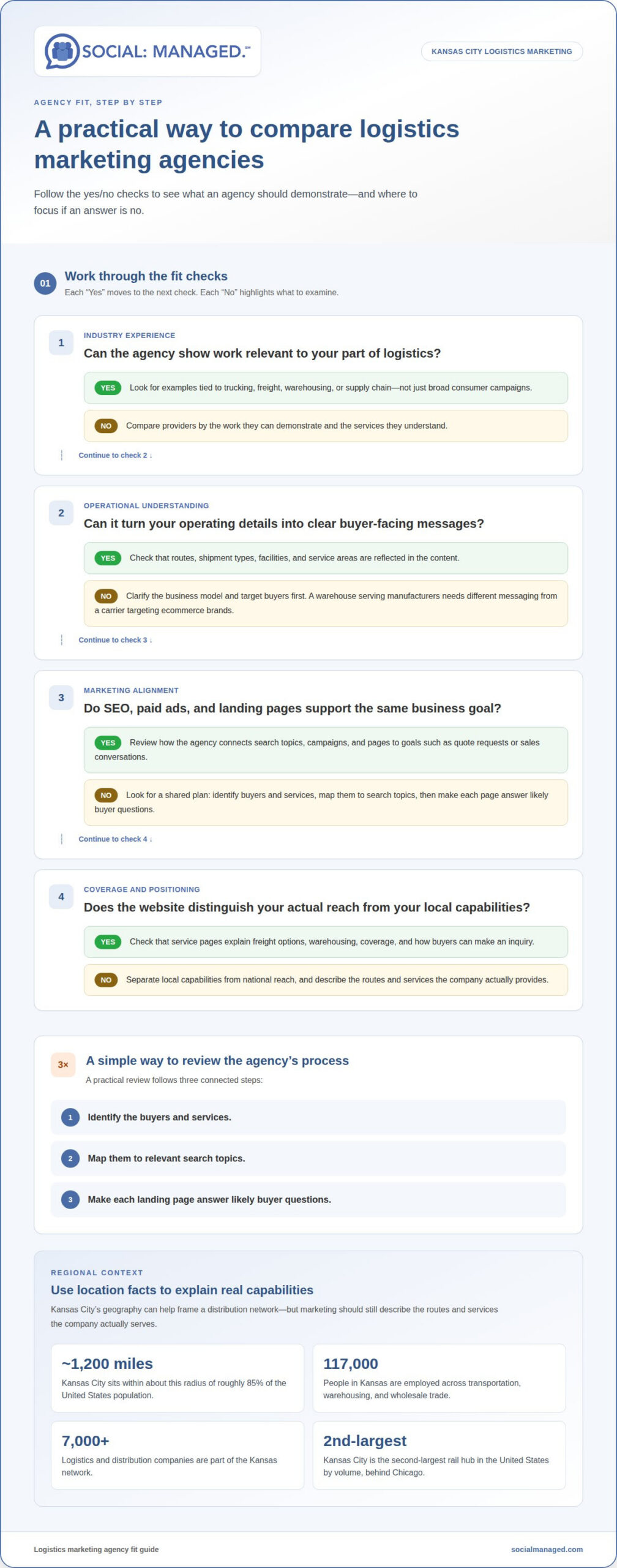
Specialization means translating operational details into clear messages for shippers, manufacturers, distributors, and other business buyers. Look for work that reflects your actual service, such as domestic freight, warehousing, or ecommerce fulfillment, rather than consumer-focused brand campaigns. Kansas has 117,000 people employed across transportation, warehousing, and wholesale trade, alongside a network of more than 7,000 logistics and distribution companies. That breadth makes precise audience and service positioning essential.
Look for an agency that takes time to understand how your business works. It should translate details about routes, shipment types, facilities, and service areas into useful website content and campaign themes. A warehouse serving manufacturers, for example, needs different messaging from a carrier targeting ecommerce brands. Clear distinctions help buyers understand your capabilities before they inquire.
SEO, Paid Advertising, and Website Services
SEO helps logistics firms appear in relevant service and location searches, while paid advertising can target specific buyer needs. Website pages connect these efforts by explaining freight options, warehousing, and how prospective customers can take the next step. Assess whether the agency aligns keywords, ads, and landing pages with a shared business goal, such as quote requests or sales conversations.
Ask to see how the work is organized, not just a list of services. A practical review can follow three steps: identify the buyers and services, map them to search topics, then make each landing page answer a buyer’s likely questions. For a firm serving several states, the site should distinguish its national reach from its local capabilities. A Kansas City website design approach can help structure those service details for visitors.
Regional context can sharpen that message. Kansas City sits within about a 1,200-mile radius of roughly 85 percent of the United States population, giving companies a useful geographic point to explain their domestic distribution networks. Freight businesses can describe how their network connects origins, destinations, and services, rather than relying on broad claims such as “worldwide reach.” Chicago may matter as a comparison or connection point, but the message should focus on the routes and capabilities the company actually serves.
Compare agency specialties by the work they can demonstrate: industry-relevant messaging, search strategy, targeted campaigns, and useful service pages. Each element should make it easier for a business buyer to understand the offer and take a clear next step.
Contact Social: Managed. Let’s Develop Your Logistics Strategy
Kansas City supply chain marketing agency directory
A useful agency directory groups providers by the marketing work they do, rather than relying on broad labels. For trucking, distribution, and fulfillment companies, compare capabilities in search visibility, paid campaigns, content, and lead generation. Then match those capabilities to your sales model, target buyers, and geographic reach.
Which digital marketing strategies work best for Kansas City trucking and logistics companies? Start with a website that clearly explains your services, then connect search content and paid campaigns to specific buyer needs. Email marketing can keep relevant information in front of prospects evaluating freight, warehousing, or distribution partners.
Which local trends and transportation hubs matter for logistics marketing? Kansas City’s position as the second-largest rail hub in the United States by volume, behind Chicago, can help companies explain their intermodal connections. Logistics Park Kansas City in Edgerton spans 3,000 acres and has more than 14.4 million square feet of new distribution facilities.
Use these agency capabilities as directory filters:
- Search and content: Agencies in this category build useful service pages around freight, trucking, and supply chain needs. Review whether their work explains how a carrier or distributor serves specific states and buyer types.
- Paid campaigns: Look for campaigns that separate business audiences and service lines. A company targeting manufacturing buyers may need different messaging from one focused on consumer ecommerce fulfillment.
- Website and conversion: Assess whether the site makes services, coverage, and inquiry steps easy to find. For example, a warehousing page should distinguish storage capabilities from transportation services.
- Email and ongoing engagement: This work can support follow-up with prospects and existing business contacts. Useful messages might explain a new distribution service or a change in the company’s network.
Local infrastructure gives marketers specific context for those messages. Kansas has 4,257 total rail miles and more than 15 transload facilities. Companies serving domestic or global supply chains can use accurate service details to show how their network connects rail, trucking, and distribution operations. Avoid turning location into a broad promise; describe the routes and services your business actually provides.
Logistics Park Kansas City also has 300 acres of rail-served land and 30 million square feet of existing facilities. These details help frame the area’s distribution capacity, while each company’s own services should remain the focus. Use a directory shortlist to compare agency capabilities against your target markets, channels, and sales priorities.
Kansas City Logistics & Transportation Marketing Agencies
To identify a Kansas City marketing agency for logistics, distinguish marketing specialists from transportation operators. The distinction matters: a trucking or warehousing company may understand freight firsthand, but it isn’t automatically a marketing agency. Riverside Transport Inc., for example, provides logistics consulting and trucking in Kansas City, Kansas, and was established in 1993. Its services illustrate the difference between operating in logistics and marketing logistics businesses.
Build a shortlist around the work your business needs. Some agencies focus on search visibility and useful website content; others emphasize paid campaigns, email, or broader digital strategy. A freight carrier seeking shipper inquiries needs clear explanations of its lanes, equipment, and customer fit. A warehouse targeting manufacturers may need content that clarifies its storage and distribution capabilities.
Use these categories to organize Kansas City options:
- Search-focused agencies: Evaluate how they research buyer intent and structure pages around actual services. A page about freight brokerage should answer different questions than one about warehouse fulfillment.
- Paid-media agencies: Look for a clear connection between audience, campaign message, and landing page. A campaign aimed at manufacturers needs a distinct offer from one aimed at ecommerce businesses.
- Full-service digital agencies: These can coordinate several online channels under one strategy. Compare the proposed work against your priorities, such as qualified inquiries, service awareness, or stronger site content.
Local context can also guide the shortlist. Kansas City is within about a 1,200-mile radius of roughly 85 percent of the United States population. For a company with a domestic distribution network, that geography can support a specific message about market access. It does not replace clear details about the company’s actual routes, services, or coverage.
Check how each agency turns your business context into practical marketing. Can it explain trucking, freight brokerage, intermodal service, and warehousing in plain language? Can it organize the site so buyers find relevant services quickly? Review a sample service page, campaign structure, and explanation of how the work supports your sales process.
Compare the proposed scope, communication, and reporting. The right agency is the one whose work aligns with your buyers and business priorities, not simply the one with the longest service list. A Kansas City logistics firm serving several states, for example, needs messaging that distinguishes local operations from broader coverage.
Which Kansas City agencies have experience with trucking, freight, warehousing, or supply chain clients?
To verify an agency’s logistics experience, look for evidence that connects it to specific clients or projects. Kansas City has transportation and distribution businesses, but their presence alone does not establish agency-client relationships. Treat company names as examples of sectors an agency may need to understand, not proof that it has served those businesses.
That distinction matters because a transportation operator and a marketing provider do different work. CTW Logistics, established in 1897, is a logistics business, while The Scarbrough Group was founded in 1984. Those names can help clarify the market’s range, but neither fact demonstrates a marketing agency’s experience. Look for a published project that names the agency, identifies the logistics client, and explains the work.
Use local operators to assess whether an agency understands a business model, not to infer its client list:
- Trucking and freight: Riverside Transport Inc. provides trucking and logistics consulting in Kansas City, Kansas. A relevant marketing example should show how an agency explained services, audiences, and the client’s freight offering.
- Warehousing: Nautical Manufacturing & Fulfillment describes its Lenexa facility as a 465,000-square-foot, food-grade warehouse. A case study for this sector should make the facility’s role and target buyers clear.
- Distribution: Best Way Distribution operates a 750,000-square-foot facility in Kansas City, Kansas. For this kind of business, look for marketing that communicates distribution capabilities rather than generic brand language.
- Supply chain and fulfillment: Paris Brothers Inc. distributes more than 4,500 items to retail grocers and foodservice providers. An agency project in this area should explain how marketing addressed varied products and business audiences.
For each agency project, examine the client’s logistics segment, the agency’s actual contribution, and the reported outcome. Website content for a warehouse is different from a paid campaign for a trucking company. This distinction helps you judge whether the work resembles your needs, rather than relying on broad claims of industry expertise.
Ask whether the example addresses a challenge your business recognizes, such as explaining freight services, reaching manufacturers, or making warehouse capabilities easy to understand. eShipping, LLC received Better Business Bureau accreditation on July 25, 2023, but that is a business credential, not evidence of an agency’s marketing results. Keep operator credentials, agency experience, and campaign outcomes separate as you compare evidence.
A business credential is not evidence of marketing work for logistics clients. Barkley is listed with 323 tracked professional contacts in Kansas City, but that figure alone does not identify a trucking, freight, warehousing, or supply chain project. Ask agencies to provide named examples and explain their role before treating a local presence as relevant sector experience.
Operating details can also help define the marketing challenge without proving an agency relationship. Coastal warehouses shipping to the opposite half of the United States may have transit times of four or five days. Tallgrass Freight Company was founded in 2012, and Waller Truck Company Inc. was established in 1959. Johnstone Supply, The Balsan Group serves customers through a network of 22 locations and has 99 employees. These facts describe businesses and their reach; they do not establish which agency served them. For a credible assessment, request a project example that connects the agency’s work to a specific logistics client and need.
What case studies and results have Kansas City logistics marketing agencies published?
Assess case studies by their evidence, not by general claims of logistics experience. A useful example identifies the client or sector, explains the marketing challenge, describes the work completed, and connects it to a reported outcome. Without those details, a polished project summary does not show whether the strategy fits a trucking, freight, warehousing, or supply chain business.
Look for a clear baseline and a defined result. A freight company case study, for example, might explain how an agency improved a service page, promoted it, and measured qualified inquiries. A warehouse example could show how campaign messaging clarified storage capabilities for manufacturers. These are ways to evaluate case studies, not claims about a particular Kansas City agency’s work.
Separate the agency’s activity from the business result. A redesigned website or launched campaign describes work completed, but does not by itself demonstrate greater visibility or stronger sales conversations. Check whether the case study reports relevant outcomes, such as organic traffic, qualified leads, or conversion activity, and explains how they were measured.
- Client fit: Identify whether the example involves trucking, freight, warehousing, distribution, or another relevant business model. A retail campaign may show creative skill, but it won’t establish direct logistics experience.
- Work completed: Note the specific channels and assets, such as search content, an advertising campaign, email, or a website page. Distinct work helps you compare the example with your own priorities.
- Outcome and context: Look for the reported result, its measurement period, and the business goal. A lead increase means more when the case explains what counted as a qualified lead.
Kansas City logistics firms should also consider whether a case study reflects the complexity of their offer. A company with trucking and warehousing services needs clear pathways for different audiences, not one generic campaign. A freight provider serving several customer types may need messaging that distinguishes shippers’ needs from manufacturers’ needs. These examples show whether an agency can organize complex services into useful marketing.
Use a consistent review process: note the client sector, challenge, agency actions, and stated result, then compare those details across agencies. If a Kansas City example covers a different sector, assess which elements transfer, such as its search structure or lead-generation approach. Treat claims as evidence only when the method and outcome are clearly explained.
Check whether a case study shows how marketing materials make the company’s capabilities clear and whether the reported outcome reflects a business goal. If the audience, measurement, or result is unclear, ask for more detail before treating it as evidence of a good fit.
Social: Managed: Search Engine Optimization
Social: Managed. helps logistics businesses build online visibility through Search Engine Optimization, Digital Marketing, Social Media Management, and Google Ads. Use SEO to make it easier for shippers and business buyers to find your services. A freight company, for example, can organize service pages around its capabilities and the questions prospective customers ask.
Search visibility is more effective when relevant website content supports the wider marketing strategy. Social: Managed. can coordinate SEO with digital campaigns and social media activity, helping your business maintain a consistent message across channels. The right focus depends on your services, audience, and growth priorities. Contact Social: Managed. to discuss your marketing goals and next steps.
Turn Your Marketing Priorities Into a Clear Plan
Choose one business priority to guide your marketing plan. You may want more qualified inquiries, clearer service messaging, or greater visibility among your target buyers. A Kansas City logistics and transportation marketing agency should connect that priority to practical work, with clear ownership and a way to assess progress.
Before moving forward, define what a useful outcome means for your business. Decide which services need attention, who needs to understand them, and what action you want prospects to take. This focus gives your marketing a clearer purpose and helps your team make informed decisions as the work develops.
Social: Managed. can shape a digital marketing approach around your goals and business priorities. Start a conversation about the next step for your logistics marketing. A focused plan can make your expertise easier to find and understand. Take the next step with confidence.
Frequently Asked Questions
What logistics and transportation marketing services do Kansas City agencies offer?
A Kansas City logistics and transportation marketing agency may offer SEO, paid advertising, website design, social media management, email marketing, photography, and video production. A carrier, for example, could use a service page to explain its freight options, then run targeted ads for relevant business buyers. Social: Managed. provides digital marketing services in Kansas City, Overland Park, Olathe, and Leawood. Choose services that support a clear business goal.
What should a transportation company look for when choosing a marketing agency in Kansas City?
Choose a Kansas City logistics and transportation marketing agency with a clear strategy, relevant examples, and reporting tied to business goals. A trucking company might prioritize shipper inquiries, while a warehouse may need prospective customers to understand its facility and services. Review how the agency will tailor messaging, coordinate channels, and report progress. Local knowledge can help keep campaigns relevant across Kansas City, Overland Park, Olathe, and Leawood.

Ready to get started? Reach out to Social: Managed. online, or call us at 866-324-9700. We manage your company’s social life so you can have one! You don’t need complicated packages. We listen to your goals.
Then we design and manage SEO, social media, ads, websites, and email campaigns built to deliver results. No jargon. No guesswork. Just real growth from a team that cares. Ready to get rolling? Follow Social: Managed. on Facebook for a peek into our social life.