
Top Digital Marketing and SEO Services in Kansas City: Your Go-To Agency for Web Design, WordPress, and Custom Solutions
A bigger email list isn’t always a better one. If your sign-up forms attract few subscribers, or a growing list rarely engages, the answer isn’t to chase every tactic you come across. Effective email list growth strategies focus on attracting people who have a real reason to hear from your business.
It’s understandable to want more subscribers, but relevance matters just as much as reach. The right audience is more likely to open your emails, click through, and stay connected over time. This guide will help you choose sustainable ways to attract those subscribers, improve sign-up conversion, and grow without depending on a single incentive.
We’ll explore how useful content, your website, and social channels can work together to encourage sign-ups, then look at how to assess list health and refine your approach. With consistent measurement and monthly performance reviews, you can make informed improvements that support long-term growth.
Key Takeaways
- Choose email list growth strategies that attract people interested in your business, not just a larger number of contacts.
- Place sign-up opportunities where they meet a clear audience need instead of adding forms everywhere.
- Match incentives to your ideal subscribers so the reward supports lasting interest in your business.
- Track sign-ups by source alongside engagement to see which channels bring in subscribers who stay involved.
- Connect email, website content, social promotion, and analytics to build a more consistent approach to list growth.
Why email list growth starts with the right subscribers
A list can grow quickly and still fail to support your business. If subscribers don’t recognize your offer, need your services, or value the emails you send, a rising contact count may create little opportunity for a lasting relationship. Strong email list growth strategies start with fit: attracting people who choose to hear from you and have a clear reason to stay.
A healthy email list brings together relevant subscribers who have given permission to hear from your business and continue to engage with its messages. That definition puts the focus on three connected measures: who joins, how they joined, and whether your communication remains useful to them.
What makes an email list valuable to a business?
Relevance connects subscribers to your audience, your offers, and the content you can consistently provide. Someone who signs up for home maintenance advice may welcome seasonal service reminders, while a person who wants restaurant menu updates may not value the same messages. Before adding a sign-up opportunity, be clear about what subscribers will receive and why it matters to them.
That choice also shapes the relationship. A social following can help people discover your business, but the platform controls how posts reach followers. An email subscriber has actively shared an address to receive your communication. As this page on email marketing explains, email supports direct communication with an audience, making clear expectations and permission central to a useful subscriber relationship.
Lists also change over time. New people subscribe, some stop engaging, and others unsubscribe. Growth is the ongoing work of attracting a good-fit audience while paying attention to whether your emails still serve them. Purchased, scraped, or otherwise unsolicited contacts don’t represent people who chose your communications. They can undermine trust and make it harder to understand whether your content is reaching an interested audience.
Which businesses benefit from a focused list?
A focused list can support businesses with very different customer journeys, but the right audience and message depend on the business. A home services company might share maintenance advice with homeowners in the areas it serves. A real estate business could tailor updates to buyers, sellers, or people following a particular neighborhood. These groups may all have an interest in property, but their needs aren’t interchangeable.
A restaurant might invite diners to receive menu news or updates about upcoming events, while an ecommerce business could share guidance or offers related to products a subscriber has shown interest in. In each case, the sign-up promise should reflect what the business can meaningfully send, not simply collect addresses.
There’s no universal tactic that suits every audience. Consider what people need, when they’re likely to need it, and what communication they’ve agreed to receive. A thoughtful list gives your emails a clearer purpose and helps your business build relationships that can develop beyond the initial sign-up.
Schedule a Free Consultation with Social: Managed.
Where to find new email subscribers across your existing channels
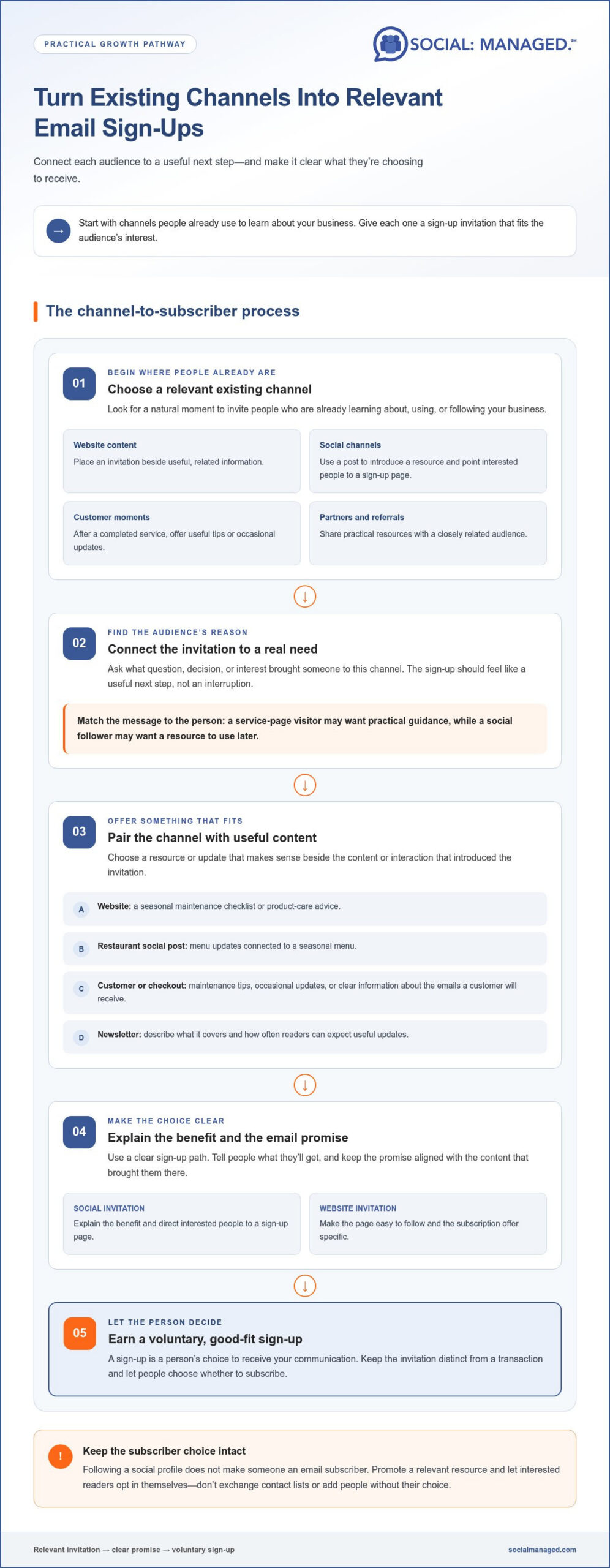
You don’t need to add a sign-up form to every page or profile. Start with the channels people already use to learn about your business, then identify a useful next step for each audience. A visitor reading a service page may want practical guidance; a social follower may be looking for a resource they can use later.
Each acquisition channel needs a relevant reason to subscribe, so the invitation feels like a useful next step rather than an interruption. This simple filter helps you prioritize: connect the sign-up to a question, decision, or interest your audience already has.
Use your website and useful content to earn sign-ups
Place sign-up invitations beside content that gives them context. A home services page could offer a seasonal maintenance checklist, while an ecommerce guide might invite readers to receive product-care advice. A newsletter can work, too, if you explain what it covers and how often readers can expect useful updates. Keep the promise specific and aligned with the content that brought someone to the page.
Make the path easy to follow. A clear page structure helps visitors find related information and understand what they’ll get by subscribing. Our Kansas City website design work focuses on creating intuitive experiences that connect people with relevant content and next steps.
Turn social, customer, and partner interactions into opt-ins
Social channels can introduce a resource to people who may want more detail. For example, a restaurant could share a post about a seasonal menu and invite interested followers to subscribe for menu updates. The post should explain the benefit and direct people to a sign-up page; following a profile doesn’t automatically make someone an email subscriber. A coordinated Kansas City social media management approach can help connect social content with a relevant email invitation.
Customer interactions offer another natural moment. After a completed service, a business might invite a customer to receive maintenance tips or occasional updates, making the value clear before asking for an address. At checkout, an online shop can describe the kinds of emails subscribers will receive. In both cases, keep the invitation distinct from the transaction and let people choose whether to sign up.
Partnerships and referrals can introduce your business to a new, closely related audience. A real estate professional and a home organizer, for instance, might share each other’s practical resources with their respective audiences. The useful step is to promote the resource and let interested readers opt in themselves, not to exchange contact lists or add people without their choice.
To choose where to begin, look for the point where audience interest and a useful email offer already meet. Test that opportunity before adding more sign-up placements. If coordinating your website, social content, and email invitations is a challenge, talk with our team about connecting your marketing channels.
How to improve sign-up forms and incentives without sacrificing subscriber fit
A compelling offer can make a sign-up feel worthwhile, but the reward also shapes who responds. If it appeals to almost anyone, you may collect addresses from people with little interest in your business. Strong email list growth strategies weigh the appeal of an incentive against the kind of relationship it’s likely to create.
Choose an incentive that fits the audience
Start with a question your prospective customers already ask. A downloadable planning guide, comparison checklist, or how-to resource can help people understand a service before they’re ready to choose one. Newsletter access suits audiences that value ongoing ideas or updates. Discounts and early access may fit a retail business, but only if they make sense for its margins, offers, and customer expectations.
Contests can draw attention, but the prize may matter more to entrants than the business itself. Before choosing an offer, consider its relevance, the work required to create and deliver it, and what subscribers will expect afterward. A useful resource may take more initial effort, while a simple newsletter offer depends on providing consistent value over time.
- Educational resource: Useful when prospects need guidance, with effort focused on creating and maintaining accurate content.
- Newsletter access: A natural fit for regular insights or updates, with an ongoing commitment to deliver what the form promises.
- Relevant offer: Can encourage action when it suits the business model, while shaping expectations around future promotions.
- Contest entry: May attract attention, but a broad prize can bring sign-ups from people unlikely to care about the business.
The right choice isn’t automatically the one that produces the most form submissions. Look for a clear connection between the offer and what your business can continue to provide.
Reduce friction while setting clear expectations
Keep the form focused on what you need to deliver the stated value. If someone is signing up for a guide, an email address may be enough. Ask for additional details only when they’ll help tailor the content or serve a clear purpose. Each extra field adds a decision, so remove anything that doesn’t support the sign-up experience.
Use plain language to describe the emails: what they cover, who they’re for, and the expected cadence if you can state it accurately. Explain how subscribers can update their preferences or stop receiving messages. Clear expectations help people decide whether the offer fits before they submit the form.
Then test with discipline. Change one element at a time, such as the headline, form placement, incentive, or number of fields. Record what changed and compare not only sign-ups, but also whether new subscribers engage with the emails that follow. More sign-ups don’t automatically mean a healthier list. A smaller number of people who value the offer may be a stronger result than a surge driven by a mismatched reward.
How to measure and improve email list growth over time
List growth becomes easier to manage when you treat it as a learning process, not a race to add contacts. A simple review can show which audience and channel are attracting subscribers who respond to your emails, and where your sign-up experience may need attention. The goal is to make decisions from your own results rather than chase a universal benchmark.
Acquisition volume tells you how many people joined; relevance and ongoing engagement help show whether those new subscribers are a good fit. Use both kinds of signals to understand what’s working.
Select measures that answer useful questions
When your analytics support it, track sign-ups by source, such as a specific website page, social post, or customer touchpoint. If you can also compare visitors with completed sign-ups, conversion by source can help distinguish a channel that drives traffic from one that encourages action. Keep the source labels consistent so the results remain useful from one review to the next.
Pair acquisition data with engagement indicators that fit your email program. Clicks can show whether readers act on particular content; replies may be useful when your messages invite a conversation. Review unsubscribes and inactive subscribers in context. A change may point to a mismatch between the sign-up promise and the emails people receive, a shift in audience interest, or a message that isn’t meeting expectations. It’s a prompt to investigate, not a verdict on one campaign.
Be careful with attribution. Sign-ups can be connected to a source more directly than later sales or revenue, which may involve several interactions. Report list-growth results separately unless your measurement can support a reliable connection to broader business outcomes.
Run focused experiments and learn from them
Use a repeatable sequence to keep the work manageable: choose one audience, select one channel, test one change, and review the results. For example, if local homeowners are the audience and a service page is the channel, you might assess whether a more relevant sign-up invitation leads to more subscriptions from that page. Keep other parts of the experience steady so the comparison is easier to interpret.
For each experiment, record the audience, channel, test period, change made, and observed outcome. Note what the email program sent to those subscribers afterward, too. A sign-up increase matters differently if the resulting subscribers engage than if they quickly go inactive or unsubscribe. This context helps you decide whether to repeat the approach elsewhere or revise the offer.
Compare results with your own baseline and account for campaign context, such as changes in traffic or the email content sent during the review period. We use real-time reporting and monthly performance reviews to help make those patterns easier to discuss and act on. Depending on what you learn, refine the tactic, repeat it with a related audience, or stop investing effort in it. That steady cycle turns email list growth strategies into informed decisions rather than a collection of disconnected tests. Click here to talk with us about measuring and improving your email marketing.
Build an email list growth system that supports your wider marketing
Email sign-ups work best as part of a connected customer journey. A useful page gives people a reason to subscribe, social content helps them discover it, and email delivers on the promise. Analytics then show which parts of that journey are attracting the right audience. This connection makes email list growth strategies more purposeful than treating every channel as a separate source of contacts.
Coordinate email acquisition with the channels around it
Start with the questions prospective customers ask as they learn about your business. Shape website content around those questions, then offer an email resource or updates that extend the value of the page. A service article might lead to a practical guide, while a product page could invite readers to receive relevant advice. The sign-up offer should feel like a natural next step, not a disconnected promotion.
Social media can bring interested people to that experience. Share a useful tip, explain what a resource covers, and direct people to the relevant sign-up page. Paid promotion can also introduce the offer to a defined audience, but the landing page and email promise should match the message in the ad. Consistency from post or ad to sign-up helps people understand what they’re choosing.
Connect email activity to broader marketing goals, such as educating prospective customers or keeping existing customers informed. Keep consent central at every point: promotion can invite people to subscribe, but it shouldn’t turn a social following, customer record, or ad audience into an email list without their choice.
Get practical support for a measurable growth plan
Coordinating these moving parts can be difficult for a small team that’s also managing day-to-day operations. A connected plan helps clarify who owns the content, how channels support the sign-up journey, and what the team will review. Without that coordination, a website may promise one thing while social posts promote another, or sign-ups may happen without a clear plan for what subscribers receive next.
At Social: Managed., we bring email marketing together with content strategy, social media management, website design, SEO, paid media, and analytics. We work collaboratively to align the channels with your goals, create a consistent experience, and make performance easier to assess. Real-time reporting and monthly performance reviews help us examine what’s happening, discuss what the results suggest, and shape the next steps. They don’t replace thoughtful strategy, but they do give the team a regular basis for learning and adjustment.
A practical starting point is to map one audience’s path: what they need, where they encounter your business, why they might subscribe, and what email follow-up supports that interest. From there, your team can prioritize the content and channels that fit, then assess progress without assuming every tactic will suit every business.
Make your next growth decision a focused one
Your next step doesn’t need to be a complete marketing overhaul. Choose a business priority, then consider how email can support it in a way that’s useful to the people you want to reach. A clear starting point makes it easier to focus your time, evaluate progress, and adjust your approach as your audience responds.
Our team can help shape that plan around your goals and existing marketing. Founder David Alexander brings digital and web experience dating from 2001, and we work as a collaborative partner to help businesses connect their marketing efforts without promising a particular result. A thoughtful plan gives you a practical place to begin and room to adapt. Build steadily, learn from your audience, and let each informed decision move your business forward.
Schedule a Conversation About Your Email Marketing Strategy
Frequently Asked Questions
How can I grow my email list without using discounts?
Offer information or access that helps people make progress, rather than lowering a price. A home services business could share a seasonal preparation checklist, while a consultant might send a short guide to a common planning challenge. You can also invite people to receive useful updates or expert tips. The best non-discount offer connects to what your audience already wants to learn from your business.
Are email list giveaways a good way to get subscribers?
They can help attract attention, but the prize determines who is most likely to enter. A giveaway for a product or experience closely related to your business is more likely to interest potential customers than a broadly appealing prize. State clearly that entering involves signing up for email, and explain what those emails will contain. Consider whether you can continue serving entrants after the contest ends.
Where should I put an email sign-up form on my website?
Place it where the invitation matches the page’s purpose, such as beside a related article, on a service page, or near the end of a useful guide. For a Kansas City business serving customers in Overland Park, Olathe, and Leawood, a local service page could invite visitors to get relevant area updates. Check that the form works well on mobile and doesn’t block the content people came to read.
How often should I review email list growth?
A monthly check-in is a practical starting point for spotting changes without reacting to every small fluctuation. Review sooner after a major campaign or a new sign-up offer, but give the activity enough time to produce useful observations. Compare the same measures across review periods, and note unusual factors such as a seasonal promotion or a change in website traffic before deciding whether a result calls for action.
Should I buy an email list to grow my subscribers faster?
No. A purchased list contains people who haven’t chosen to receive your business’s messages, so a large address count may not translate into genuine interest. Recipients may ignore or report unwanted emails, making it harder to reach people who do want your updates. Build your audience through invitations that explain the value of subscribing, and keep records that show how each person opted in.
What should I offer people who join my email list?
Offer something your team can deliver well and your intended subscribers will actually use. A practical checklist, a focused how-to guide, early notice about relevant updates, or a well-described newsletter can all work, depending on your audience. For example, an online shop could share product-care advice rather than a generic download. Make the sign-up message specific, and ensure the first email follows through on that promise.
How do I know if my email list is growing well?
Look beyond the total number of addresses. Check whether sign-ups are coming from the channels you intended, whether subscribers click or otherwise respond to your messages, and whether unsubscribes or inactivity are changing. For email list growth strategies to support business goals, compare these signals with your own past results and the purpose of each campaign. A steady, relevant audience can be more useful than rapid growth without engagement.

Ready to get started? Reach out to Social: Managed. online, or call us at 866-324-9700. We manage your company’s social life so you can have one! You don’t need complicated packages. We listen to your goals.
Then we design and manage SEO, social media, ads, websites, and email campaigns built to deliver results. No jargon. No guesswork. Just real growth from a team that cares. Ready to get rolling? Follow Social: Managed. on Facebook for a peek into our social life.