
Top Digital Marketing and SEO Services in Kansas City: Your Go-To Agency for Web Design, WordPress, and Custom Solutions
Ranking locally takes more than adding your business name to Google. Getting your Johnson County business on the first page of Google starts with an eligible, claimed, and verified Google Business Profile. From there, visibility depends on how clearly the profile represents your business and its services. Creating a profile is free, and customers can find it on Google Search and Maps after it’s added or claimed and verified.
It makes sense to focus on your profile: it gives nearby customers a useful snapshot of what you offer, where you work, and how to reach you. But setting it up is only the beginning. Accurate details, relevant photos, and appropriate service-area settings help make that snapshot more useful for local searches.
This guide explains how to set up and optimize your profile, use customer search insights to understand how people find your business, and configure a service area that reflects where you work. You’ll also learn how profile improvements fit into a broader local SEO strategy for Johnson County, including Overland Park, Olathe, and Leawood.
Key Takeaways
- Set up or claim an eligible Google Business Profile, then complete verification so customers can find it on Search and Maps.
- Make your profile more useful with an accurate description, relevant photos, and business attributes that reflect what you offer.
- Define a realistic service area that matches where your business works, including if you don’t have a storefront.
- Use customer search insights to understand how people discover your business and where your profile may need attention.
- Build a consistent review-request process that follows Google’s policies and supports your local reputation.
How a local SEO professional creates or claims a Google Business Profile
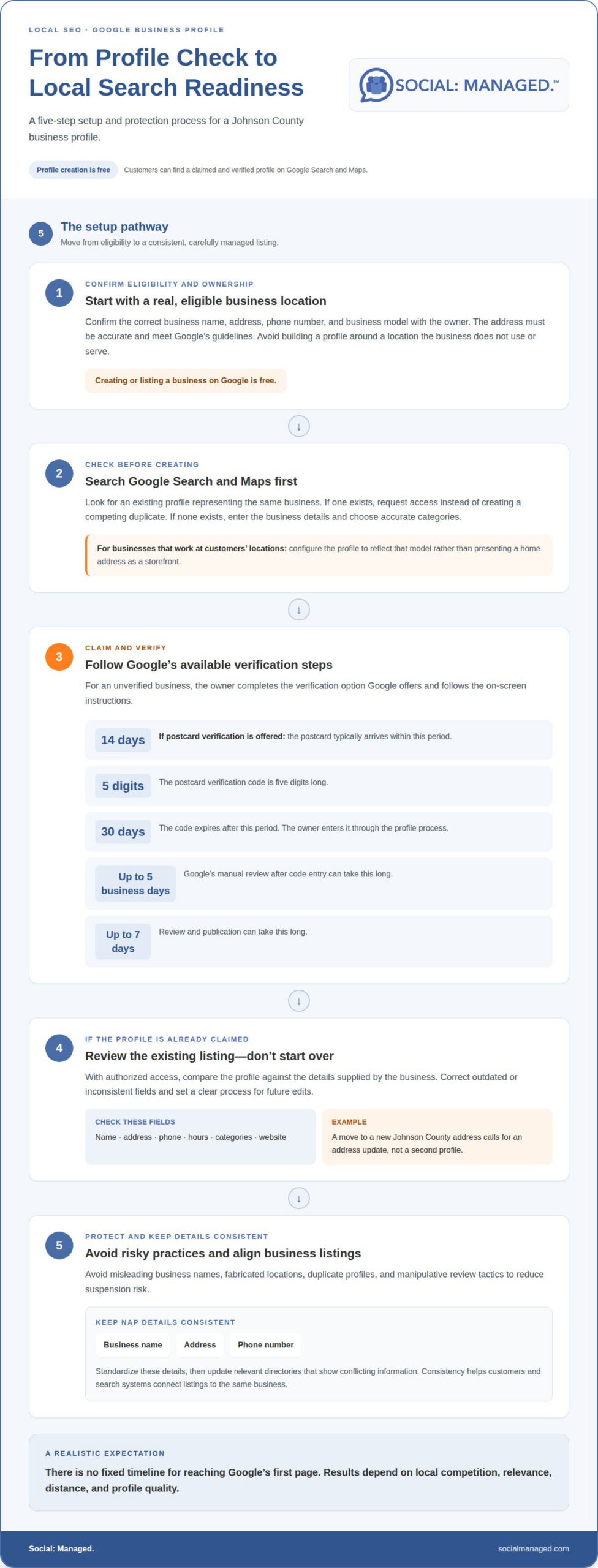
- Confirm eligibility and ownership. A professional first determines whether the business qualifies for a Google Business Profile. They confirm the correct business name, address, phone number, and business model with the owner. The address must be accurate and meet Google’s guidelines. This step prevents a profile from being built around a location the business does not use or serve. Creating or listing a business on Google is free.
- Search for an existing profile before creating one. The professional checks Google Search and Maps for profiles representing the same business. If a profile already exists, they help the owner request access instead of creating a competing duplicate. If none exists, they enter the business details and select accurate categories. For a business that works at customers’ locations, they configure the profile to reflect that model rather than presenting a home address as a storefront.
- Claim an unverified business and complete verification. The professional guides the owner through Google’s available verification option and on-screen steps. If Google offers postcard verification, the postcard typically arrives within 14 days. Its verification code is five digits long and expires after 30 days. The owner provides the code through the profile process. Google’s manual review after code entry can take up to 5 business days, while review and publication can take up to 7 days.
- Manage a profile that’s already claimed. With authorized access, the professional reviews the existing profile rather than starting over. They compare the listed name, address, phone number, hours, categories, and website details with information supplied by the business. They then correct outdated or inconsistent fields and establish a clear process for future edits. For example, a move to a new Johnson County address should prompt an address update, not a second profile.
- Protect the profile and strengthen local citations. To reduce suspension risk, the professional avoids misleading business names, fabricated locations, duplicate profiles, and manipulative review tactics. For citations, they standardize the business’s name, address, and phone number, then update relevant directories that show conflicting details. This consistent NAP information helps customers and search systems connect listings to the same business. There’s no fixed timeline for reaching Google’s first page; results depend on local competition, relevance, distance, and profile quality.
Discuss a Review Strategy for Your Business
How a local SEO professional optimizes business descriptions, photos, and attributes
- Shape a clear, customer-focused description. A professional writes the Google Business Profile description around what the business does, who it serves, and where it operates. Google allows up to 750 characters, so each phrase needs a purpose. For example, a Johnson County electrician might describe residential electrical repairs and the communities served. The wording should sound natural and match the actual business. A list of repeated search terms makes the description harder to read and doesn’t explain the service to customers.
- Choose accurate business categories. The primary category should describe the business’s main service, not every service it could potentially provide. A professional reviews the available options and selects additional categories only when they accurately fit. Google Business Profiles can include up to nine additional business categories beyond the primary category. For example, a bakery that also serves coffee could add a relevant category for that offering. Categories should reflect real operations, not unrelated services added to attract more searches.
- Build a useful photo set. A local SEO professional organizes authentic images that help customers understand the business before they call or visit. Suitable examples include a storefront, staff at work, completed projects, or products the business sells. Profiles with photos get 35% more clicks, so images can make the listing more compelling in search results. The professional checks that each photo represents the business accurately and replaces images that no longer reflect its location, team, or services.
- Complete relevant attributes and operating details. Google Business Profiles can display hours, photos, and other essential information on Search and Maps. Review these fields together so customers get a coherent picture of your business. For example, a retailer can show whether it offers curbside pickup or delivery. A service business can clarify its offerings through relevant profile details. Hours and attributes should match actual operations, rather than describe options the business doesn’t provide.
- Review the profile as a customer would. Before publishing edits, the professional checks how the description, categories, photos, hours, and attributes work together. A Johnson County customer looking for a nearby service should quickly understand what the business does and how it serves the area. The professional also revisits the profile when the business changes its services, hours, or customer options. For focused help aligning these details with local SEO, talk with a local SEO professional.
How a local SEO professional sets up service-area businesses
Align your Google Business Profile and website around the places you actually serve. Make your Johnson County coverage clear without claiming communities your business doesn’t reach.
- Professional setup of a service-area business. Start by identifying the business’s real operating base and the places its team serves. A professional configures the Google Business Profile for a service-area business, rather than presenting a residential address as a customer-facing storefront. Google allows up to 20 service areas and recommends staying within a 2-hour drive from the business’s base. The listed places should reflect actual service coverage, not a wish list.
- Targeting nearby areas with local landing pages through professional SEO. Build location pages around services genuinely available in each community. For example, a business might create useful pages for Overland Park, Olathe, or Leawood, explaining the relevant service and local coverage. Each page should offer distinct, helpful information, not simply swap a city name into identical copy. That gives visitors a clear reason to use the page and helps search engines understand its geographic focus.
- Connect each page to a real service location. Map the website’s location pages to the coverage stated on the profile. For example, a plumbing company serving Olathe and Shawnee can describe those communities where its services are available. Page content should match the business’s actual work, travel patterns, and customer needs. Avoid listing a city merely to attract searches if the business doesn’t serve customers there. Connect location pages through clear website navigation. A visitor exploring an Overland Park service page should be able to find related service details and contact information. Consistent place names across the profile and website make coverage easier to understand. Each page should provide useful local details, rather than thin, repeated text.
- Keep coverage and page details aligned. Review the profile’s service areas whenever the business changes where it operates. If the company expands from Lenexa into Olathe, the profile and relevant website pages should reflect that change. The service-area list, page content, and descriptions must not suggest broader coverage than the team can deliver.A professional can also assess which communities deserve dedicated pages based on the business’s services and customer demand. For example, a contractor serving several Johnson County communities could prioritize pages that explain distinct services, project types, or local needs. Strong pages answer practical questions and make coverage transparent. This gives prospective customers a useful next step, instead of a city keyword repeated without context.
How does Google rank local businesses in Maps and organic search results?
- Separate Maps visibility from organic rankings. Google’s Local Pack displays three top map results. Those listings appear alongside a map, while organic results show webpages that match the search. A Johnson County business can appear in one format without appearing equally prominently in the other. A local SEO professional reviews both result types to identify whether visibility gaps involve the profile, website, or both. The strategy then addresses each surface with relevant local information.
- Strengthen relevance for the services customers seek. Google needs clear signals connecting a business to a search. Align the business’s actual services across its profile and website. For example, a roofer should clearly describe roofing work, rather than rely on broad phrases such as “home solutions.” Service pages can explain project types, customer needs, and communities served. This gives searchers useful context and helps search engines match pages with relevant queries.
- Account for distance and the searcher’s location. Local results can change based on where a person searches and how close businesses are. A company based in Overland Park may appear differently for someone searching in Olathe than for someone nearby. Set practical priorities across Johnson County with that geographic reality in mind. Focus on places the business truly serves, rather than assuming optimization can erase distance from search results.
- Build prominence through credible, consistent signals. Prominence reflects how established and recognized a business appears online. Review mentions of the business across relevant websites and directories, then address inconsistencies in its name, address, or phone number. Reviews and useful local content also shape the overall picture customers encounter. For instance, a detailed project page can demonstrate relevant experience more clearly than a generic page targeting every nearby city.
- Measure Maps and organic performance separately. Track visibility for relevant searches, locations, and service pages instead of relying on one broad ranking. A local search for “plumber near me” may produce different results from a search naming a Johnson County city. Reviewing those differences helps show whether content needs more service detail or clearer geographic focus. Search results also evolve, so adjust the strategy to changes in customer behavior and business offerings.
Profile insights can add a practical layer to that review. Use them to see what search terms customers use and review information about calls, reviews, and bookings. Comparing these signals with monitored searches and service pages can help you understand what customers are seeking and what they do after finding the business. The information can guide decisions about whether profile descriptions and website content reflect customer language, and whether to focus on inquiries, feedback, or bookings. It complements Maps and organic visibility checks rather than replacing them.
How important are reviews, and how can a local SEO professional help request them without violating Google’s policies?
Reviews help customers in Johnson County assess a business before choosing it. Build a consistent, neutral process for inviting honest feedback without directing what customers should write.
- Ask customers for honest feedback. Create a simple review request that invites customers to share their genuine experience. For example, after completing a repair, the business can send a brief follow-up with its Google review link. The message should not ask for a particular rating or suggest specific wording. A neutral invitation respects the customer’s choice and keeps feedback independent.
- Send requests consistently, not selectively. Establish a repeatable process for inviting customers to review completed transactions or services. Don’t screen customers first and send requests only to those expected to leave positive feedback. That kind of filtering can distort the profile’s public picture. A consistent process gives each customer the same opportunity to describe their experience.
- Keep incentives and pressure out of the request. A review invitation should not offer a discount, gift, or other reward in exchange for a review. It should not imply that a customer must leave feedback to receive support. For example, a Johnson County contractor can send a thank-you message after a project and include an optional review link. Keep the request courteous, brief, and pressure-free.
- Make the review link easy to use. A local SEO professional can organize the review link and request template for the business’s normal customer follow-up. A salon might include the link in a post-appointment email, while a service company could add it to a completion message. The wording should invite a candid account, not a five-star rating. Clear timing and a convenient link reduce friction without dictating what customers say.
- Respond professionally to positive and critical reviews. A business response shows that feedback receives attention. A professional can help prepare concise, respectful replies that address the reviewer’s point without exposing private customer details. For example, if a customer mentions a delayed appointment, the business can acknowledge the concern and offer an appropriate next step. Responses should avoid arguments, personal information, or promises the business cannot keep.
- Use reviews to improve customer experience. A professional can review recurring themes, such as praise for clear communication or concerns about scheduling. The business can then address practical issues and update its service process. Reviews help prospective customers understand others’ experiences, but no review plan guarantees a particular Google ranking. Honest feedback and thoughtful responses support a credible local presence over time.
Social: Managed. | Search Engine Optimization
Social: Managed. helps Johnson County businesses strengthen local visibility through Search Engine Optimization. When profile updates, service-area pages, and review processes need to work together, a coordinated strategy can connect those efforts with the business’s wider digital presence. The focus is practical: clarify what the business offers, make its service coverage easy to understand, and improve website relevance for local searches in communities such as Overland Park, Olathe, and Leawood.
This support can help when your business lacks time to manage ongoing SEO or needs a clear plan to improve its local search presence. Social: Managed. can also coordinate SEO with Google Ads, Social Media Management, or broader Digital Marketing when those channels fit your goals.
Contact Social: Managed. to discuss your local SEO needs.
Turn Local Visibility Into Your Next Growth Step
Local search is an ongoing part of how customers discover and evaluate a business. Use customer inquiries and profile activity to set your next priorities. Which services do people ask about most? Which Johnson County communities should your website address more clearly? Those answers can guide a practical plan as your business evolves.
Getting a Johnson County business onto Google’s first page is most useful when visibility supports goals beyond rankings, such as attracting inquiries for a priority service. Social: Managed. offers Search Engine Optimization, with Social Media Management and Digital Marketing available to complement that work when they fit your goals.
With a clear direction and steady attention, your online presence can keep pace with your business. Start with the opportunity that matters most, then build from there.
Frequently Asked Questions
How can a local SEO professional optimize a Johnson County business’s Google Business Profile?
Use customer insights to prioritize profile improvements beyond its visible details. Search terms reveal how people discover a listing, while calls, reviews, and bookings show how they respond. For example, if Johnson County customers find a business through one query but call about another need, the profile and linked page can better address that intent. Ongoing profile management can then respond to customer behavior.
What local SEO services help a business rank on Google’s first page?
Local SEO can combine profile management, website optimization, citation consistency, review processes, and performance measurement. A professional first identifies what may be limiting discovery, then prioritizes work around customer intent and the business’s actual services. Search Engine Optimization supports organic visibility, while Google Ads can provide paid visibility alongside that work. The best mix depends on the business’s goals, competition, and current online presence.
What website content and technical SEO services can improve local search rankings?
Improve how search engines access and understand your website while making important pages easier for customers to use. This may include reviewing page titles, internal links, mobile navigation, broken pages, and the structure of service information. For example, an HVAC company’s repair page should clearly explain the service and guide visitors toward contacting the business. Technical fixes support discoverability, while useful content gives local customers relevant answers.
How can a local SEO provider measure results with Google Search Console, Analytics, and rank tracking?
A local SEO provider can combine these tools to understand visibility and customer actions. Google Search Console shows how pages appear in search, including queries, impressions, and clicks. Analytics can show what visitors do after arriving, such as viewing service pages or completing tracked actions. Rank tracking adds a view of keyword positions across selected local searches. Together, these signals help distinguish increased visibility from meaningful website engagement.

Ready to get started? Reach out to Social: Managed. online, or call us at 866-324-9700. We manage your company’s social life so you can have one! You don’t need complicated packages. We listen to your goals.
Then we design and manage SEO, social media, ads, websites, and email campaigns built to deliver results. No jargon. No guesswork. Just real growth from a team that cares. Ready to get rolling? Follow Social: Managed. on Facebook for a peek into our social life.