
Top Digital Marketing and SEO Services in Kansas City: Your Go-To Agency for Web Design, WordPress, and Custom Solutions
Choosing Olathe marketing services for credit unions starts with fit, not flashy campaigns. Look for an agency that understands member ownership, field-of-membership considerations, and compliance needs, then measures performance against outcomes such as funded loans, new accounts, and deposits. Clicks and impressions add context, but they shouldn’t be the whole scorecard.
It makes sense to want clear reporting, thoughtful paid media, and a team that understands how credit unions build trust with members. The right partner connects strategy to your institution’s goals and explains how each channel supports them.
This article outlines how to assess agency fit, analytics, Google and Facebook advertising, credit union experience, and the role of specialized marketing firms in Olathe. You’ll find a practical framework for deciding which capabilities matter most and choosing a marketing partner that can work alongside your team.
Key Takeaways
- Choose an agency that can connect brand campaigns to your credit union’s goals and member needs.
- Assess performance using outcomes such as funded loans, new accounts, and deposits, not just impressions or follower counts.
- Align paid media with clear objectives, relevant audiences, and a measurement plan before campaigns launch.
- Prioritize credit union experience that accounts for member ownership, field-of-membership considerations, and compliance needs.
- Decide whether a specialized firm or a broader digital marketing partner better fits your team’s priorities and scope.
How should a credit union choose a marketing agency?
Choose an agency that can turn your credit union’s member promise into a clear, consistent campaign. In Olathe, that means defining whom the institution serves, what makes membership distinctive, and which business goals the work should support. A strong partner connects brand awareness, creative development, and measurement rather than treating them as separate tasks.
For Kansas credit unions, the main federal framework includes the Gramm-Leach-Bliley Act and applicable advertising regulations. Kansas had not enacted a comprehensive consumer privacy law as of late 2026. A campaign plan should therefore include review with the credit union’s compliance and legal teams, especially for privacy, product terms, and promotional claims.
Start agency selection with discovery. The agency should learn about the credit union’s field of membership, member priorities, products, and existing reputation before recommending a campaign. An institution seeking awareness among first-time homebuyers, for example, needs a different message from one focused on small-business relationships. A written brief can connect each audience to a message and intended action.
Next, assess brand positioning. Ask how the agency will distinguish the credit union from banks and other financial institutions without relying on generic claims such as “personal service.” A useful strategy identifies specific proof points and expresses them consistently across the website, social content, and email. In the Kansas City metro, Johnson, Wyandotte, and Jackson counties share a television market, while cross-state commuting can shape where residents consider banking.
Review the proposed brand campaign as a complete experience. The agency should explain how its concept will appear in headlines, visuals, landing pages, and follow-up messages. A campaign promoting a checking account, for instance, should use consistent language from the first advertisement through the account information page. This makes the message easier to recognize and reduces mismatches between the promise and the next step.
Creative work should serve the strategy, not simply decorate it. Ask how the agency develops messaging and visual direction from the credit union’s positioning. A useful process includes stakeholder input, concept development, review, and revisions. It also accounts for accessible language and clear calls to action, helping members understand the offer without sorting through competing messages.
Before approving a campaign, agree on its purpose, audience, channels, and reporting approach. Brand awareness may be tracked differently from new-account activity, so the agency should explain what each measure shows. A clear plan also identifies who reviews creative and claims before launch. That structure helps keep campaigns recognizable, relevant, and aligned with the credit union’s goals.
Analytics and performance tracking
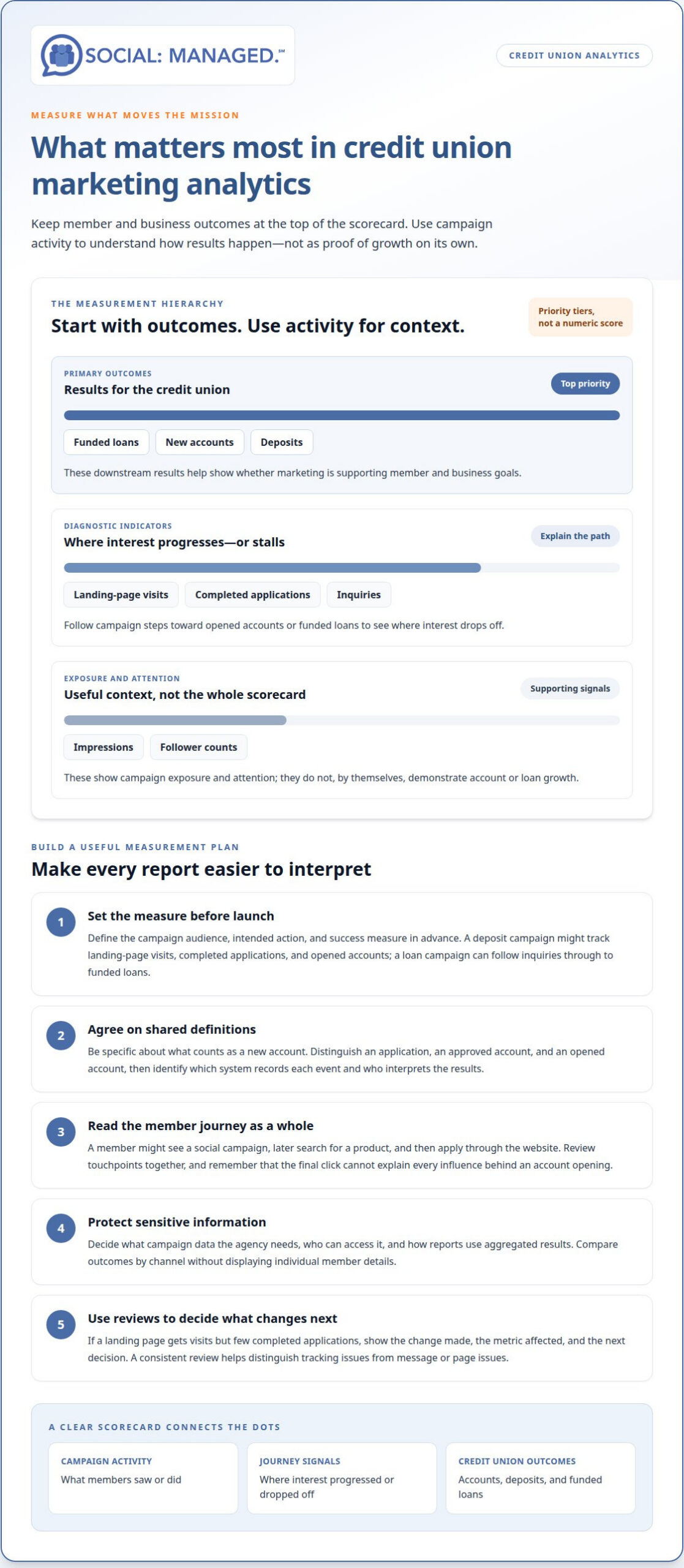
Useful credit union analytics connect marketing activity to member and business outcomes. Track funded loans, new accounts, and deposits alongside impressions and follower counts. These measures serve different purposes: impressions show campaign exposure, while account and loan data show downstream results. A dashboard should keep those categories distinct rather than treating attention as proof of growth.
Begin with a measurement plan for each campaign. Define its audience, intended action, and success measure before launch. A deposit campaign, for example, might track landing-page visits, completed account applications, and opened accounts. A loan campaign could follow inquiries through to funded loans. These steps help the agency explain where interest drops off instead of reporting only how many people saw an advertisement.
Agree on shared definitions before reviewing reports. “New account” should mean the same thing to the marketing team and the credit union’s banking staff. Specify how reporting distinguishes an application, an approved account, and an opened account. Then map which system records each event and who interprets the results. Without shared definitions, teams may report different totals for the same campaign.
Credit union analytics also benefit from a view of the member journey. Someone might first see a social campaign, later search for a product, then apply through the website. Reviewing those touchpoints together can reveal how channels connect. Attribution requires care: the final click doesn’t explain every influence behind an account opening. Reports should identify the method used and clarify what it can show.
Privacy and security belong in the analytics workflow from the start. Define which campaign data the agency needs, who can access it, and how reports use aggregated results. A report, for example, can compare account outcomes by channel without displaying individual member details. Clear access roles and limited data sharing help teams use evidence while protecting sensitive banking information.
Review performance on a schedule that supports campaign decisions. The agency can flag a landing page with visits but few completed applications, then recommend a focused improvement. A report should show the change made, the metric affected, and the next decision. This turns analytics into an operating tool rather than a static presentation, and helps separate tracking issues from message or page issues.
For a practical next step, discuss a shared measurement plan that connects campaign activity to credit union outcomes. Clear definitions, privacy-conscious reporting, and consistent reviews make results more useful to both teams.
Paid media and advertising
Effective Olathe marketing services for credit unions connect paid social campaigns, email marketing, and digital marketing with clear member-growth goals. Each channel has a distinct role. A social campaign can introduce a checking offer, while an email sequence explains its features to subscribers. The plan should connect every message to a relevant next step.
Start by matching each campaign to an audience and objective. A campaign for new residents near an Olathe branch might highlight digital banking and local service. A campaign for existing members could feature a relevant product instead. These goals call for distinct creative, audience settings, and landing-page content. Combining them without a clear purpose can blur the message.
Paid advertising needs a destination that carries the promise forward. If an advertisement promotes a personal loan, its landing page should explain the product and make the application path easy to find. The same applies to deposit campaigns. Consistent messaging from advertisement to page helps prospective members understand what happens after they click.
Audience decisions should reflect the credit union’s membership strategy. A professional can define geographic targeting around the communities the institution serves, then align campaign content with those audiences. In Kansas, residents may commute across state lines within the Kansas City metro. Olathe marketing services for credit unions should account for those regional patterns while staying grounded in membership goals.
Security policies should shape campaign operations from the start. Establish who approves creative, who can access advertising accounts, and how member information is handled. A campaign can, for example, use audience-level performance reporting without placing personal banking details in ad creative. A clear approval path also helps teams review product wording, links, and landing pages before launch.
After launch, the agency should review delivery, audience response, and intended actions together. If a campaign earns clicks but few completed applications, the issue may be the landing page or application path. If engagement is low, the audience or message may need refinement. Decisions should follow the campaign’s measurement plan, not a single attention metric.
Social media management and email marketing can keep communication consistent between advertisements and ongoing member content. A social post, for example, can reinforce a campaign theme, while a follow-up email provides more detail. Together, these channels can carry a paid campaign’s message across the member journey.
Credit union marketing experience
Olathe agencies can differ in how well they understand credit unions’ member-owned structure and defined fields of membership. Ask how that knowledge shapes campaign planning, creative review, and reporting. Compare results through the agency’s process and the outcomes it tracks, not broad claims about financial-sector experience.
A credit union’s field of membership affects who can join and which audiences a campaign should reach. An experienced agency builds that detail into its audience strategy instead of treating every Kansas resident as a prospective member. A campaign for an institution serving a particular employer group, for example, should speak to that community’s needs and clearly explain the path to membership.
Member ownership also calls for a different message from a conventional customer-acquisition pitch. Credit unions serve members as participants in the institution, so campaign language should reflect that relationship. During discovery, the agency should learn how the institution describes membership, which benefits it wants to emphasize, and how those messages differ across products. This keeps digital content relevant without reducing the credit union to generic banking claims.
Credit union experience includes working within an approval process. A practical workflow identifies who reviews product details, creative, and final campaign materials. The agency, for example, can prepare a draft message and supporting context for internal review, then incorporate approved changes before publication. This helps marketing move forward while leaving product and compliance decisions with the appropriate institution teams.
Ask for a specific explanation of how past financial-institution work shaped a strategy. A useful example describes the audience, marketing challenge, channels used, and how performance was assessed. A vague reference to “financial clients” doesn’t show whether the agency understands member acquisition, retention, or the differences between credit unions and other institutions.
Evaluate results in context. A campaign’s performance depends on its audience, offer, landing page, and the action being measured. A digital campaign that generates interest but few completed applications, for instance, may need a clearer application path. The agency should explain what it reviewed and recommend what to do next, without presenting one isolated metric as proof of overall success.
Finally, assess how the agency works with your team. A sound partnership makes responsibilities clear: the agency develops and manages marketing work, while the credit union supplies product information and internal approvals. Ask how the team handles feedback, organizes shared materials, and communicates campaign decisions. These working practices reveal whether its credit union knowledge can translate into consistent execution for your institution.
An agency with credit-union experience should be able to show how membership eligibility and member-owned messaging influenced its campaign strategy and how it worked through institutional reviews. Compare results by the audiences and actions measured, the performance context, and how findings informed recommendations, not by broad claims or isolated metrics.
Credit union-focused marketing firms
A credit union-focused firm builds its work around the institution’s membership model, not just financial-services terminology. That focus can shape audience planning, campaign language, and how the marketing team understands member priorities. A general agency may also bring relevant expertise, but its process should show how it adapts to credit union needs.
Look for evidence in the firm’s approach, not only its positioning. During an initial planning conversation, a specialized team should be able to discuss field of membership, member ownership, product goals, and internal review. A campaign for a credit union serving a county-based community, for example, may need different messaging from one designed for a defined employer group.
A personalized strategy should reflect how members interact with the institution. Some may prefer digital account information, while others value branch access or direct communication. The marketing plan should connect those preferences to useful content and convenient next steps. A firm that understands the distinction can help avoid using one broad message for every audience and channel.
Specialization can also influence workflow. A firm familiar with credit union teams should clarify responsibilities, from receiving product information to preparing campaign materials for internal review. The marketing team can, for instance, organize draft messages and creative together so decision-makers can review the full context. Clear stages help owners and staff understand where their input matters.
Ask how the firm’s work supports both member growth and ongoing relationships. New-member campaigns may focus on membership eligibility and a product’s value. A separate communication plan might help current members understand a new service. These are different objectives, so the firm should explain how its recommendations change with the audience, offer, and intended action.
Specialization is not automatically the best fit for every institution. A credit union with a narrow project may need a focused capability, while a team coordinating several channels may value broader strategic support. Compare the proposed scope with your internal capacity. If staff already manage some campaign tasks, define how an outside firm would complement that work rather than duplicate it.
Use a practical evaluation sequence. First, review the firm’s discovery questions and proposed planning process. Next, ask it to explain how it would adapt a sample campaign to your membership and priorities. Then assess how it handles creative review, reporting, and collaboration with staff. This gives owners and decision-makers a clearer view of the working relationship before choosing a direction.
In Olathe, the right firm is one whose specialization and process match your credit union’s goals, team, and member communities. A focused firm may bring relevant context; a broader partner may offer useful coordination across marketing needs. The deciding factor is how clearly its proposed work connects your institution’s priorities to specific activities and measures.
Social: Managed: Search Engine Optimization
Social: Managed helps credit unions connect marketing priorities with practical digital campaigns. Its Search Engine Optimization, Social Media Management, Digital Marketing, and Google Ads offerings can support visibility and member engagement across different channels. Turn to the agency when you want a coordinated approach shaped around your institution’s goals, audience, and available team capacity.
A credit union, for example, can align helpful search content with social posts and paid campaigns, then assess how each channel supports broader marketing objectives. The right mix depends on what your institution needs to communicate and which outcomes matter most. Social: Managed can help organize the work into a clear, connected strategy.
Contact Social: Managed to discuss your credit union’s marketing needs.
Move Your Credit Union’s Marketing Forward
Choosing Olathe marketing services for credit unions is an opportunity to shape how your institution connects with members and prospective members. The next step is turning your priorities into a focused plan, with clear roles for your internal team and marketing partner. Start with the challenge that matters most now, whether improving discoverability, strengthening ongoing communication, or coordinating digital campaigns. A defined starting point helps keep decisions practical and collaboration productive.
Social: Managed can support that work through Search Engine Optimization, Social Media Management, and Digital Marketing. We can shape these capabilities around your credit union’s goals and audience. Bring your priorities and questions to the conversation, then explore a direction that fits your team.
Your next marketing move can start with a clear conversation about what your members need and where you want to go.
Frequently Asked Questions
Can marketing improve the member experience too?
Yes. Clear marketing can help members find useful information and understand what to do next. A credit union could, for example, publish a plain-language guide to preparing for a vehicle loan application, then share it with members by email. This can make a common banking task easier to understand and help members feel more informed before contacting staff.
Which marketing agencies in Olathe, Kansas specialize in credit unions?
Social: Managed serves businesses in Olathe and provides digital marketing services relevant to credit unions. Institutions evaluating Olathe marketing services for credit unions can consider how an agency adapts its work to member priorities, eligibility, and campaign goals. Ask for a clear explanation of the proposed process, including how the agency will coordinate marketing activity with the credit union’s product knowledge and internal approvals.
What marketing services do Olathe agencies offer credit unions?
Services can include search engine optimization, social media management, Google Ads, Facebook Ads, email marketing, and website design. Social: Managed offers these digital services, along with photography and video production. A credit union might update its website to clarify product details, then support that information with social content. The right combination depends on the audience and the purpose of each campaign.
Which Kansas City-area agencies serve credit unions in Olathe?
Social: Managed serves businesses in Kansas City, Overland Park, Olathe, and Leawood. Credit unions seeking Olathe marketing services for credit unions can explore how our digital marketing capabilities fit their goals and team capacity. A useful discussion can focus on the institution’s priority audience, communication needs, and the channels it wants coordinated, rather than assuming every service belongs in the plan.
What local advertising channels reach prospective credit union members in Olathe?
Local SEO, Google Ads, Facebook Ads, social media, and email can help credit unions reach audiences with relevant information. Search content, for example, can explain membership eligibility, while a local ad can direct interested people to a page describing account options. Email can support ongoing communication with subscribers. Channel selection should reflect the intended audience and the action each campaign is designed to encourage.
What should a credit union look for when choosing a marketing agency in Olathe?
Look for a defined planning process, relevant understanding of financial institutions, transparent reporting, and clear collaboration practices. Ask how the agency would approach a specific need, such as explaining membership eligibility to prospective members. Its response should connect audience, message, and channel choices. Also establish how drafts and revisions will be coordinated with credit union staff before campaign materials are published.
How can a marketing agency help Olathe credit unions measure campaign performance and ROI?
An agency can connect campaign activity with outcomes such as new accounts, deposits, and funded loans. It can also clarify how visits, inquiries, and completed applications are tracked across channels. Social: Managed provides real-time reporting on advertising performance and conversions. Reviewing these measures together can help a credit union understand how its marketing supports business goals and which campaign elements may need adjustment.
How do Olathe marketing agencies compare on credit union experience and results?
Compare agencies by whether they understand member ownership, field-of-membership considerations, and compliance needs. Assess results using funded loans, new accounts, and deposits, with impressions and follower counts treated as supporting measures, not proof of growth.

Ready to get started? Reach out to Social: Managed. online, or call us at 866-324-9700. We manage your company’s social life so you can have one! You don’t need complicated packages. We listen to your goals.
Then we design and manage SEO, social media, ads, websites, and email campaigns built to deliver results. No jargon. No guesswork. Just real growth from a team that cares. Ready to get rolling? Follow Social: Managed. on Facebook for a peek into our social life.