
Top Digital Marketing and SEO Services in Kansas City: Your Go-To Agency for Web Design, WordPress, and Custom Solutions
SEO alone isn’t the whole growth strategy for an engineering firm. A B2B SEO strategy for engineering firms in Overland Park is stronger when organic search works alongside local visibility, a website built to convert, paid search, and other digital channels.
It makes sense to focus on SEO: engineering buyers often research technical capabilities and compare potential partners before they reach out. But visibility only helps when the information they find answers their questions and gives them a clear next step. Ongoing digital marketing connects those parts of the journey instead of treating each channel as a separate effort.
This article explains how SEO, local search, conversion-focused websites, SEM, and supporting channels can work together. You’ll see what each contributes, how to match channels to different stages of a B2B buying journey, and why clear, technically credible content matters to engineers and decision-makers alike.
Key Takeaways
- Shape technical content around the questions engineers, decision-makers, and other buyers need answered before they make contact.
- Build local visibility around genuine operating presence and relevant regional needs, not city names alone.
- Choose service and location pages based on what they can accurately explain, then make the next step clear to prospective buyers.
- Connect SEO with paid search and other digital channels so each supports a different part of the research and purchasing journey.
- Measure progress through separate stages, from search visibility and site visits to accepted inquiries and sales opportunities.
Content for engineers, decision-makers, and technical buyers
For engineering firms, effective SEO combines technically accurate service content, sound technical SEO, and evidence that helps buyers make decisions. A strong strategy answers specific project questions, explains specialized capabilities, and connects organic traffic with qualified sales conversations.
Buyer-Question Content Opportunities
Start with questions from sales calls, project briefs, and search queries, such as whether your firm handles a particular testing method or facility type. Compare these questions with organic traffic and inquiry patterns, then refine content around topics that attract relevant buyers. To earn authoritative backlinks and industry citations, create useful technical resources and pursue relevant editorial references instead of relying on unrelated links.
Specialized Engineering Service Content
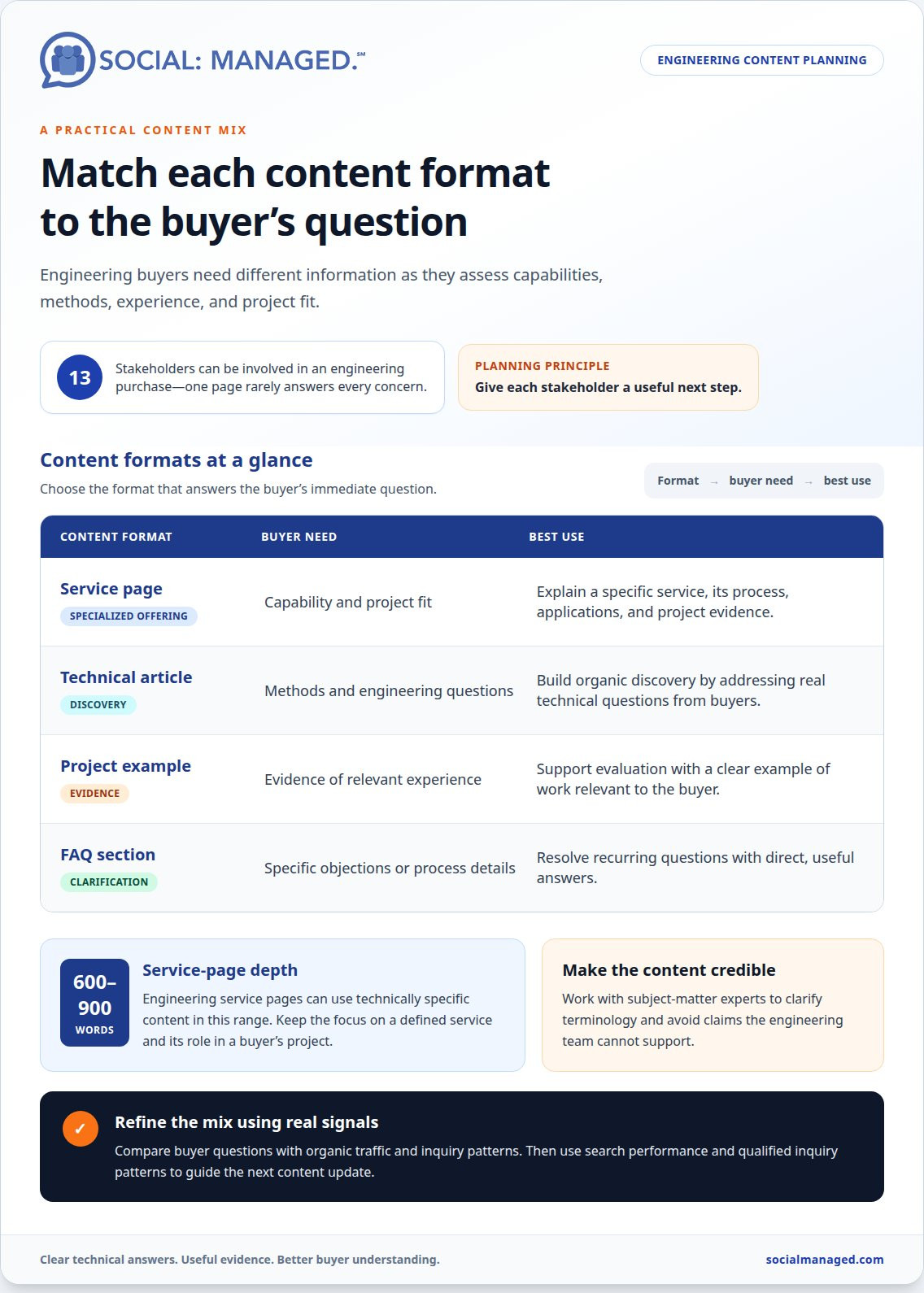
Dedicated service pages explain a firm’s actual capabilities, processes, applications, and project evidence. A page about structural analysis, for example, should clarify the problems addressed and the information a prospective buyer needs to assess fit. Engineering service pages can contain 600 to 900 words of technically specific content. Unlike broad educational articles, these pages focus on a defined service and its role in a buyer’s project.
Technical accuracy matters as much as search visibility. A professional SEO provider works with subject-matter experts to organize details, clarify terminology, and avoid claims the engineering team cannot support. Clear page structure also helps search engines interpret the service. A well-organized Overland Park website design can support that information with a focused layout and a visible inquiry path.
Complex B2B Journey Content Planning
Engineering purchases can involve 13 stakeholders, so one service page rarely answers every buyer’s concern. A technical evaluator may need methods and specifications, while a project leader may look for delivery fit and documented experience. A content plan should connect service pages, supporting explanations, and project evidence, giving each stakeholder a useful next step without making every page repeat the same pitch.
| Content option | Buyer need | Best use |
|---|---|---|
| Service page | Capability and project fit | Explain a specialized offering |
| Technical article | Methods and engineering questions | Build organic discovery |
| Project example | Evidence of relevant experience | Support evaluation |
| FAQ section | Specific objections or process details | Resolve recurring questions |
Choose a format that answers the buyer’s immediate question, then use search performance and qualified inquiry patterns to guide the next content update.
Local SEO and Google Business Profile optimization
Local search can help engineering firms appear for relevant regional needs, but geographic targeting must reflect actual service coverage. A desired sales territory alone does not establish a local operating presence for a Google Business Profile. Local SEO should connect accurate business details with useful service information and clear next steps for buyers.
A professional SEO provider aligns the profile and website around the same capabilities, service territory, and contact information. For example, if an engineering firm serves Overland Park from an office elsewhere, its pages can explain the actual coverage without implying a local office. An Overland Park SEO strategy should make regional relevance clear while keeping business details accurate.
Location pages need a distinct purpose. Adding a city name to several nearly identical pages gives buyers little useful information. Instead, a regional page should explain relevant project needs, supported delivery conditions, and the services available in that area. If an existing service page answers those questions accurately, improving it may help buyers more than creating another page.
On-page optimization makes those answers easier to find. Refine page titles, headings, service descriptions, and internal links so related capabilities connect logically. A page about environmental engineering, for example, might link to a relevant assessment service and project example. Technical structure matters too: search crawlers need access to readable content, and buyers need a clear path to contact you or request information.
AI search adds another reason to make technical content accessible and direct. AI systems use website content they can read, rank, and cite when answering buyer questions. Answer Engine Optimization supports that discovery by organizing clear explanations around real questions, not by repeating keywords. Digital PR can also earn relevant industry citations when useful expertise receives coverage from credible publications.
Reporting should distinguish search visibility, website visits, accepted inquiries, and sales opportunities. A contact form alone does not show whether an inquiry is qualified. Compare landing-page performance with sales feedback, then improve content or internal links where relevant buyers stall. For AI search observations, record the question, answer surface, date, and cited sources to distinguish company mentions from citations, referral visits, and sales activity.
Conversion optimization connects local discovery to pipeline outcomes. The provider can assess whether a service page explains project fit, whether contact options are easy to find, and whether sales receives enough context to follow up.
Plan an Integrated Digital Marketing Strategy
Local search and conversion-focused websites
A regional search result can earn attention, but the page must help engineering buyers assess fit. For an Overland Park project, your site should explain relevant capabilities, delivery conditions, and a clear next step. A location page makes sense when buyers have a distinct regional decision to make and your firm can provide specific information, not simply another variation on a city name.
Website structure should make technical detail easy to find. A professional SEO provider can map each service page to a buyer need, connect related pages with internal links, and ensure inquiry paths remain visible. For example, a page about industrial process design can link to a relevant project example and explain what information helps scope a conversation. This supports search relevance and buyer engagement together.
Technical SEO issues often surface during redesigns: missing redirects, blocked pages, broken internal links, duplicate templates, and content search engines cannot read. A poorly managed migration can cause an established B2B company to lose 60-80% of its organic traffic within weeks of launching a new site. Before redesign work, an agency can audit 12-24 months of Search Console and Analytics data to identify valuable pages, queries, and traffic patterns.
Use the audit to guide design and optimization, not just document past performance. Preserve important URLs, map old pages to relevant replacements, and check that templates publish crawlable content. Search Console exports also need their original dimensions and filters preserved. Do not combine separate page and query exports as proof that a particular query led to a particular page.
Engineering firms should work with an SEO provider to track ranking and visibility as diagnostic measures, then connect qualified leads to sales opportunities and revenue records. The sales team’s definition of a qualified lead gives reporting a practical standard, while Analytics and CRM outcomes help assess return on investment.
AI search visibility needs its own evidence trail. For each observation, record the question, answer surface, date, and cited sources. Distinguish a company mention from a citation, recommendation, referral visit, or sales activity. A changed answer alone does not prove that a website edit caused the change, so compare observations over time with website and pipeline records.
Technical accuracy strengthens both traditional ranking and AI visibility. Search systems need readable, well-structured explanations; engineers need precise service details that match the firm’s actual work. A professional provider can connect those requirements, then use engagement and inquiry patterns to improve pages without sacrificing technical meaning.
Engineering buyers’ online research and purchasing decisions
Engineering buyers research capabilities, compare technical evidence, and align stakeholders before contacting a firm. Strong content supports each decision, from early problem research to enterprise vendor evaluation.
Buyer Research and Complex Sales Cycles
Different stakeholders assess different risks. An engineer may evaluate methods and technical fit, while a procurement lead focuses on scope and vendor requirements. A project executive may prioritize delivery confidence. Support each perspective with relevant service details, project examples, and clear explanations. Unlike a single landing page, a connected set of resources lets buyers return as their evaluation becomes more specific.
Buyer Intent and Keyword Selection
Choose keywords based on the question behind a search, not just search volume. “Engineering consulting” signals broad research; a phrase about a specific assessment or design challenge suggests a more defined need. Map each intent to an appropriate page, then review organic traffic and accepted inquiries. This connection helps separate useful visibility from visits that do not match your firm’s work.
Buyer-Specific Keyword Targeting
Buyer-specific targeting connects language to the role, project, and service involved. A facility manager researching a system upgrade may need different details from an engineer evaluating calculations. Address those needs without creating thin variations for every job title. A geographic phrase also does not establish the searcher’s identity or project location, so support regional intent with page content and sales context.
AI tools now form part of some buyers’ research journeys. Buyers may use them to summarize technical topics, compare approaches, or prepare questions for vendors. AI visibility depends partly on clear, readable website content that systems can interpret and cite. Strengthen that foundation with accurate explanations, descriptive headings, and specific service information instead of keyword repetition.
Measurement should follow the path from discovery to sales. Track rankings and organic visibility, then compare landing-page visits with accepted inquiries and sales opportunities. Analytics shows site behavior, while sales feedback clarifies whether a lead fits your services. A completed form alone is not a qualified opportunity; the project need and your sales team’s criteria matter.
For an enterprise purchase, content should help stakeholders share an understanding of a service. A technical explainer can clarify methods, while a project example shows how those capabilities apply. Internal links can guide buyers between these resources and a relevant service page. This creates a practical research path without assuming every visitor is ready to contact sales.
Combining SEO with SEM and other digital marketing channels
SEO builds organic visibility around engineering services, while search engine marketing can place paid listings beside relevant searches. Used together, they give a firm more than one route to reach buyers. A B2B SEO strategy for engineering firms in Overland Park can pair an organic service page with a Google Ads campaign targeting buyers searching for that service.
Each channel has a different role. SEO supports discovery through useful pages and search visibility; paid search can test specific messages and direct buyers to focused landing pages. Search terms, clicks, and inquiries can reveal which needs deserve deeper organic content. Use actual buyer responses, not assumptions about which services will attract opportunities, to guide marketing decisions.
Campaign alignment matters. If an ad promises information about a structural assessment, its landing page should explain the service, relevant project fit, and next step. A mismatch between ad copy and page content wastes attention and makes evaluation harder. Consistent language across paid and organic pages helps buyers understand your firm’s capabilities.
Email marketing can support prospects who are not ready to discuss a project after one visit. A useful follow-up might share a technical article, project example, or explanation of an engineering process. Match the content to the reader’s interest and offer a meaningful next step instead of treating every contact as ready to buy.
Social media can extend the reach of technical content, especially when an engineer shares a clear explanation or project insight. A post can direct interested readers to a detailed service page, where they can continue their evaluation. These channels work best when each has a defined role rather than repeating the same message everywhere.
Execution depends on shared goals and clear reporting. A coordinated digital marketing program can connect campaign traffic with landing-page engagement, accepted inquiries, and sales opportunities. Search visibility, visits, and qualified leads are separate stages, so reporting should preserve those distinctions. Sales feedback also helps identify whether an inquiry fits your firm’s actual services.
Choose channels to match the growth objective. A firm entering a new service market may use paid search to test relevant demand while building organic pages around buyer questions. For a local strategy in Overland Park and the Kansas City area, your sales team’s definition of a qualified lead should guide targeting and show whether campaigns reach suitable prospects.
The practical takeaway is integration, not simply adding channels. SEO, Google Ads, email marketing, and social media can support different moments in the research journey when messaging, destination pages, and measurement work together.
Social: Managed. | Search Engine Optimization
At Social: Managed., we help engineering firms connect search visibility with the questions buyers ask before starting a project. Our Search Engine Optimization work can strengthen technical service content, improve how pages appear in search, and align organic traffic with qualified inquiry goals. When your firm also needs paid visibility, our Google Ads management can support campaigns around priority services.
Turn to us when your website attracts the wrong inquiries, important capabilities are hard to find, or search activity is not translating into meaningful sales conversations. We can shape the work around your services, sales process, and the information buyers need to evaluate fit.
Set a Clear Direction for Your Next Stage of Growth
The next step is to decide which business objective should guide your marketing investment. A B2B SEO strategy for engineering firms in Overland Park can be shaped around priorities such as entering a new market, strengthening demand for a specialized service, or improving the quality of sales conversations. A clear priority helps keep channel choices and performance measures connected to meaningful business outcomes.
At Social: Managed., we offer Search Engine Optimization, Social Media Management, and Digital Marketing to support this work. The right starting point depends on your firm’s goals, existing marketing activity, and the buyer actions you want to encourage. A focused discussion can turn those priorities into a practical direction for your next stage of growth.
With a defined direction and the right support, your engineering firm can build a more deliberate path from online discovery to valuable business relationships.
Discuss Your Goals With Social: Managed.
Frequently Asked Questions
Why ongoing SEO and digital marketing?
Ongoing work keeps your online information aligned with changing services, buyer questions, and website performance. A new engineering capability may call for updated pages, while analytics can reveal that an older page attracts visitors but few suitable inquiries. Regular review gives your marketing strategy a way to respond and helps coordinate search, paid campaigns, and follow-up content around current business priorities.
What should regional B2B SEO services cover?
Regional B2B SEO should connect relevant searches with accurate service information and a clear sales handoff. For a firm serving Overland Park, Kansas City, Olathe, and Leawood, that means explaining where projects can be delivered and what capabilities apply. A provider can also clarify who handles technical fixes, approves publishing, and receives qualified inquiries. These responsibilities keep strategy connected to website execution and sales follow-through.
How do engineering buyers search for engineering services online?
Engineering buyers often begin with a technical problem, then narrow their research by application, service, and provider fit. A facilities team might search for help evaluating a system; an engineer may look for a specific analysis method. Some buyers also use AI tools to summarize unfamiliar topics or prepare vendor questions. Useful pages should therefore explain terminology clearly and connect the problem to relevant engineering capabilities.
Which SEO keywords have commercial intent for engineering firms in Overland Park?
Commercial-intent keywords usually combine a service or application with provider language and, where relevant, a location. Illustrative examples include “Overland Park civil engineering firm,” “structural engineering consultant Kansas City,” or “industrial engineering services.” The best targets depend on your firm’s actual capabilities and project types. Map each phrase to a page that answers the buyer’s evaluation question, rather than forcing every term onto one generic services page.
Who are the top-ranking engineering firms in Overland Park, and what SEO tactics do they use?
There is no single permanent list of top-ranking firms because results can vary by service query, search location, and time. A meaningful competitive review compares firms appearing for the same engineering need, then examines their service-page depth, technical explanations, local relevance, and project evidence. This analysis can reveal content gaps and positioning opportunities without assuming a competitor’s visible tactic caused its rankings or sales results.
What local SEO services help engineering firms improve visibility in Overland Park and Kansas City?
Useful local SEO can include accurate Google Business Profile information for eligible businesses, consistent business details, and regional service content grounded in real delivery capabilities. For a firm serving Overland Park and Kansas City, assess whether existing service pages answer local buyer questions or whether distinct regional information is warranted. Make coverage clear without implying an office or operating presence where none exists.
How can an SEO provider optimize engineering firms’ service pages and technical content?
Work with engineering subject-matter experts to clarify the service, intended applications, methods, and project evidence. Then organize the page with descriptive headings, accurate page titles, and links to related capabilities. For example, a page about site assessment could guide readers toward relevant services and a practical inquiry step. Keep technical accuracy central so optimization supports understanding rather than changing engineering claims.

Ready to get started? Reach out to Social: Managed. online, or call us at 866-324-9700. We manage your company’s social life so you can have one! You don’t need complicated packages. We listen to your goals.
Then we design and manage SEO, social media, ads, websites, and email campaigns built to deliver results. No jargon. No guesswork. Just real growth from a team that cares. Ready to get rolling? Follow Social: Managed. on Facebook for a peek into our social life.