
Top Digital Marketing and SEO Services in Kansas City: Your Go-To Agency for Web Design, WordPress, and Custom Solutions
The strongest UpSwell marketing alternatives for local businesses combine customer engagement, advertising expertise, and an understanding of the local market. The right fit depends on whether you need to attract new customers, strengthen relationships with existing ones, or coordinate both.
It’s easy to compare providers by their service lists, but what matters is how those services support your business goals. This guide explains how customer engagement platforms differ from advertising-led agencies, what local-business expertise looks like in practice, and which capabilities to weigh when comparing options. Use these criteria to identify an approach that fits your priorities.
Key Takeaways
- Compare platforms by how they attract customers and support ongoing engagement, not just by their feature lists.
- Assess marketing alternatives by their advertising expertise, channels, and fit with your business goals.
- Look for a local-business approach that connects marketing activity to the customers and communities you serve.
- Review contract length, setup costs, cancellation terms, and account access so you understand the commitment before signing.
- Choose between software and agency support based on the time, skills, and strategic guidance your team needs.
Customer acquisition and engagement platforms
Customer acquisition tools help businesses reach prospective buyers. Engagement platforms support useful communication after first contact. Some alternatives combine both, while others focus on a channel such as advertising or direct mail. The practical difference is whether the solution supports the customer journey from discovery through follow-up.
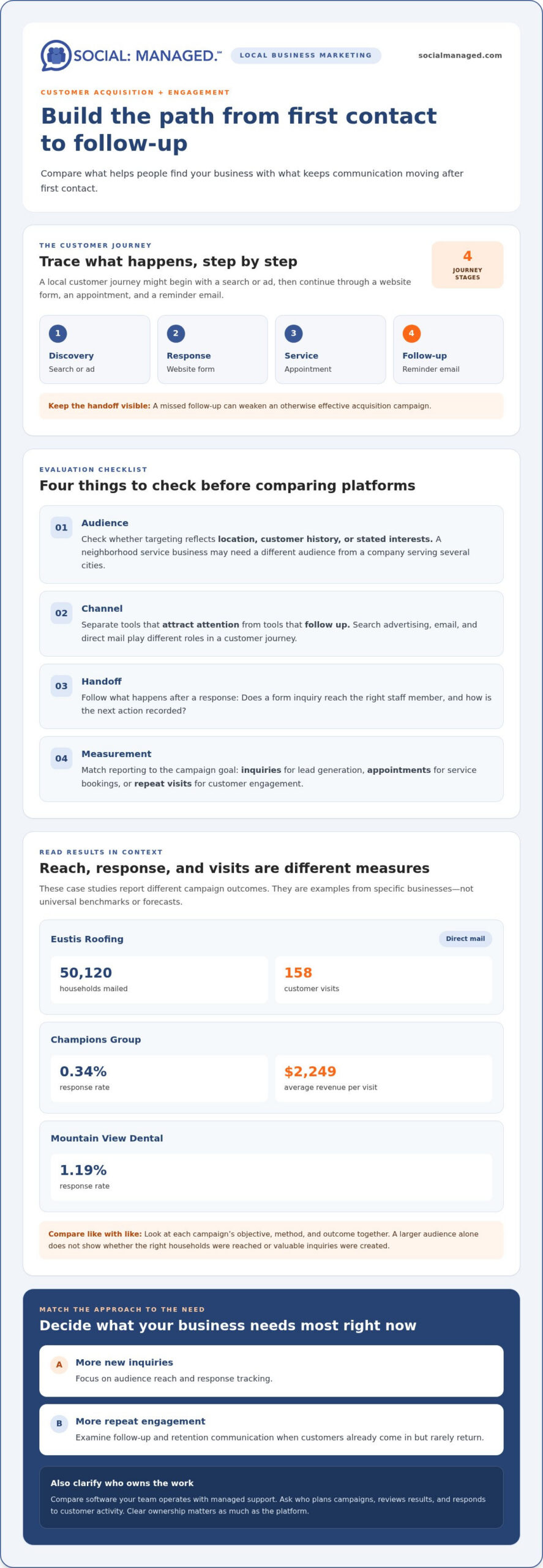
For a local business, that journey might start with a search or ad, then continue through a website form, an appointment, and a reminder email. A platform can organize these steps, while advertising expertise helps shape the audience, message, and campaign. Before comparing options, map how customers find you and what happens next. A missed follow-up can weaken an otherwise effective acquisition campaign.
Use specific outcomes to understand what a campaign is designed to do. The Eustis Roofing case study reports 50,120 households mailed and 158 customer visits. Those figures describe a direct-mail campaign, not a universal benchmark for other businesses. They show why comparisons should distinguish reach from response and visits. A larger audience alone doesn’t explain whether a campaign reached the right households or created valuable inquiries.
Other case studies illustrate different measures. The Champions Group case study reports a 0.34% response rate and average revenue per visit of $2,249. The Mountain View Dental case study reports a 1.19% response rate. These examples reflect different businesses and campaign contexts. Compare each metric with the campaign goal, rather than treating one response rate as a forecast for another company.
When evaluating an acquisition or engagement platform, examine these practical elements:
- Audience: Identify whether targeting is based on location, customer history, or stated interests. A neighborhood service business may need a different audience from a company serving customers across several cities.
- Channel: Separate the tools used to attract attention from those used to follow up. Search advertising, email, and direct mail play different roles in a customer journey.
- Handoff: Trace what happens after someone responds. For example, note whether a form inquiry reaches the right staff member and how the business records the next action.
- Measurement: Match reporting to the objective. Track inquiries for lead generation, appointments for service bookings, or repeat visits for customer engagement.
Market priorities add context: digital marketing was the top area where surveyed businesses planned to increase investment, while most planned to keep workforce numbers steady. That makes efficient campaign management relevant. Compare software-led options with managed support by asking who plans campaigns, reviews results, and responds to customer activity. Clear ownership matters as much as the platform.
Distinguish customer acquisition from ongoing engagement before choosing an approach. If your immediate need is new inquiries, focus on audience reach and response tracking. If customers already come in but rarely return, examine follow-up and retention communication. Comparing UpSwell marketing alternatives for local businesses is more useful when each option is assessed against a specific business need.
Contact Social: Managed. to Discuss Your Marketing Strategy
UpSwell competitor comparisons
Compare UpSwell with alternatives by service model, campaign channels, and who does the work. A direct-mail provider, customer engagement platform, and digital marketing agency may all support acquisition, but they do different jobs. One may focus on campaign execution, while another coordinates search visibility, advertising, and ongoing optimization. Start by defining the outcome you need, such as more qualified inquiries or stronger repeat engagement.
Next, consider how each option reaches local customers. A campaign targeting a defined service area differs from one built for broad online visibility. Ask how location, audience intent, and messaging shape the plan. For a roofing company, reaching nearby homeowners may matter more than maximizing general impressions. For a dental practice, appointment inquiries may be more useful to track than raw website visits.
Then compare what the working relationship includes. One provider may supply software for your team to operate; another may plan and manage campaigns. A third may handle selected channels while your staff manages follow-up. These differences affect how much internal time you need to set aside. Compare responsibilities for strategy, creative work, campaign adjustments, reporting, and lead handoff.
Use a simple comparison sheet. Record the same details for each option, rather than relying on broad claims or feature counts.
- Primary objective: Note whether the offer targets new leads, repeat customers, or both.
- Channel coverage: List the channels included, such as search, social media, email, or direct mail.
- Management: Identify who plans, launches, monitors, and adjusts each campaign.
- Reporting: Check whether reports connect activity to inquiries, appointments, or sales conversations.
- Business fit: Record how the approach accounts for service areas, seasonal demand, and customer type.
A local contractor with limited staff, for example, may value coordinated management and a clear lead handoff. A business with an experienced in-house marketer may prefer a focused platform that supports internal execution. Neither model is automatically better. The right choice depends on which tasks your team can manage consistently and where specialist support would help.
Businesses assessing UpSwell marketing alternatives for local businesses should distinguish documented results from promises. A case study shows what happened for one company, but its audience, offer, and market may differ from yours. Consider the stated objective, campaign method, and outcome together, then decide whether the circumstances resemble your own.
Finally, score each option against your written priorities. If local reach matters most, weigh its audience and geographic targeting. If follow-up is the gap, focus on workflow and ownership. This turns a broad comparison into a practical decision based on the work your business needs.
Local-business marketing focus
A local campaign should reflect where customers live, what they need, and how they choose a nearby provider. A plumber serving Kansas City, for example, needs messaging that reflects its actual service area. Broad national language can attract visitors who cannot become customers. Compare providers by how clearly they connect audience, location, and business goals.
Map the customer journey for one service. A homeowner might search for a roof repair, compare local businesses, then call or submit a form. Each stage needs useful information: relevant service details, a clear next step, and a responsive follow-up process. This map helps show whether a marketing plan supports local discovery or simply increases general visibility.
Location should shape campaign targeting and website content. A business serving several nearby communities can create distinct pages or campaigns for each area, as long as the content reflects the services actually offered there. A landscaping company, for example, could feature seasonal work relevant to local customers. Avoid swapping city names into identical copy, which gives visitors little reason to trust the page.
Review how a provider handles local search signals. A Google Business Profile, accurate business details, and service-specific website content help customers understand where a business operates. Ask how these elements work together. A listing may attract attention, but visitors still need a useful page with clear services, contact options, and relevant local information.
Local focus also means adapting campaigns to the business calendar. A tax preparer may emphasize planning before filing deadlines, while a patio contractor may highlight outdoor projects before warmer weather. Timing, offers, and messaging should match customer demand. Ask how campaign content is adjusted when services, availability, or seasonal priorities change.
Use this practical review before comparing proposals:
- Service area: Check that targeting reflects the places the business actually serves.
- Customer intent: Match each campaign to a need, such as booking a consultation or requesting an estimate.
- Local relevance: Look for examples tied to real services, neighborhoods, or customer questions.
- Follow-up: Identify who responds when a local prospect calls, emails, or submits a form.
- Measurement: Track meaningful actions, such as qualified inquiries, rather than visibility alone.
These criteria make comparisons more practical. Businesses comparing UpSwell marketing alternatives for local businesses can judge whether a proposal fits their market, service area, and customer journey. A neighborhood retailer may prioritize nearby discovery and repeat visits. A home-service company may need stronger inquiry handling across several communities. The right plan reflects those differences instead of applying a generic local strategy.
Look for a direct connection between local insight and day-to-day execution. If customers often ask about service boundaries, make those boundaries clear. If seasonal demand shifts, update campaign messages to match. Specific adjustments make marketing more relevant without relying on broad claims about community expertise.
What contract terms, setup fees, and cancellation policies should businesses compare?
Before signing a marketing agreement, compare the full commitment, not just its monthly scope. A short initial term with automatic renewal differs from a fixed-term agreement. Identify the start and renewal dates, notice window, and process for changing services. Put key dates in your calendar so a renewal doesn’t pass unnoticed.
Separate one-time setup from ongoing campaign management. Setup may include account configuration, tracking, creative preparation, or onboarding. Clarify what each task includes and who owns the resulting accounts and materials. If your business already has analytics or advertising accounts, establish whether the provider will use them or create new ones.
Compare fees with the specific deliverables they cover. A setup charge should have a clear scope, such as building campaign structure or configuring reporting. Ongoing charges should explain what work is performed during each service period. Costs depend on the scope, channels, setup requirements, and management needs, so request a quote for your situation.
Give cancellation terms the same attention as the initial commitment. Find the required notice method, effective cancellation date, and any obligations that continue afterward. If a business plans to end service before a seasonal campaign, for example, it should understand whether work stops immediately or continues through a specified period. Compare the written agreement with the proposal rather than relying on a verbal summary.
Check how the contract handles advertising budgets and third-party accounts. It should distinguish provider fees from money paid to advertising platforms. Confirm who controls account access, campaign data, creative files, and website or analytics credentials after cancellation. A clear handover process helps the business retain useful records and continue its marketing.
Use this checklist when reviewing a proposal from any provider:
- Term: Record the start, end, renewal, and notice dates.
- Scope: Match each recurring task to a stated deliverable.
- Setup: Identify one-time work, required access, and account ownership.
- Payment: Separate service charges, advertising spend, and other third-party costs.
- Exit: Document cancellation steps, final work, access transfer, and data handoff.
Test the terms against a realistic scenario. Suppose a local retailer pauses advertising during a slow season. Check whether services can be adjusted, paused, or ended, and what notice applies. If the retailer changes campaign priorities, identify how scope changes are approved and recorded. These examples reveal whether the contract supports ordinary business changes.
Finally, compare the proposal, contract, and invoice description side by side. If the proposal promises campaign reporting but the agreement describes only campaign management, ask for consistent wording before signing. A concise written record makes responsibilities easier to track and gives both sides a shared reference throughout the relationship.
Can local businesses use marketing software instead of hiring an agency like UpSwell?
Yes. A local business can use marketing software if its team has time to plan, run, and review campaigns. A neighborhood café, for example, might schedule email promotions and monitor customer responses internally. Software supports execution, but the business still chooses its audience, message, timing, and goals.
The main trade-off is ownership. A platform can organize marketing tasks, but staff still need to interpret results and decide what to change. A home-service company running Google Ads, for instance, needs to review search terms, inquiries, and service-area fit. Without clear ownership of those decisions, tools alone won’t create a coherent strategy.
An agency can take on strategic and campaign work that a small team may struggle to manage consistently. That can matter when a business needs coordinated advertising, search visibility, or customer communication. The agency model still requires input from the business, such as service details, priorities, and timely lead responses. Software and expert support address different workload needs.
Some businesses may prefer a hybrid approach. A retailer could manage its customer email calendar while getting outside help with campaign planning. A contractor might keep customer records in-house and delegate paid advertising management. This works best when responsibilities are written down, including who creates content, approves changes, and reviews performance.
Before choosing software, estimate the recurring work it requires. List weekly tasks such as drafting messages, checking campaign activity, updating offers, and responding to inquiries. Assign an owner to each task. If one person already handles sales, service, and operations, marketing execution may compete with essential work.
Use these questions to assess whether software alone fits:
- Skills: Can someone on the team set objectives and interpret campaign results?
- Time: Who will maintain campaigns and handle follow-up during busy periods?
- Coordination: Can the team align email, advertising, and website messages?
- Accountability: Who will decide whether to adjust, pause, or continue an activity?
- Support: Does the business need tools, strategic guidance, execution, or a combination?
A software-first approach may suit a business with clear processes and an employee who can manage them. An agency may fit better when planning, execution, and optimization would otherwise fall between roles. A growing clinic, for example, may need a consistent campaign calendar but lack an internal marketing lead. The decision hinges on capacity and expertise, not the software’s feature count.
For a practical test, choose one marketing task and assign its owner, schedule, and success measure. Review the workflow after a full campaign cycle. If the work is difficult to sustain, consider whether additional expertise could close the gap. This makes the choice between software and agency support a decision based on actual workload.
Social: Managed. Search Engine Optimization
Local businesses looking to improve search visibility can work with Social: Managed. Our Search Engine Optimization can align website content with the services and locations your business serves, while Digital Marketing can connect that work with broader campaign goals.
This support can help when your team wants a more consistent online presence or needs to coordinate search with Social Media Management or Google Ads. The right mix depends on your priorities, audience, and current marketing activity. To discuss an approach for your business, contact Social: Managed.
Make your next marketing move with purpose
When comparing UpSwell marketing alternatives for local businesses, start with one priority: the next customer action you want to encourage. Set that goal, identify who will own the work, and decide how you’ll assess progress. A clear starting point keeps decisions focused on your business rather than an endless list of features.
For local visibility goals, a practical next step is to work with our team at Social: Managed. Our Search Engine Optimization, Social Media Management, and Digital Marketing services can support a coordinated approach. The right focus depends on your goals and which tasks your team wants to manage internally. Choose an approach that fits your team’s capacity and gives you a practical way to keep moving forward.
Which UpSwell alternatives specialize in home services, healthcare, or other local industries?
Specializations vary by provider. Social: Managed. serves home services, franchises, real estate, restaurants, ecommerce, business services, and wedding services. For a healthcare practice, compare providers by their experience with patient-focused messaging and appointment inquiries. Businesses in Kansas City, Overland Park, Olathe, and Leawood can also assess whether a provider understands their service area and customer needs. Match industry experience to your audience and marketing goal.

Ready to get started? Reach out to Social: Managed. online, or call us at 866-324-9700. We manage your company’s social life so you can have one! You don’t need complicated packages. We listen to your goals.
Then we design and manage SEO, social media, ads, websites, and email campaigns built to deliver results. No jargon. No guesswork. Just real growth from a team that cares. Ready to get rolling? Follow Social: Managed. on Facebook for a peek into our social life.