
Top Digital Marketing and SEO Services in Kansas City: Your Go-To Agency for Web Design, WordPress, and Custom Solutions
The agency with the biggest menu of services isn’t automatically the right fit for a small business. If you’re weighing WebFX alternatives for midwest small businesses, the better choice depends on which services you need now, how clearly an agency explains its fees, and whether its communication keeps you in control.
It’s reasonable to want one partner who can coordinate marketing without locking you into work that doesn’t match your priorities. You also need reporting that makes campaign activity understandable, not another dashboard you’re left to interpret alone.
This comparison will help you assess agency models, service coordination, communication, and reporting before you commit. You’ll see how to weigh a broad provider against a more tailored approach, including Social: Managed.’s build-your-own service structure, Kansas City roots, and national campaign capacity. The goal is a practical framework for choosing a partner that fits your business today and can adapt as your plans grow.
Key Takeaways
- Choose an agency based on the marketing support your business needs, not on how closely it resembles WebFX.
- Compare service coordination and fee flexibility to understand how an agency can support your priorities without adding unnecessary channels.
- Connect campaign reporting to meaningful business conversions, and consider both real-time visibility and scheduled performance reviews.
- Use a clear shortlist process to match each business goal with a service, a measurable indicator, and the regional experience you value.
- Explore WebFX alternatives for midwest small businesses by weighing local understanding, national reach, communication, and accountability together.
Why Midwest Small Businesses Consider WebFX Alternatives
Comparing marketing agencies can be difficult when each presents a different mix of services, packages, and reporting. A long list of capabilities doesn’t automatically mean a better fit. The right partner should match your current priorities, fee preferences, and capacity to manage marketing, not simply imitate WebFX or another agency.
Start with five practical criteria: service scope, communication, reporting, flexibility, and regional fit. A business focused on local visibility may prioritize search engine optimization and a well-built website. Another may need paid advertising or social media support. Digital marketing can span several core digital marketing channels, but that doesn’t mean every business needs to invest in all of them at once. The useful question is which channels support your goals and how the work will be coordinated.
For example, if a website update, advertising campaign, and social content all support the same seasonal promotion, disconnected vendors can make it harder to keep messaging consistent. A coordinated approach can clarify responsibilities and keep the campaign connected. Comparing digital marketing agency support in Kansas City with other agency models can help you consider how local understanding and a broader service mix might work together.
When should a small business compare agency options?
Consider a fresh comparison when your marketing support no longer reflects your priorities. Signs include juggling several vendors without a clear lead, receiving reports that show activity but don’t explain its business meaning, or paying for services that rarely connect with one another. You may also have new goals, such as expanding into another market or improving the path from an ad click to an inquiry, that call for a different mix of expertise.
A fit issue is different from expecting guaranteed rankings, leads, or revenue. Marketing performance can vary, so an agency cannot responsibly promise a fixed outcome. Instead, look for clear goals, transparent reporting, and a plan that can be reviewed and adjusted as your business learns what works.
What does regional fit mean for a Midwest business?
Regional familiarity can help an agency shape messaging around the communities, customer expectations, and business context a company serves. That perspective can inform campaign planning without limiting a business to one city. Social: Managed. is headquartered in Kansas City, Missouri, and serves businesses nationally, combining a Midwest home market with national campaign capacity.
Regional fit also isn’t a substitute for a sound strategy. A local business may need campaigns centered on nearby customers, while a growing company may want to reach audiences across multiple markets. For businesses in Kansas City, Overland Park, Olathe, and Leawood, compare how an agency connects local context to channel choices, campaign messaging, and the people responsible for the work. The right alternative fits your actual scope today and can support a considered next step, rather than assuming every Midwest business needs the same channels or level of service.
Compare Agency Services, Coordination, and Fee Flexibility
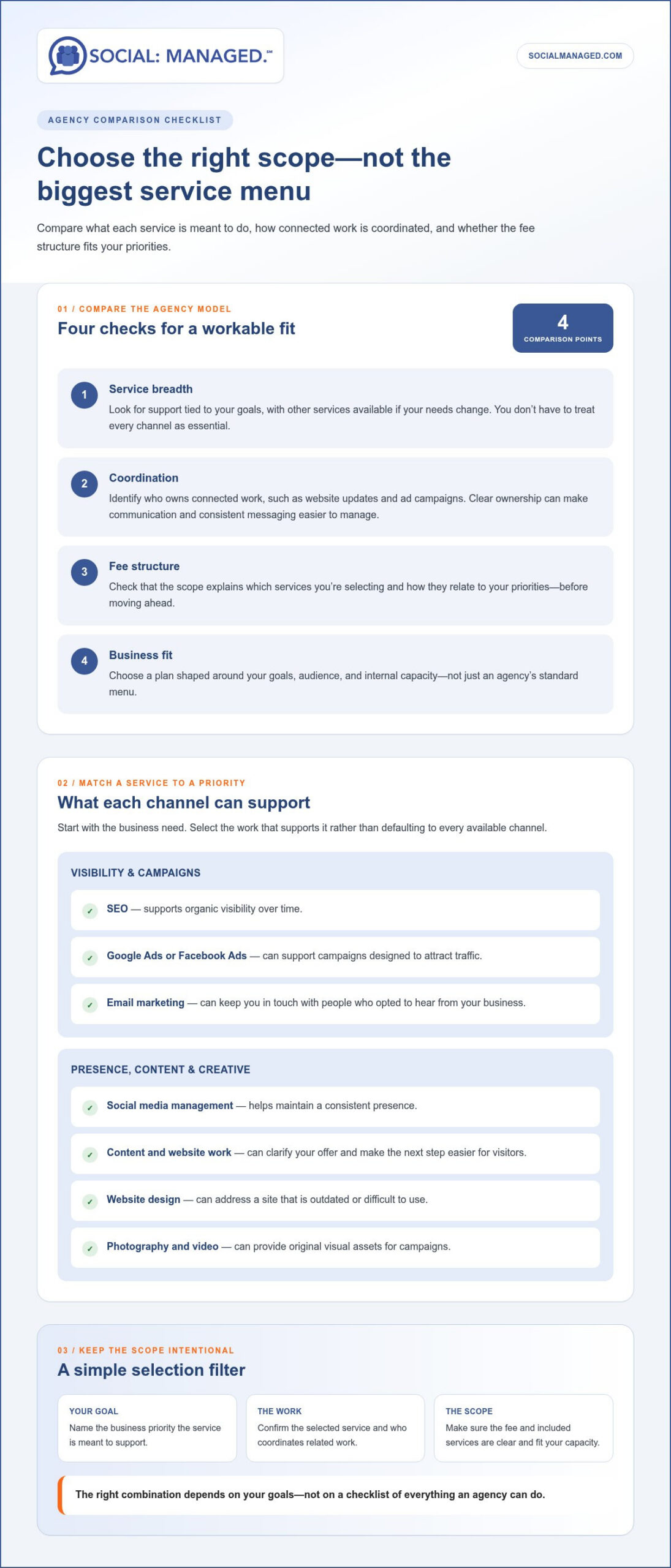
A useful agency comparison looks beyond the number of services on a website. Focus on what each service is meant to do, how related work is coordinated, and whether the fee model lets you prioritize what matters now. For WebFX alternatives for midwest small businesses, the goal isn’t to assemble the biggest package. It’s to choose a workable scope with clear responsibilities.
| Comparison point | What to look for | Why it matters |
|---|---|---|
| Service breadth | Support for the channels tied to your goals, with other services available if needs change | You can focus effort instead of treating every channel as essential. |
| Coordination | A clear owner for connected work, such as website updates and ad campaigns | Consistent messaging and communication can be easier to manage. |
| Fee structure | A scope that explains which services you’re selecting and how they relate to your priorities | You can understand what your engagement covers before moving ahead. |
| Business fit | A plan shaped around your goals, audience, and internal capacity | The support should suit how your business operates, not just the agency’s standard menu. |
Which marketing services match your current priorities?
Match each channel to a business need. SEO supports organic visibility over time, while Google Ads or Facebook Ads can support campaigns designed to attract traffic. Social media management can help maintain a consistent presence; email marketing can keep you in touch with people who have opted to hear from your business. Content and website work can clarify your offer and make the next step easier for visitors.
Creative services should serve a purpose, too. Website design can address an outdated or difficult-to-use site. Photography and video can give campaigns original visual assets. If organic search is a priority, a Kansas City SEO service can be part of a focused plan. The right combination depends on your goals, not a checklist of everything an agency can do.
How can a flexible fee structure support small-business needs?
Social: Managed. uses a transparent build-your-own fee structure, so businesses select services around their priorities rather than defaulting to a fixed bundle. A company focused on organic visibility might begin with SEO; one preparing a campaign could prioritize paid advertising and supporting creative work. As needs shift, the scope can be revisited in light of new goals. This creates a clearer connection between the services selected and the work the business wants to advance.
Coordination matters as much as selection. When one agency supports several related channels, a single campaign brief can inform the website, ads, and social content, reducing the need to relay the same context to separate vendors. Before settling on a scope, write down the goal for each service and identify how success will be assessed. If you’re shaping a focused mix for your business, you can discuss your marketing priorities with Social: Managed.
Assess Reporting, Communication, and Accountability
A useful report should help you decide what to do next, not just show that work happened. Impressions, clicks, and other activity provide context, but they matter most when you can connect them to tracked conversions and business priorities. As you compare WebFX alternatives for midwest small businesses, look for reporting that makes the path from campaign activity to meaningful action easier to understand.
Useful marketing accountability means knowing what was done, what the available data shows, and what the team plans to review or adjust next. It doesn’t mean promising a particular ranking, lead volume, or revenue outcome. Performance data informs decisions; it can’t guarantee results.
What should useful marketing reporting make clear?
Look for a straightforward view of campaign activity, ad performance, and tracked conversions. Reports should explain what the numbers relate to and how they connect with the goal. If an ad campaign aims to generate inquiries, for example, you should be able to review relevant ad activity alongside conversion tracking, rather than receiving a list of clicks without context.
Social: Managed. provides a live portal for real-time ad performance and conversion tracking, along with monthly performance reviews. These serve different purposes. The portal lets clients see campaign activity in real time; scheduled reviews create space to discuss patterns, questions, and possible next steps. Neither replaces the other.
To assess reporting, consider whether it helps you answer questions such as:
- What campaign activity took place during the period?
- What does the available ad performance data show?
- Which conversions are being tracked, and how do they relate to the campaign goal?
- What should the team examine or discuss next?
Keep the distinction clear between measurable indicators and promises. A report can show tracked activity and conversions, but it shouldn’t be framed as proof that a particular business result is guaranteed.
How does direct communication affect agency fit?
Reporting is more useful when you can discuss it with someone who understands the work behind it. Social: Managed. clients communicate directly with experienced Brand Managers who have web-marketing backgrounds. That contact can help connect questions about campaign performance with decisions across channels, rather than leaving you to interpret disconnected updates on your own.
Consistent communication also helps keep related work aligned. If a campaign’s message or priority changes, the agency and business can discuss what that means for active marketing work. A regular review gives both sides an opportunity to assess the available information and agree on what deserves attention next.
For broader context on how services can work together, Social: Managed.’s digital marketing agency approach brings multiple capabilities under coordinated support. During an agency comparison, consider whether the reporting is understandable, the contact is clear, and performance discussions lead to practical decisions. That combination makes accountability a working process, not just a document delivered on schedule.
Use This Framework to Shortlist WebFX Alternatives
A shortlist is more useful when it starts with your business, not an agency’s menu. Use these steps to turn broad goals into a clear scope, then compare WebFX alternatives for midwest small businesses against the work you actually need.
- Define the business goal. Name the outcome the marketing work should support, such as increasing awareness in a local market, improving the website experience, or attracting inquiries for a particular offering. Keep the goal as a planning priority, not a promise of a guaranteed result.
- Prioritize channels. Match each goal to a potential service and an indicator you can review. For example, pair organic visibility with SEO and a relevant search visibility indicator, or connect a paid campaign with ad performance and tracked conversions. Mark each service as a current need or a possible later priority. You don’t need to select every channel.
- Compare coordination. Consider whether the work depends on several services supporting one another. A campaign may involve ads, a landing page, and creative assets; compare how each agency would organize those responsibilities and keep the work aligned. If your goal is limited to one defined need, a narrower engagement may be more appropriate than broad support.
- Assess reporting. For every priority, identify what information would help you evaluate activity. A practical planning note might read: “Paid campaign, review ad performance and tracked conversions.” Then consider whether the proposed reporting gives useful context and whether there is a regular opportunity to discuss findings and next steps. Avoid treating a forecast or target as a guaranteed outcome.
- Review regional fit and reach. Consider where your customers are and where you plan to grow. A business serving a defined area may need messaging and campaign planning grounded in that market. A company targeting customers nationally needs a partner able to support a broader audience. These needs can coexist: regional understanding doesn’t rule out national campaign capacity.
Set priorities before comparing agency proposals
Before evaluating proposals, note the assets you already have, such as a current website, campaign accounts, photography, or email materials. Add the platforms your team uses and the time or expertise available internally. This context helps distinguish work an agency should lead from tasks your staff can manage. It also makes it easier to spot proposals that include services you aren’t ready to use.
Match capabilities to business stage and reach
A business refining one channel may need focused support; a team coordinating several campaigns may benefit from connected capabilities. For Kansas City businesses, local knowledge can inform the work, while national targeting can support expansion beyond the home market. Social: Managed.’s Kansas City digital marketing services provide context for evaluating local support as part of a broader plan.
Use your goal-to-service-to-indicator map to compare agency fit and identify the questions that matter most to your business.
How Social: Managed. Supports Midwest Small Businesses
A practical alternative should fit the work your business needs now, while giving you room to coordinate related marketing as priorities develop. We bring together digital marketing capabilities across SEO, paid advertising, social media, website design, content, email, photography, and video. That breadth supports different needs; it doesn’t mean every business should use every service.
Our Kansas City headquarters and national targeting serve complementary purposes. Midwest market familiarity can help shape local messaging and campaign planning, while national campaign capacity can support businesses seeking customers beyond their home market. The right scope depends on your audience, goals, and existing marketing resources.
A coordinated marketing partner with flexible scope
Connected services can make it easier to keep campaign work aligned. For instance, a business prioritizing organic search may pair SEO with relevant website improvements and content. If search visibility is a current goal, explore Kansas City SEO services as part of a focused marketing plan. Paid media, social media, email, and creative assets can support other priorities when they fit the strategy.
Our build-your-own fee structure lets clients select services based on their business priorities rather than defaulting to a fixed combination. That gives you a way to discuss the scope you need and the work you want to coordinate. A business focused on one priority can keep its scope centered there; a business managing connected campaigns can consider how several capabilities work together.
Accountability matters alongside scope. Our live portal provides visibility into ad performance and tracked conversions, while monthly performance reviews create dedicated time to discuss activity and its implications. Experienced Brand Managers with web-marketing backgrounds provide direct client communication, giving businesses a point of contact for discussing campaign priorities and decisions across services.
Start with a conversation about your business goals
Bring a few specifics to the discussion: what you want marketing to support, which channels are active, what assets or platforms you already use, and whether your audience is local, regional, or national. You don’t need a complete marketing plan first. A clear picture of your current priorities can help frame a practical conversation about service scope, coordination, communication, and reporting.
For businesses comparing WebFX alternatives for midwest small businesses, the right fit is a partner whose approach makes sense for both current needs and future plans. We can discuss your priorities and target markets without promising rankings, leads, or a particular timeline.
Discuss your marketing goals with Social: Managed.
Make Your Next Marketing Decision With Confidence
The next step isn’t choosing an agency for every challenge your business might face. It’s deciding what deserves attention first and finding a partner whose working style helps you move forward with clarity. As you weigh WebFX alternatives for midwest small businesses, anchor your decision to the goals, communication, and level of support that make sense for your team now.
A focused conversation can help turn your priorities into a practical starting point. Bring your questions, your current marketing picture, and the audiences you want to reach. From there, you can discuss a service scope that fits your business without treating future possibilities as immediate requirements.
Your next marketing partner should make the work feel more manageable and the path ahead clearer. Take the next step when you’re ready.
Frequently Asked Questions
Is WebFX a good fit for a small business?
It can be, if the proposed engagement fits the business’s scale and working needs. A small business with an established marketing team may be comfortable coordinating a broad program, while an owner handling daily operations may need a narrower scope and more hands-on guidance. Consider who will make decisions, provide approvals, and act on incoming inquiries. The agency relationship should support the way your team can realistically work.
What should a small business compare when choosing a WebFX alternative?
Read proposals for practical details that are easy to overlook: who owns the accounts and creative assets, what approvals are needed, how scope changes are handled, and what happens to active work if the engagement ends. These details help you understand the day-to-day relationship, not just the initial pitch. For WebFX alternatives for midwest small businesses, a clear handoff process can be especially useful if your team already works with several marketing tools or vendors.
Can a Kansas City agency support a business across the Midwest?
Yes, if its campaign plan accounts for the markets and customers the business wants to reach. For example, a company serving multiple Midwestern cities may need location-specific messaging while keeping its core brand consistent. A useful plan should distinguish where campaigns run and how local details are reflected in the content. The agency’s physical address alone doesn’t determine whether the working approach fits a business with a broader footprint.
How much do digital marketing agencies charge small businesses?
There isn’t one standard fee because the work can vary in scope and complexity. Compare proposals by separating agency services from any advertising spend, identifying included deliverables, and noting what may require additional work. Also look at how the fee changes if priorities or responsibilities shift. This makes it easier to compare the actual commitments behind two proposals, rather than judging them only by a single total.
Can one agency manage SEO, paid ads, social media, and website work?
Yes. The practical question is how the work and approvals are divided. For example, a website change may need business input, technical access, and review before an ad campaign can use the updated page. A clear workflow should identify who supplies information, who approves changes, and who manages each task. Agreeing on those handoffs early can help prevent gaps between marketing activity and the people responsible for the business.
How can a small business evaluate an agency’s reporting?
Ask how the agency checks that important actions are being recorded correctly. A simple test, such as submitting a test inquiry and confirming that it appears in the reporting process, can reveal whether tracking is working as intended. Review reports using consistent date ranges, and note when campaign changes were made so you can interpret shifts with context. Clear definitions for each reported action make the numbers easier to discuss.
What should I prepare before speaking with a digital marketing agency?
Bring examples of the customers you most want to attract and the inquiries that tend to be a strong fit. Note any seasonal busy periods, service limitations, or sales follow-up challenges that could affect campaign planning. If possible, describe what happens after a prospective customer contacts your business, from first response to a completed sale. That context helps an agency understand how marketing connects with your actual customer experience.

Ready to get started? Reach out to Social: Managed. online, or call us at 866-324-9700. We manage your company’s social life so you can have one! You don’t need complicated packages. We listen to your goals.
Then we design and manage SEO, social media, ads, websites, and email campaigns built to deliver results. No jargon. No guesswork. Just real growth from a team that cares. Ready to get rolling? Follow Social: Managed. on Facebook for a peek into our social life.