Top Digital Marketing and SEO Services in Kansas City: Your Go-To Agency for Web Design, WordPress, and Custom Solutions
What if the problem with your Facebook ads isn’t the audience, but what happens after someone clicks? If your campaigns attract attention but produce few qualified leads or purchases, it’s tempting to change the targeting first. A better way to learn how to improve Facebook ad performance is to find the weakest link in the full conversion path before making a move.
Clicks alone can’t tell you whether the offer is compelling, the creative is reaching the right people, or the landing page is turning interest into action. In 2026, Meta’s attribution changes also mean some interactions that once counted as click-through conversions are now reported separately as engagement. A change in reported numbers doesn’t always mean the campaign itself has weakened.
This guide will help you identify where results are slipping, prioritize changes you can measure, and connect campaign metrics to qualified leads, sales, or other meaningful business outcomes. For businesses in Kansas City, Overland Park, Olathe, and Leawood, the same process can help separate a local campaign’s targeting, message, and website issues. We’ll look at the campaign objective, audience, creative, offer, landing page, and measurement, then show how to test adjustments without changing everything at once.
Key Takeaways
- Define success by the business result your campaign is meant to produce, not by reach or engagement alone.
- Follow the conversion path from impression to landing page to spot where interested prospects drop off.
- To learn how to improve Facebook ad performance, test one meaningful change at a time and record the decision it informs.
- Use a consistent review process to decide whether to continue, adjust, or pause a campaign based on evidence and tracking confidence.
- Coordinated campaign, creative, website, and analytics support can help teams see performance across the full customer journey.
How to Improve Facebook Ad Performance Starts With a Clear Diagnosis
Before changing an audience or rewriting an ad, define what the campaign is supposed to achieve. A campaign may aim to generate qualified leads, drive purchases, secure bookings, or build awareness. Those goals call for different measures, so a high click-through rate is not automatically a sign of success. The first step in how to improve Facebook ad performance is to judge results against the business outcome the campaign was built to support.
Campaign performance is the outcome measured against the campaign objective. Reach, clicks, and reactions can help explain what people did after seeing an ad, but they don’t prove that the campaign produced valuable business results. A rising cost per lead, for example, is a symptom. The cause could be lower-quality inquiries, a less relevant offer, a weaker landing page, or a tracking issue. Broader social media marketing strategies also begin with clear objectives, so use the campaign’s intended role to guide your diagnosis.
Which Facebook ad metrics matter for your campaign objective?
For awareness campaigns, review reach and frequency to understand how many people saw the ad and how often. These measures describe exposure, not sales. For lead generation, look beyond lead volume: assess whether inquiries fit your target customer and progress to a meaningful next step, such as a booked appointment or sale. For sales campaigns, compare conversion rate and return on ad spend with tracked purchases. Each metric is useful only in context.
What to review before changing an underperforming campaign
Start with the objective and the business result it is meant to support. Then review a consistent reporting period, comparing like-for-like campaigns or timeframes rather than mixing different goals or seasonal conditions. Check that website activity and conversion events are recording as expected. Otherwise, the dashboard may not reflect what customers actually did.
- Objective: Is the campaign optimized for the result the business needs?
- Comparison: Are you using equivalent dates, budgets, and campaign goals?
- Tracking: Do recorded leads or purchases align with website and sales activity?
Account for Meta’s 2026 attribution change when reviewing reported conversions. Click-through attribution now counts link clicks, while other interactions, such as likes, shares, and comments, are reported separately as engage-through attribution. A change in reported click-through conversions may reflect this measurement shift, so verify the reporting basis before treating it as a performance decline. Once the objective, comparison, and tracking are clear, you can investigate the campaign itself with more confidence.
Diagnose Facebook Ad Performance Across Audience, Creative, and Landing Page
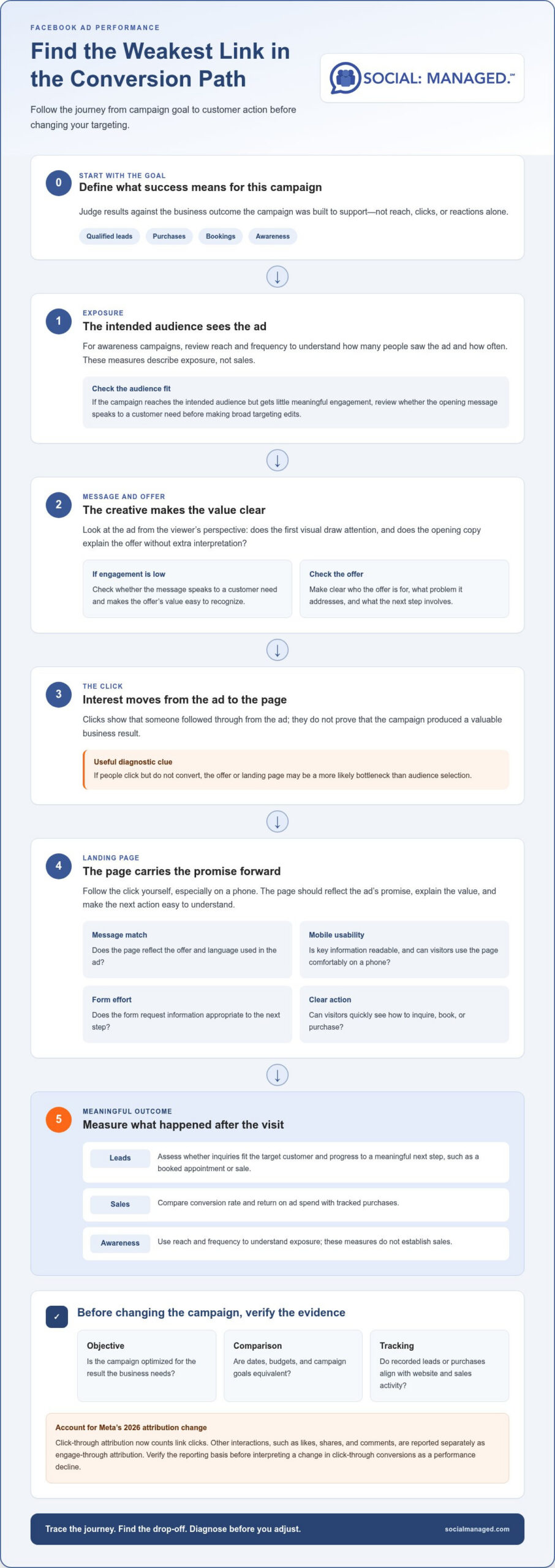
A campaign’s results come from a connected journey: the intended audience sees an ad, decides whether its message matters, clicks through, and then chooses whether to take action. A drop at any point can limit conversions. Weak results don’t automatically mean the audience needs changing. The evidence may point instead to an unclear offer, creative that fails to earn attention, or friction after the click.
A relevant ad can still lose conversions if the landing page doesn’t deliver on its promise. For example, an ad might promote a clear service offer, while the page leads with unrelated information or makes the next step hard to find. Diagnosing each stage helps you decide where to focus before adjusting campaign settings.
How to tell whether the audience or offer needs attention
Look for patterns in what people do, not just how many people see the ad. If the campaign reaches its intended audience but earns little meaningful engagement, review whether the opening message speaks to a customer need. If people click but don’t convert, the offer or page may be a more likely bottleneck than audience selection. Avoid broad targeting edits unless the available campaign evidence supports them.
Check whether the ad clearly explains who the offer is for and what problem it addresses. A message aimed at local homeowners, for instance, should make the service and next step relevant to that group. If the intended customer can’t recognize the value quickly, changing the audience alone may simply show the same unclear offer to different people.
How creative and landing-page friction affect conversion
Review the ad from the viewer’s perspective. Does the first visual draw attention? Does the opening copy make the offer clear without requiring extra interpretation? Then follow the click yourself, especially on a phone. The landing page should carry the same promise forward, explain the value, and make the next action easy to understand.
- Message match: Does the page reflect the offer and language used in the ad?
- Mobile usability: Is key information readable, and can visitors use the page comfortably on a phone?
- Form effort: Does the form request information appropriate to the next step?
- Clear action: Can visitors quickly see how to inquire, book, or purchase?
When you’re deciding how to improve Facebook ad performance, use these checkpoints to form a specific hypothesis: “The ad earns clicks, but the page doesn’t make booking clear.” We coordinate campaign, creative, website, and analytics reviews to help teams investigate the full path. Explore our Facebook ad management support when your team needs help connecting those pieces.
Let’s Create a Winning Facebook Ad Strategy Together
Compare Facebook Ad Tests Without Confusing the Results
A test is useful when it answers a clear question. If you change the audience, creative, and offer at the same time, results may shift, but you won’t know which change mattered. Keep the test focused. A useful ad test changes a defined variable and evaluates a relevant outcome. A variation might not outperform the original, and that’s still useful if the result helps you decide what to test next.
Before launching a test, record five things in a comparison table: the hypothesis, the variable you’ll change, the primary metric, what you observe, and the next decision. For example, if you suspect the opening message isn’t clear, compare two message variations while keeping the audience, offer, and landing page consistent where practical. Track a metric that fits the goal, such as qualified inquiries rather than clicks alone.
What to test first: message, format, offer, or audience
Let the diagnosis guide the test. If people see the ad but show little interest, try a clearer message or a different creative approach. If the ad earns clicks but few people take the intended action, review the offer and landing-page experience before changing the audience. Test audience changes when evidence points to poor audience relevance or insufficient reach. Change one main variable at a time so the result is easier to interpret.
How to read results when volume or tracking is limited
Small or inconsistent samples can make a test look conclusive when it isn’t. Avoid calling a winner based on a handful of conversions or a short-lived fluctuation. First check that conversion events are recording correctly and that you’re comparing the same outcome across variations. If tracking is uncertain, treat the result as directional, not definitive.
Document inconclusive tests, too. A note such as “not enough qualified leads to compare the messages” prevents the same question from being tested without context. It also points to the next useful step, such as improving measurement or collecting more evidence before deciding.
- Hypothesis: What do you think is limiting results?
- Changed variable: What single element will you adjust?
- Primary metric: Which business-relevant result will guide the comparison?
- Observation and decision: What happened, and what will you do next?
A disciplined test log turns campaign changes into learning instead of guesswork. It’s a practical part of how to improve Facebook ad performance, especially when each decision needs to connect to the customer outcome the campaign is meant to support.
Use a Repeatable Facebook Ad Optimization Workflow
A consistent review process makes campaign decisions easier to explain and evaluate. Use this cycle whenever you assess performance:
- Define the goal. Name the business result the campaign is meant to support, such as qualified leads, bookings, or purchases.
- Inspect the funnel. Review the path from ad delivery through the website and conversion, including whether tracking is working.
- Identify a bottleneck. Use the available evidence to narrow down where the journey may be losing people.
- Test one change. Choose an adjustment that addresses the suspected issue and record what changed.
- Review the evidence. Compare results against the objective, then decide whether to continue, adjust, or pause.
Continue when tracking is reliable and results still align with the campaign goal, even if more observation is needed. Adjust when evidence points to a specific issue, such as a mismatch between the ad and the next step. Pause to investigate if conversion tracking appears unreliable or the campaign is no longer serving its intended objective. A brief change log should capture the date, reason for the edit, observation, and next decision. That record helps your team learn from each change instead of repeating tests without context.
A practical weekly and monthly review routine
Use regular check-ins to catch delivery or tracking problems, but don’t react to every short-term fluctuation. In monthly reviews, step back and assess patterns, lead quality, and progress toward the campaign objective. We use real-time reporting and monthly performance reviews to connect campaign observations to decisions. A concise log makes the reasoning visible between reviews.
Connect ad data with the rest of the customer journey
Ad-platform results show only part of the picture. Compare them with website actions and your own records of which leads qualified or moved forward. If people click but don’t take the intended next step, review the landing page’s messaging, clarity, and usability alongside campaign data. Our Kansas City website design services can support a more cohesive experience from ad to page.
Our Facebook ad management services in Kansas City connect campaign execution, reporting, and customer-journey insights instead of treating each metric in isolation.
When Facebook Ad Management Can Help Improve Campaign Performance
Managing a campaign takes more than adjusting settings in Ads Manager. Strategy, creative, landing-page experience, tracking, and reporting all affect how well the campaign supports its business goal. Additional support can help when an internal team has limited time to review the full customer journey, needs fresh creative input, or isn’t sure which evidence should guide the next change.
Our approach connects those pieces rather than treating paid media as a standalone task. We coordinate campaign strategy and ad management with creative, website experience, and analytics, then use clear reporting to make results easier to review. That structure can help your team see where attention is needed without promising a particular number of leads or sales. Learn more about our Facebook advertising management in Kansas City.
What coordinated campaign support can include
Campaign support may bring planning, ad execution, creative coordination, conversion tracking, and performance reporting into one process. We provide real-time reporting and monthly performance reviews, giving teams a consistent view of activity and progress toward their stated objectives. Direct communication with experienced brand managers also keeps collaboration practical: your team can share business context, ask questions, and understand the reasoning behind campaign decisions.
This coordination matters when an ad earns attention but the website or follow-up process doesn’t carry that interest forward. Reviewing those parts together can help reveal whether the next priority is a clearer message, a more useful landing page, or better alignment between the campaign and the business outcome.
How to decide on your next step
Before bringing in additional support, write down three things: the campaign goal, the bottleneck you suspect, and what conversion or lead-quality information you can currently track. Then consider where your team needs capacity most. You may need strategy and campaign management, creative production, clearer reporting, or coordination across several of these areas.
That preparation gives a campaign discussion a useful starting point. We work with your team to understand its priorities and shape an approach around the available information, current marketing activity, and business goals. The aim is a clear plan and shared understanding, not a guaranteed performance outcome. Click here to discuss your campaign goals and challenges.
Make Your Next Facebook Ad Decision With Confidence
Improving campaign results starts with a clear business objective, not a rush to change settings. Trace the customer journey to find the likely bottleneck, then test one defined change and measure a relevant outcome. That steady process is a practical way to learn how to improve Facebook ad performance without confusing cause and effect.
We bring campaign strategy, creative, website experience, and analytics together to help businesses make informed decisions. Our reporting includes real-time updates and monthly performance reviews. Social: Managed. received the 2019 UpCity National Excellence Award, and founder David Alexander brings approximately 25 years of digital and web experience as of 2026.
If you’re ready to discuss your Facebook ad goals, current challenges, and possible next steps, we’d be glad to hear from you. With a clear objective and a thoughtful testing process, your next campaign decision can be grounded in evidence and built around the outcomes that matter to your business.
Schedule a Free Consultation with Social: Managed.
Frequently Asked Questions
Why are my Facebook ads getting clicks but no conversions?
Clicks without conversions often point to a gap between the ad and what happens next. The offer may not fit the visitor’s needs, the landing page may be confusing or difficult to use, or the form may ask for too much. Tracking could also be missing conversions. Follow the path from click to website action, and compare recorded results with actual inquiries or purchases before changing the campaign.
How can I tell if my Facebook ad creative is the problem?
Creative may need attention if people see the ad but don’t engage meaningfully, or if the message doesn’t make the offer clear. Compare variations that change one element, such as the opening message or visual, while keeping other conditions consistent where practical. Then assess a metric tied to the campaign objective. If people click but don’t convert, review the offer and landing page too, rather than blaming creative alone.
How often should I change my Facebook ads?
There’s no single schedule that fits every campaign. Check regularly for delivery or tracking issues, but avoid making significant edits in response to every short-term fluctuation. Meta’s learning phase needs time and data to optimize delivery, and major changes can disrupt that process. Review results over a consistent period, document each adjustment, and make another change when evidence gives you a clear reason to do so.
What Facebook ad metrics should a small business track?
Track metrics that reflect your campaign objective and business outcomes. For lead generation, review lead volume, cost per lead, lead quality, and how many inquiries progress to a sale or booking. For sales campaigns, monitor tracked purchases, conversion rate, and return on ad spend. Reach and engagement can provide useful context, but they don’t establish whether a campaign produced qualified prospects or revenue.
Should I change my Facebook ad audience or creative first?
Start with the evidence, not a default rule. If the ad reaches people but earns little meaningful response, assess whether the creative and offer speak clearly to the intended customer. If you have signs that the audience is poorly matched or too limited, test an audience adjustment. Avoid changing audience, creative, and offer together. One focused change makes it easier to understand what influenced the result.
Can a better landing page improve Facebook ad performance?
Yes. A landing page can help turn ad interest into action when it continues the ad’s promise and makes the next step clear. Check that the offer matches, key information is easy to find, the page works well on mobile, and the form feels appropriate for the inquiry. Also confirm conversion tracking. If clicks are coming through but intended actions aren’t, the page deserves a close review.
When should a business hire a Facebook ads agency?
Consider agency support when your team needs more capacity for campaign strategy, creative coordination, tracking, or consistent reporting. A coordinated partner can connect ad activity with website actions and qualified-lead records instead of reviewing platform metrics in isolation. We support businesses in Kansas City, Overland Park, Olathe, and Leawood with real-time reporting and monthly performance reviews to guide campaign discussions without promising specific results.

Ready to get started? Reach out to Social: Managed. online, or call us at 866-324-9700. We manage your company’s social life so you can have one! You don’t need complicated packages. We listen to your goals.
Then we design and manage SEO, social media, ads, websites, and email campaigns built to deliver results. No jargon. No guesswork. Just real growth from a team that cares. Ready to get rolling? Follow Social: Managed. on Facebook for a peek into our social life.