Top Digital Marketing and SEO Services in Kansas City: Your Go-To Agency for Web Design, WordPress, and Custom Solutions
What if your website could do more than look polished? A website redesign for small business should turn a static online brochure into a reliable source of leads. If your site is hard to find in local searches, frustrating on mobile, or difficult to update, a fresh coat of design alone won’t solve the problem. You need a strategy that connects what visitors need with clear next steps for becoming customers.
A successful redesign starts with the question many business owners ask: how can I make my website generate leads, not just look good? The answer is to build around visibility, user experience, useful content, and measurable results. In this guide, you’ll learn how to plan a modern website that supports local SEO, makes it easier for visitors to take action, and gives your business a clearer way to track performance. We’ll also explore the practical decisions that help your new site stay useful as your business grows, from content management to mobile performance. With the right foundation, your website can become an active part of your growth strategy.
Key Takeaways
- A website redesign for small business works best as a growth strategy, not just a visual refresh. Use it to strengthen trust and give visitors clearer paths to take action.
- Put customer needs first: organize pages around what visitors want to know and make important next steps easy to find.
- Build SEO into the redesign from the start, including a plan for page structure and redirects that helps protect existing search visibility.
- Use a phased process to assess your current site, set priorities, and map a structure that supports business growth.
- Bring design, content, and search strategy together with an experienced partner who understands the Kansas City market and measures performance over time.
Why a Website Redesign for Small Business is Your 2026 Growth Catalyst
A website should do more than confirm that your business exists. It should help the right people understand what you offer, trust your expertise, and take a clear next step. A strategic website redesign for small business turns a static brochure into an active sales tool, connecting design, content, and search visibility to the goals you want to reach in 2026.
That shift starts with how customers experience your business online. They expect pages to load smoothly on mobile, information to be easy to find, and the site to look current and credible. The principles of web design bring together usability, visual communication, and site structure. Applied with care, these principles make it easier for visitors to move from a first impression to a useful action, whether that’s calling, requesting information, or exploring a service.
For a Kansas City business, the cost of doing nothing can show up in missed opportunities. A dated design may make a capable company seem less established, especially when customers compare options in nearby communities such as Overland Park. A redesign should reflect your real strengths and local relevance, not simply copy a competitor’s look. Thoughtful website design in Overland Park can help businesses present a consistent, professional experience to local visitors.
Signs Your Small Business Website is Costing You Leads
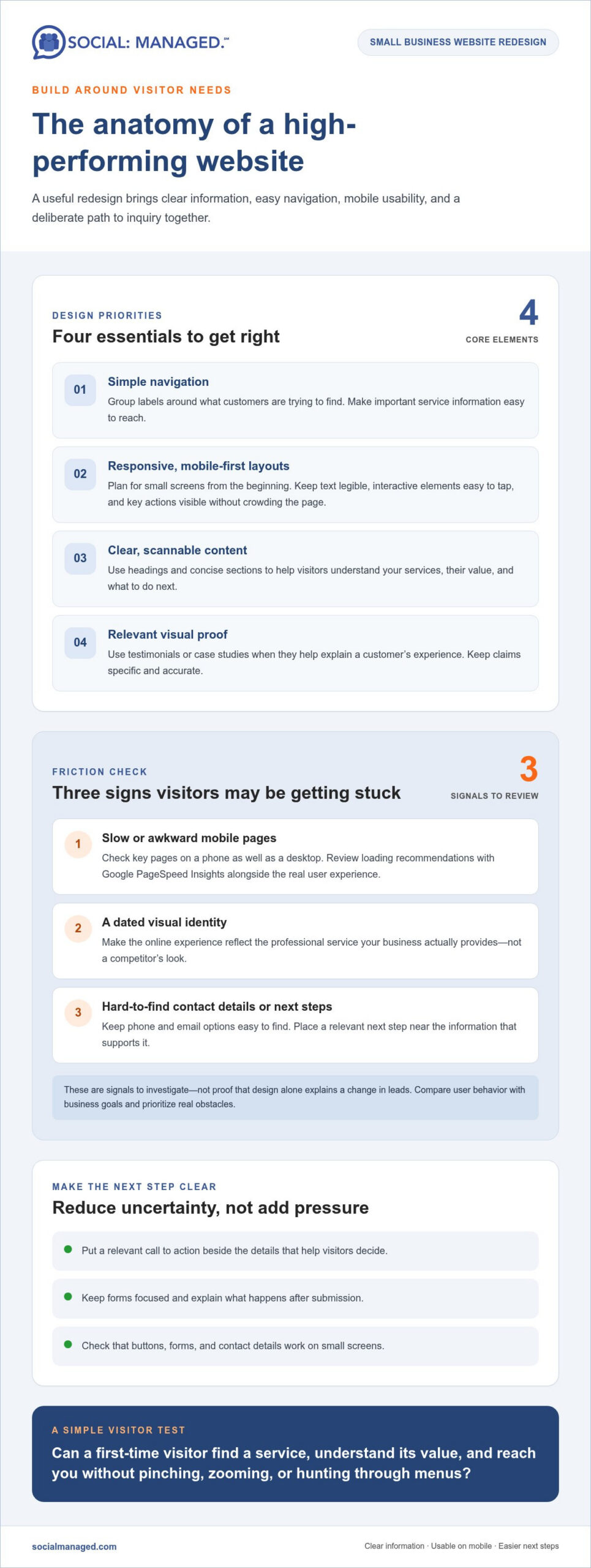
Look for friction that prevents visitors from finding information or getting in touch. Mobile pages that load slowly, a dated appearance, and unclear calls to action can all weaken the path from interest to inquiry. Review your site on a phone as well as a desktop, and check whether a new visitor can quickly understand what you do and what to do next.
- Important pages feel slow or awkward to use on a mobile device.
- Your visual identity looks out of step with the professional experience you provide.
- Contact details and next steps are difficult to spot or inconsistent across pages.
These are practical signals to investigate, not proof that design alone explains a drop in leads. Compare user behavior with your business goals, then prioritize fixes that remove real obstacles.
The ROI of Strategic Web Design
Good user experience supports business results by making key information easier to find and the next step easier to take. Set measurable goals before the redesign, such as tracking relevant calls, inquiry forms, or visits to important service pages. Professional photography and video can also show your people, work, and process, helping visitors make a more informed first impression.
A scalable WordPress foundation gives your team room to update content and expand the site as priorities change. At Social: Managed., we integrate custom WordPress design with SEO and content strategy, so the site supports your broader marketing rather than operating as a disconnected asset. The result is a stronger foundation for testing, learning from performance, and making purposeful improvements over time.
Schedule a Meeting With Our Web Design Experts
The Anatomy of a High-Performing Small Business Website
A strong website reflects your business, but it’s built around the people you want to reach. That means designing for visitor needs before personal preferences. A favorite color or clever slogan matters less than clear service information, readable pages, and an obvious path to the next step. Each design choice should help customers understand your offer and decide what to do.
Conversion rate optimization (CRO) makes that path intentional. Place a relevant call to action near the information that supports it, such as a “Schedule a Consultation” button beside a description of your process. Avoid promising a free consultation unless that offer is part of your business. Keep forms focused, explain what happens after submission, and make phone and email options easy to find. The goal is to remove uncertainty, not pressure visitors.
Essential Design Elements for 2026
Prioritize a simple navigation structure, responsive layouts, and visual assets that load efficiently. Test pages with Google PageSpeed Insights, then review any recommendations alongside the actual experience on phones and desktop screens. Include testimonials or case studies where they support a service decision, and make sure claims are specific and accurate. Social proof works best when it gives visitors useful context, not when it’s added as decoration.
- Group navigation labels around what customers are trying to find.
- Use headings and concise page sections to make information easy to scan.
- Check that buttons, forms, and contact details work on small screens.
- Choose relevant testimonials that explain the customer’s experience.
Mobile-first architecture means planning for a small screen from the beginning, not shrinking a desktop layout at the end. Keep text legible, space interactive elements so they’re easy to tap, and ensure important actions remain visible without crowding the page. A useful test: can a first-time visitor find a service, understand its value, and reach you without pinching, zooming, or hunting through menus?
The Power of In-House Content Strategy
Generic copy can make a distinctive business sound interchangeable. Strong website content uses your actual expertise, customer questions, and working process to explain why your approach matters. It should be clear and original, whether drafted by a person or supported by writing tools, then carefully reviewed for accuracy and a natural brand voice. Pair that copy with custom photography that shows your team, workspace, or finished work instead of relying on visuals that could belong to any company.
Video adds another layer of storytelling. A brief brand introduction can show who you are, what you do, and what customers can expect. Keep the message focused, add captions for people watching without sound, and avoid letting large media files slow the page. At Social: Managed., we bring website design, photography, video, and content strategy together to create a consistent experience. Explore our website design in Kansas City approach to see how those elements can work as one.
These details turn design into a practical sales tool: clear messaging earns attention, useful proof builds confidence, and well-placed actions make it easier to move forward.
SEO-First Redesign: Why Design Without Search Strategy Fails
A redesigned site can look polished and still lose search visibility if SEO is treated as a final check. Page addresses, content, and internal links all help search engines understand what your business offers. Plan them before layouts are finalized, and the new site can support both customer journeys and organic discovery from launch.
Start by auditing the current site. Identify pages that attract relevant visits, earn links, or generate inquiries before changing URLs or removing content. If a page needs a new address, set up a 301 redirect from the old URL to the closest relevant replacement. This permanent redirect guides visitors and search engines to the new page and helps preserve continuity, though it can’t guarantee rankings will remain unchanged.
Technical foundations matter, too. A logical site structure groups related services under clear navigation, while an XML sitemap lists the important URLs you want search engines to discover. Schema markup can describe details such as your business type, location, and services in a structured format. These elements help clarify the site, but they don’t replace useful pages written for real customer needs.
Integrating Local SEO into Your New Build
Build your page plan around the places you serve and the services customers seek. A Kansas City business might need distinct, genuinely useful pages for Kansas City, Overland Park, and Olathe, rather than duplicating one page and swapping city names. Connect your website with your Google Business Profile by keeping business details consistent and linking to the most relevant page. Our Kansas City SEO company approach aligns local search strategy with site structure and content.
Local visibility depends on more than adding place names. Explain the services available in each community, include relevant local context, and make it straightforward for visitors to contact you. This gives people and search engines a clearer understanding of where your business is relevant.
Content Architecture and Site Health
Map the sitemap before development: give each core service a clear destination, connect related pages with descriptive internal links, and avoid burying important information several clicks deep. A well-organized structure helps people browse and gives search engines paths to crawl. During launch, submit the XML sitemap through Google Search Console and use the platform to review indexing, search queries, impressions, and clicks over time.
After launch, compare performance with the baseline from your old site. Check that priority pages are indexed, redirects lead to the intended destinations, and search visitors land on relevant content. If a page is missing or a query brings visitors to the wrong section, refine the structure or content instead of assuming the redesign is finished.
Site speed is a critical ranking consideration in 2026 because Google uses Core Web Vitals, including loading and interaction measures, among its page experience signals. With a website redesign for small business, treating SEO as part of the build helps protect useful site history while creating a stronger foundation for local search growth.
Planning Your Redesign: A 5-Phase Roadmap for Small Businesses
A clear process keeps a redesign focused on business priorities instead of last-minute preferences. Each phase builds on decisions made earlier, from identifying what your current site does well to improving the new experience after launch. For a website redesign for small business, shared goals and timely feedback help keep the project moving in the right direction.
Phase 1: Discovery and Audit
Start by reviewing the existing site’s content, traffic, lead sources, and usability. Identify pages that attract relevant visitors or inquiries, along with outdated information, broken paths, and gaps in the customer journey. Include input from staff who answer customer questions. Their insights can reveal what visitors need to know before they’re ready to reach out.
Phase 2: Strategy and Sitemap
Turn the audit into a practical plan. Define priority audiences, services, and actions, then map those needs into a sitemap. Decide which pages to retain, revise, combine, or add. A clear sitemap gives the project team a shared blueprint and helps prevent important service information from getting lost in navigation.
Phase 3: Creative and Content
Develop the visual direction and page content together so the design supports the message. Gather accurate service details, customer questions, and brand language before copywriting begins. Plan photography and video around specific page goals, such as introducing the team or showing how a service works. This preparation makes the content more cohesive and reduces rushed decisions later.
Phase 4: Development and Testing
Build the approved design, then test the site across screen sizes and browsers. Check forms, buttons, menus, contact details, redirects, and page loading. Ask someone unfamiliar with the project to complete common tasks, such as finding a service or submitting an inquiry. A fresh perspective often catches confusing labels or missed steps the team has learned to overlook.
Phase 5: Launch and Optimization
Before launch, confirm that key pages, tracking, redirects, and analytics are ready. After the new site goes live, monitor performance and gather feedback rather than treating launch as the finish line. Review visitor behavior and lead quality, then refine pages based on what the evidence shows. Ongoing adjustments help the website stay aligned with changing business priorities.
Set Goals and Keep the Team Aligned
Choose a few measurable indicators before work begins, such as qualified lead volume, form conversion rate, or organic traffic to priority service pages. Record a baseline so you can compare results after launch. Project timelines depend on scope, content readiness, feedback, and testing needs, so establish milestones with your project team instead of relying on a generic schedule.
Consistent communication keeps decisions clear and gives your team a role in the transition. Assign someone to gather feedback, approve content, and coordinate staff training on the new platform. After launch, monthly performance reviews can turn results into specific next steps. At Social: Managed., we work as a collaborative partner, connecting design and marketing priorities throughout the process. Click here to discuss your website redesign project with our team.
Partnering for Success: Why Social: Managed. is Your Trusted Adviser
A successful redesign takes more than a polished launch. It needs an experienced partner who understands how design, search, and marketing work together, then helps you use performance insights to guide what comes next. Social: Managed. is led by David Alexander, whose 25 years of digital and web experience inform a practical, lead-focused approach for small and midsize businesses.
Our local perspective matters, too. Ingram’s Magazine recognized Social: Managed. as a Top 25 Website Designer in Kansas City. That experience helps us shape digital strategies around the needs of businesses competing in the area, not apply a one-size-fits-all template. We connect website design with SEO, paid search, and social media so your channels reinforce a consistent message and support shared business goals.
A Full-Service Approach to Digital Growth
For a business serving Johnson County, for example, a clear website structure can connect local service information with search content and campaign landing pages. Our website design in Overland Park work brings design and local SEO together, helping visitors find relevant information and giving your marketing a coherent foundation.
Visuals play a role in that trust. In-house photography and video production let us create assets that reflect your actual team, work, and customer experience instead of relying on generic stock imagery. A genuine project photo or concise introduction video can make a service page more specific and help potential customers picture what working with your business may be like.
The partnership doesn’t have to end at launch. Ongoing marketing support can include regular performance reviews, where we look at available data, discuss what’s working, and identify practical improvements. Search visibility and customer behavior can change, so reviewing results helps keep the site and its supporting campaigns aligned with your goals. We focus on measurable lead generation, without promising rankings or outcomes no agency can control.
Ready to Transform Your Digital Presence?
The right time to plan a website redesign for small business is when your current site no longer supports the way you want to grow. A thoughtful project gives you a chance to align your online presence with current services, customer needs, and local marketing priorities. With one team coordinating design and digital strategy, you can make decisions with clearer context and avoid managing disconnected efforts alone.
Our role is to be a trusted adviser and an extension of your team: listen to your priorities, explain the reasoning behind recommendations, and use performance insights to inform the next step. You stay involved in the decisions that shape your brand, while we help organize the work and keep the focus on meaningful business outcomes. That partnership brings clarity to a complex project and supports steady improvement after launch.
Ready to map out a redesign that fits your goals? Start a conversation with our team about your website and growth priorities.
Make Your Next Website Work Harder
Your next step doesn’t need to be a complete list of design decisions. Start with one business priority: attract more local inquiries, make it easier for customers to understand your services, or give your team a simpler way to keep information current. A clear goal gives your redesign a useful measure of success and helps keep decisions focused as the work takes shape.
A website redesign for small business is an opportunity to build a stronger foundation for the way you want to grow. At Social: Managed., we bring design and digital marketing together, then use performance insights to guide ongoing improvements. Our Google Partner status and A+ BBB rating reflect our commitment to professional, accountable work.
Bring us the challenge you want your website to solve. We’ll work with you to shape a thoughtful next step around your business priorities. Your next chapter online can start with a focused conversation and a plan built around your goals.
Talk With Us About Your Website Redesign Strategy
Frequently Asked Questions
How much does a website redesign for small business cost in Kansas City?
The cost depends on the project’s scope, including the number of pages, custom features, content needs, photography, and any integrations or content migration. A straightforward refresh has different requirements from a rebuild with new service pages and custom functionality. We scope website redesign projects around each business’s priorities, so the best starting point is defining what the site needs to accomplish for your Kansas City customers.
How long does the website redesign process typically take?
There isn’t one timeline that fits every redesign. The schedule depends on the site’s size, the features involved, how quickly content and approvals are ready, and the amount of testing needed before launch. You can help avoid delays by gathering current brand materials, assigning a decision-maker, and organizing feedback in one place. A clear project plan should outline stages and review points before design work begins.
Will I lose my Google rankings if I redesign my website?
A redesign doesn’t automatically remove search visibility, but changes to page addresses, content, and internal links can affect how search engines interpret the site. Before launch, document important landing pages and their performance, then verify that each has a relevant destination on the new site. After launch, monitor indexing and search traffic in Google Search Console. Rankings can fluctuate, so compare trends rather than reacting to a single day’s data.
Does my small business need a new website or just an optimization project?
You may only need targeted improvements if your current platform works reliably and the site’s structure still fits your services. Updating page content, improving forms, or refining navigation may address specific issues. A rebuild is worth considering if your team can’t maintain the site, its structure no longer reflects the business, or technical limitations block needed changes. Review customer feedback and site analytics before choosing the level of work.
What is the difference between a custom WordPress site and a template?
A template uses a predesigned layout that can be adapted with your branding and content. A custom WordPress site is planned around your business goals, audience, and content structure, which gives more control over how pages and features fit together. Both approaches can use WordPress. The right choice depends on how much flexibility your team needs and whether a ready-made layout can support your brand and future updates.
Do you provide in-house photography and video for the new site?
Yes. We provide photography and video production in-house, creating visual content for your website that reflects your actual business. For example, a Kansas City service company could plan photos of its team and work process, while a Leawood professional firm might use a short introduction video to help visitors meet its people. We align the shot list and video purpose with the pages where each asset will appear.
How do you measure the success of a website redesign?
We measure success against goals set before launch, using indicators such as qualified calls, completed inquiry forms, and organic visits to priority pages. Track where leads originated and which pages they viewed, then compare results with a pre-launch baseline over a meaningful period. Review lead quality as well as volume: an increase in form submissions is more useful if those inquiries match the services and locations your business serves.
Can you support multiple franchise locations with a single redesign?
Yes. We can plan a shared website structure that keeps the brand consistent while giving each franchise location relevant information. For example, a network serving Overland Park, Olathe, and Leawood could use distinct location pages with accurate local details and clear contact paths. A coordinated approach also makes it easier to manage updates centrally while helping customers find the location and service information that applies to them.

Ready to get started? Reach out to Social: Managed. online, or call us at 866-324-9700. We manage your company’s social life so you can have one! You don’t need complicated packages. We listen to your goals.
Then we design and manage SEO, social media, ads, websites, and email campaigns built to deliver results. No jargon. No guesswork. Just real growth from a team that cares. Ready to get rolling? Follow Social: Managed. on Facebook for a peek into our social life.