
Top Digital Marketing and SEO Services in Kansas City: Your Go-To Agency for Web Design, WordPress, and Custom Solutions
The difference between terminating with cause and without cause comes down to why you’re ending the agreement and what the contract allows. With cause, you rely on a failure or another contractual basis for ending it; without cause, you use an exit option that doesn’t depend on proving a breach. This RevLocal contract cancellation and switching guide explains how that distinction can shape your next steps.
It’s understandable to expect a clear reason for leaving to make cancellation straightforward. But the agreement’s notice period, renewal language, cancellation method, and applicable consent or disclosure rules can all affect the process.
Here, you’ll learn what to look for in your contract, how to document a cancellation request, and what to consider before switching marketing support. The goal is an orderly transition with fewer surprises.
Key Takeaways
- Cancellation with cause relies on a contractual reason, while cancellation without cause depends on an exit option in the agreement.
- Find the agreement’s cancellation, renewal, notice, and fee clauses before choosing a cancellation date.
- Send notice using the contract’s required method, keep a copy, and retain proof that it was received.
- Clear renewal disclosures and separate consent can affect ongoing subscription charges and the cancellation process.
- Review prepaid-fee and refund terms alongside your cancellation plan to understand what may happen to unused services.
Clear disclosures and express consent
Clear disclosures explain important terms before a subscription begins or renews. Express consent records the customer’s affirmative agreement to those terms.
Clear Contract Disclosures
A clear contract disclosure explains the subscription’s material terms in language customers can understand before enrollment. Subscription disclosures should explain material terms clearly before enrollment and distinguish renewal consent from acceptance of other terms.
This distinction matters when an agreement combines service details, billing terms, and renewal language. A customer’s acceptance of general terms should not be confused with separate consent to recurring charges. For example, a signup flow could display renewal terms next to the consent action rather than burying them in a long terms document.
The FTC Click-to-Cancel Rule also treats material misrepresentations about a subscription or renewal as deceptive. Misleading statements about when charges begin or how renewal works can affect a customer’s understanding of the agreement. Read the disclosures alongside the contract and signup record, not in isolation.
For a practical review, identify whether the agreement or enrollment record clearly explains:
- What service the subscription covers and when recurring charges begin.
- Whether the agreement renews automatically and what renewal terms apply.
- How consent was captured separately from acceptance of other terms.
- What cancellation method is available to end future renewals.
The FTC rule covers negative-option programs offered in any medium when customer inaction triggers an ongoing charge. That scope includes B2B and B2C arrangements. The FTC has also indicated that individually negotiated B2B agreements would not be its enforcement focus.
Cancellation Clauses and Notice Requirements
A cancellation clause explains how a customer can end an agreement, including the notice process. Locate it in the signed contract, order form, renewal terms, or other agreement documents, then compare its instructions with the cancellation method presented during enrollment.
Under the FTC Click-to-Cancel Rule, cancellation must be comparably simple to enrollment and available through the same communication channel. The FTC Click-to-Cancel Rule requires cancellation to be comparably simple to enrollment and available through the same communication channel. The cancellation process should not add unnecessary steps that make ending the subscription harder than starting it.
Notice details still matter. Check the clause for the required method, recipient, effective date, and renewal timing. If the agreement directs you to a designated email or postal address, follow the instructions and keep a copy. A written record helps show what you requested and when.
The FTC rule operates alongside the Restore Online Shoppers’ Confidence Act and the Telemarketing Sales Rule. It also does not preempt stricter state automatic-renewal laws unless provisions directly conflict. Contract terms and applicable state requirements may both shape the cancellation process.
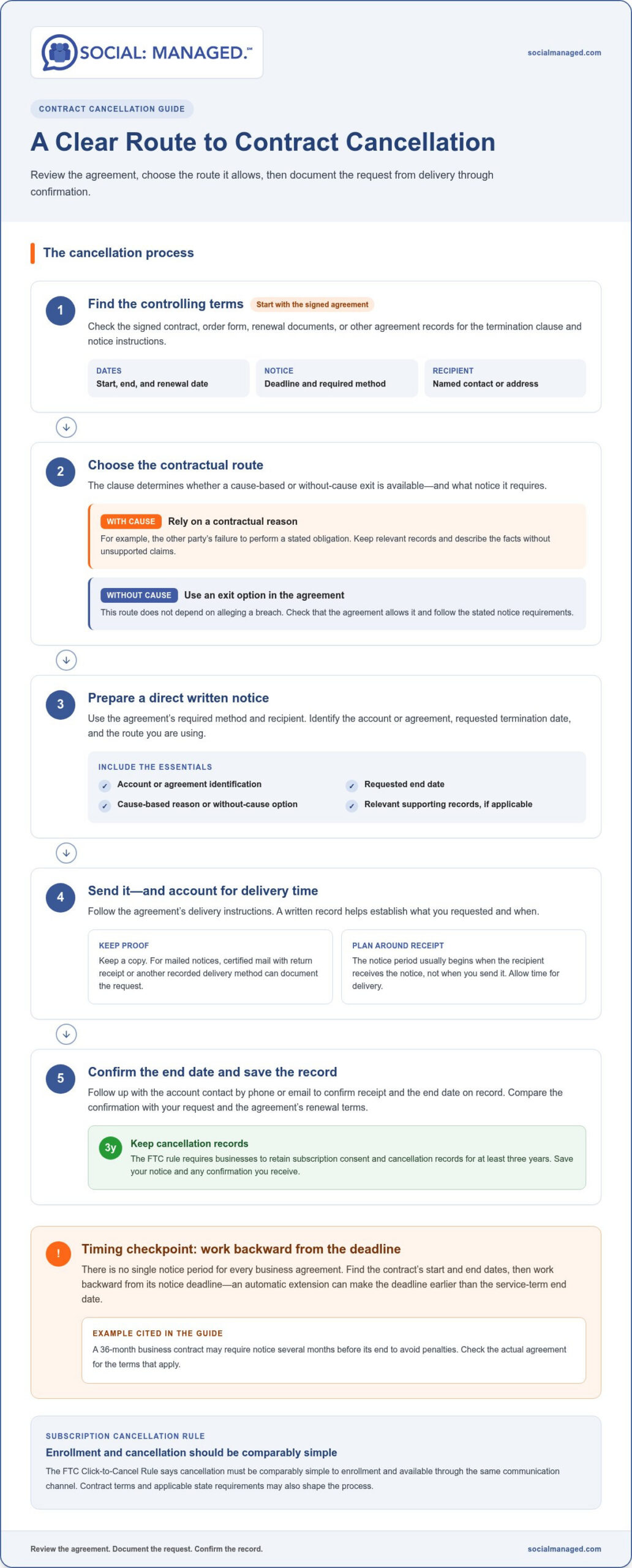
The FTC rule requires businesses to retain subscription consent and cancellation records for at least three years. These records can include the consent action and cancellation request. Save your notice and any confirmation you receive, then compare the confirmation with your requested end date and the contract’s renewal language.
Contact Social: Managed. to discuss your marketing transition
What are RevLocal’s contract cancellation terms and notice requirements?
Cancellation terms set the conditions for ending an agreement, while notice requirements explain how and when to submit the request. Start with the signed agreement: its renewal date, termination clause, and notice instructions determine the steps for that contract. Use this RevLocal contract cancellation and switching guide to organize those details before planning your exit.
There isn’t one notice period that applies to every business agreement. For example, a 36-month business contract may require notice several months before its end to avoid penalties. Find the contract’s start and end dates, then work backward from any notice deadline. A deadline tied to the renewal date can arrive before the service term ends.
Distinguish cancellation with cause from cancellation without cause. With cause means relying on a contractual reason, such as the other party’s failure to perform a stated obligation. Without cause means using an exit option the agreement allows, without alleging a breach. The applicable clause determines whether either route is available and what notice it requires.
Use the agreement’s required notice method, recipient, and address. A cancellation request should identify the account or agreement, the requested termination date, and whether you’re ending for cause or using a without-cause option. Keep the language direct. If you’re relying on a missed contractual obligation, identify it and describe the relevant facts without making unsupported claims.
Send the notice in writing and keep a copy. For mailed notices, certified mail with return receipt or another recorded delivery method can document the request. The notice period usually begins when the recipient receives it, not when you send it. Allow time for delivery, then follow up by phone or email with the account contact to confirm receipt and the recorded end date.
Before sending, assemble the details that can help prevent avoidable delays:
- The signed agreement and any renewal documents.
- The contract’s end date and stated notice deadline.
- The notice recipient, permitted delivery method, and requested end date.
- Relevant records supporting a cause-based termination, if applicable.
Automatic extensions can affect the timing of a switch or service reduction, so review renewal language alongside termination terms. Don’t treat a verbal discussion as a substitute for formal notice when the agreement requires a written request. After sending, save delivery proof and written confirmation, then compare the confirmed date with the contract’s renewal schedule. This RevLocal contract cancellation and switching guide helps keep contract details and transition steps together.
For a marketing transition, organizing the agreement dates and notice record helps you plan the next steps. You can discuss your transition plans once you’ve identified the contract’s requirements.
How can I find the cancellation clause in a RevLocal agreement?
A cancellation clause explains the conditions for ending an agreement. Start with the signed agreement, then search for headings such as “Termination,” “Cancellation,” “Renewal,” or “Term.” A digital copy makes the terms easier to find: use its search function for each heading and review the surrounding paragraphs, not just the matching line.
The clause may be outside the main contract text. Gather the signed service agreement, any order form, renewal document, and amendments before drawing conclusions. For example, an order form may set the service period while the main agreement explains how termination works. An amendment may later change either term, so compare dates and wording across all the documents.
Read the definition of “cause” if the agreement uses that word. It may refer to a specific breach, missed obligation, or other defined event. Compare that definition with the termination language. If the agreement permits termination for cause after a particular failure, identify the relevant requirement and find the clause explaining how to address that failure.
Next, look for a separate right to terminate without cause. The language may describe when either party can end the agreement without alleging a breach. Record any conditions attached to this option, such as a required notice method, permitted termination date, or fee clause elsewhere in the agreement. Don’t assume that the absence of one heading means there is no related term.
Use this document review sequence to build a clear picture:
- Match the agreement’s title, signing date, and parties to the version you use.
- Search for “termination,” “cancel,” “renew,” “notice,” and “early termination.”
- Read each matching clause with the definitions and cross-references it names.
- Compare the main agreement with order forms, amendments, and renewal records.
- Mark the clauses that describe cause, without-cause rights, and any related conditions.
Cross-references matter. A termination clause may direct you to another section for the notice process, renewal timing, or charges. Follow each reference and note how the provisions work together. For example, the right to end service may have a separate deadline tied to the renewal date. Record the exact wording and document location.
If two documents appear to conflict, compare their dates and determine whether one expressly changes the other. Keep both versions rather than relying on a summary or conversation. A short written record can list the applicable clause, its conditions, and related documents, giving you a practical reference when planning cancellation or evaluating a switch.
Does RevLocal charge an early termination or cancellation fee?
An early termination fee is a contract charge tied to ending an agreement before its stated term expires. A cancellation fee may refer to a separate charge for processing or completing cancellation. The agreement’s wording determines whether either applies. The company name alone does not establish that a fee is owed.
Start with the signed agreement and search for “early termination,” “cancellation fee,” “remaining balance,” and “termination for cause.” Read each result with its surrounding section. A fee may appear under a different heading from the cancellation clause, or a clause may describe payments due through the end of a term without calling them a fee.
Separate these possible obligations before estimating the impact:
- Early termination fee: a charge the agreement ties to ending service before the term ends.
- Remaining contractual payments: amounts the agreement says remain due after early termination.
- Cancellation charge: a separate amount expressly associated with processing a cancellation.
- Unpaid invoices: charges already billed for services or work completed before the end date.
These categories can have different triggers. For example, an agreement might specify a fee for ending without cause while allowing termination for a defined breach under separate conditions. Don’t treat the word “termination” as proof that every listed payment applies to every exit route. Match each charge to the clause that authorizes it.
Check how the contract calculates any stated amount. It might use a fixed charge, remaining service payments, or another written formula. Record the calculation method, triggering event, and payment timing. If the language refers to another section, read that provision too. An amount in a pricing schedule may not be a cancellation charge unless the contract connects it to termination.
Then compare the fee clause with your reason for leaving. If you’re ending the agreement for cause, identify the specific contractual obligation involved and follow the stated process. If you’re leaving without cause, find the applicable exit option and its conditions. Your written notice should identify the clause you’re relying on and request an itemized explanation of any amount claimed.
Keep the signed version, amendments, invoices, and cancellation correspondence together. If a charge appears, compare its basis and calculation with the relevant clause before paying or disputing it. If an invoice doesn’t explain a charge, ask in writing for the provision it relies on. This creates a clear record for assessing the amount against the agreement, rather than relying on a label alone.
Some property management agreements set an early termination fee equal to one to several months of management fees. This general example does not establish RevLocal’s specific contract terms.
What happens to prepaid fees or refunds when canceling RevLocal services
A prepaid fee is an amount paid before the related service period or work is completed. A refund is money returned after cancellation, according to the agreement’s terms and the account’s billing history.
The agreement determines how prepaid amounts are handled. Read its billing, cancellation, service-period, and refund sections together. A payment covering future service differs from an invoice for completed work. For example, match a monthly payment made before a service period begins against the dates and services named in the contract.
Start by identifying what each payment covered. Compare invoices with the agreement, payment records, and service descriptions. Mark which charges relate to completed work, active service, or a future period. This creates a clear account of what was paid and what remained due when cancellation took effect.
Then find the contract language that applies to unused prepaid amounts. It might address prorated credits, nonrefundable charges, or payments due through the end of the term. Follow the exact wording. Don’t assume every unused amount is refundable or that every advance payment is forfeited. The relevant provision and services already delivered shape the accounting.
Request a closing statement that separates each amount by reason. Ask it to show:
- Payments received and the service periods or work they covered.
- Services completed before the effective cancellation date.
- Any prepaid balance applied to future or unfinished work.
- Credits, deductions, or refund amounts with the contract clause supporting them.
- Any remaining invoice balance and its stated basis.
Compare the statement with your own records. If an invoice lists an unexplained charge, identify the line item and request its calculation in writing. If a credit appears, confirm which payment it offsets and how it relates to the cancellation date. Keep the agreement, invoices, payment confirmations, and written responses together.
Timing can affect the final reconciliation. For example, review a payment made before renewal against the renewal period and effective end date. Distinguish payment for completed work from an advance covering future work. Record the date cancellation became effective, then compare it with each billed period and deliverable.
Keep refund discussions in writing so the requested amount and explanation are easy to track. If the parties disagree, refer to the exact billing or refund language and provide the corresponding invoice or payment record. A documented breakdown gives both sides a specific basis for resolving the account.
Social: Managed. | Search Engine Optimization
For businesses planning their next marketing chapter, Search Engine Optimization from Social: Managed. can strengthen organic search visibility and align website content with what potential customers are looking for. It’s a focused way to build on your transition with a strategy centered on search.
If your business wants a more focused search strategy after switching support, this can be a natural next step. Our team can coordinate SEO with Digital Marketing, Social Media Management, or Google Ads when those channels fit your goals. The right mix depends on your priorities, audience, and existing marketing plan.
To discuss your SEO goals and next steps, contact Social: Managed.
Build your next marketing chapter with a clear plan
Once you’ve decided to move on, treat the transition as a chance to set a deliberate direction, not simply replace one agreement with another. Use this RevLocal contract cancellation and switching guide as a reference while considering what your business needs from its next marketing relationship. Define the goals to prioritize, the audiences to reach, and how you’ll assess whether the work supports those goals.
Search Engine Optimization, Social Media Management, and Digital Marketing can support your next phase through a coordinated approach from Social: Managed. Bring your goals and transition plans to the conversation to explore a practical fit for your priorities. A thoughtful transition gives you room to move forward with purpose. Set your direction, then build on it with confidence.
Explore Your Next Marketing Steps with Social: Managed.
Frequently Asked Questions
What is the difference between terminating with cause and without cause?
Terminating with cause relies on a contract-recognized failure; terminating without cause uses an agreed exit right without alleging a breach. For example, if a contract requires a particular deliverable and it wasn’t provided, gather the relevant records before citing cause. For a without-cause exit, identify the clause that allows it and follow its conditions. Neither route automatically removes other contractual obligations, so review separate payment terms.
What should I compare when choosing a replacement for RevLocal, including pricing and contract terms?
Compare the services covered, contract term, renewal and notice clauses, cancellation method, and any early termination, prepaid-fee, or refund terms. The material provides no pricing comparison.
How long does RevLocal take to process a cancellation, and when does billing stop?
The agreement’s notice period and required process determine the timing; the notice period usually begins when the recipient receives the notice. Billing stop timing is not established, so review the contract’s renewal terms and obtain written confirmation of the end date.
How do I switch from RevLocal to another digital marketing agency without losing campaigns or local SEO rankings?
Review the contract’s end date, renewal schedule, and notice deadline before planning the transition. Send formal notice using the required method, keep delivery proof, and confirm the recorded end date; the material provides no steps for preserving campaigns or local SEO rankings.
Are there state-specific consumer protection rules that apply to canceling a RevLocal business services contract?
Applicable state automatic-renewal requirements may shape the cancellation process. The FTC rule does not preempt stricter state laws unless their provisions directly conflict.

Ready to get started? Reach out to Social: Managed. online, or call us at 866-324-9700. We manage your company’s social life so you can have one! You don’t need complicated packages. We listen to your goals.
Then we design and manage SEO, social media, ads, websites, and email campaigns built to deliver results. No jargon. No guesswork. Just real growth from a team that cares. Ready to get rolling? Follow Social: Managed. on Facebook for a peek into our social life.